Long before humans ran the first cable across an ocean floor, whales had already found their own version of a planet-spanning communication network — a natural channel built into the physics of seawater itself, capable of carrying a single call across thousands of kilometers with barely any loss of signal. It's not a metaphor stretched for effect. The ocean genuinely contains a built-in acoustic "cable," and the largest animals on Earth have apparently been using it for millions of years.
The Ocean's Hidden Acoustic Highway
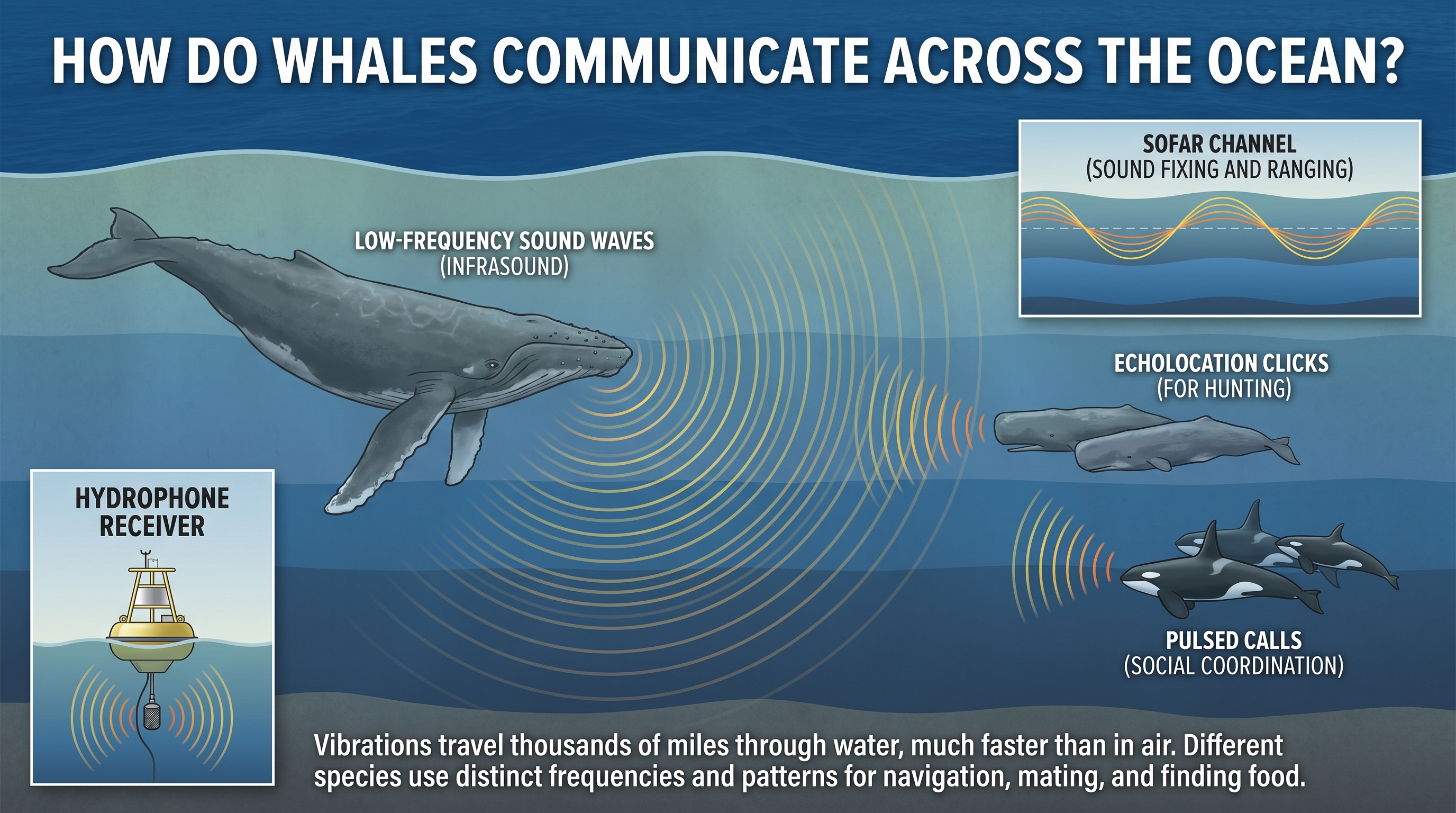
The secret lies in something called the SOFAR channel (short for "Sound Fixing and Ranging"), also known as the deep sound channel. At a certain depth in the open ocean — typically somewhere around 600 to 1,200 meters, depending on location, temperature, and salinity — water pressure and temperature combine to create a layer where sound travels at its slowest speed compared to the water above and below it. Because sound naturally bends toward slower-traveling layers, any sound produced near this depth gets continuously refracted back toward the channel's center rather than spreading upward or downward and dissipating, the way sound normally does in open water or air. The effect is remarkably similar to how a fiber-optic cable keeps light trapped and traveling efficiently along its length rather than leaking out the sides — except this "cable" is made entirely of ocean water, and nobody built it on purpose.
Humans actually discovered and exploited this channel before we fully understood whales were using it too: during and after World War II, the US Navy developed a device called a SOFAR bomb, a small explosive charge set to detonate specifically at deep sound channel depth, producing a sound so efficiently transmitted that hydrophone stations thousands of kilometers away could detect it and use the timing to pinpoint the location of a downed pilot's life raft at sea. It was, in effect, an early emergency locator system built entirely on a physical phenomenon that whales appear to have been exploiting for a very, very long time before anyone put a name to it.
How Whales Get Their Calls Into the Channel
Large baleen whales — the blue whale, fin whale, and their relatives — produce extremely low-frequency calls, some dipping into infrasound territory below the lower edge of human hearing, and researchers believe these whales specifically dive to depths that align with the deep sound channel to send their calls through it as efficiently as possible. Lower frequencies travel especially well over long distances in water because they lose less energy to absorption than higher frequencies do, which is part of why the loudest, longest-distance whale calls tend to be deep, resonant, almost sub-audible booms rather than higher-pitched sounds. Under quiet, favorable historical ocean conditions, researchers have estimated that a blue whale call transmitted through the deep sound channel could, in principle, be detectable across genuinely vast distances — historically discussed in terms of potentially spanning much of an entire ocean basin under ideal circumstances, though how much of that theoretical range whales actually use in practice, especially in today's noisier oceans, is a more complicated and much-debated question covered further below.
Not All Whales "Talk" the Same Way
It's worth being clear that "whale communication" isn't one single system — different whale species have evolved genuinely distinct acoustic strategies suited to their different lifestyles.
Baleen whales, including humpbacks, blue whales, and fin whales, are the long-distance broadcasters, producing songs and calls primarily built for traveling far through open water, often associated with mating displays and long-range contact between individuals that may be separated by enormous distances. Humpback whale songs specifically are famous for being remarkably long, structured, and complex, arranged in repeating phrases and themes the way a piece of music is — and, in one of the more genuinely charming findings in whale research, these songs are known to change over time and spread between populations almost like cultural trends, with a new song pattern popularized in one region sometimes spreading progressively across whale populations in other parts of an ocean basin over subsequent years, a phenomenon researchers describe as a form of cultural transmission.
Toothed whales, including sperm whales, orcas, and dolphins, communicate differently, relying heavily on rapid clicks and pulsed calls, partly for echolocation (essentially biological sonar, used for hunting and navigating) and partly for social communication between individuals. Orca pods, for instance, are known to develop their own distinct vocal "dialects" specific to their social group, stable and recognizable enough that researchers can often identify which pod a group of orcas belongs to purely from their call patterns.
A Real Whale "Alphabet," Decoded for the First Time
One of the most genuinely exciting recent developments in this field comes from sperm whales specifically. Sperm whales communicate using patterned sequences of clicks called codas, and for a long time, these codas were understood only as a fairly limited set of distinct patterns. That changed with research published in 2024 by Project CETI (the Cetacean Translation Initiative), a large interdisciplinary research collaboration using machine learning to analyze enormous datasets of recorded sperm whale codas. Their analysis revealed a previously unrecognized layer of structure: rather than a small, fixed set of coda "words," sperm whale codas appear to be built combinatorially from a set of underlying features, including rhythm, tempo, subtle timing variations the researchers termed "rubato," and additional ornamental clicks — meaning whales can apparently combine these elements to produce a far larger and more expressive space of distinct vocal patterns than previously recognized, structurally more sophisticated than earlier researchers had appreciated, arguably closer to something like a genuine phonetic system than the simpler, more repetitive signal set scientists had assumed for decades.
It's important to be precise about what this discovery does and doesn't mean. Finding this kind of combinatorial structure is a genuinely significant scientific finding about the complexity of sperm whale communication — it is not the same thing as having translated what whales are actually saying to each other, and researchers involved in this work have been careful to describe it as an important structural discovery rather than a working whale-to-English dictionary. Meaningful interpretation of what specific coda combinations actually communicate remains a much harder, still largely unsolved problem, and claims of full "AI whale translation" circulating in some popular coverage get considerably ahead of where the actual published science currently stands.
The Ocean Is Getting Louder, and That's a Real Problem
Here's the less charming part of this story: the same deep sound channel that lets whale calls travel so efficiently also efficiently carries human-made noise, and the ocean has become measurably, substantially louder over the past century. Commercial shipping traffic, naval sonar, and seismic survey air guns used in oil and gas exploration have all significantly raised background ocean noise levels, particularly in the same low-frequency ranges baleen whales rely on most heavily for long-distance communication. Multiple research groups studying this problem have found that elevated background noise measurably shrinks the effective distance over which a whale call remains detectable above the ambient noise floor — some estimates suggest the practical communication range for large whales in busier shipping regions may now be a small fraction of what it would be in a quieter ocean, forcing whales to call louder, shift the frequency or timing of their calls, or in some documented cases, simply go quiet during especially noisy periods rather than compete with it. It's an active area of marine conservation concern and policy discussion, since it directly affects whales' ability to find mates, coordinate with other members of their species, and navigate across the same ocean basins their calls were, evolutionarily speaking, apparently built to cross.
Why This Research Matters Beyond Curiosity
Understanding whale communication has real conservation stakes attached to it, not just scientific curiosity. Knowing how far whale calls travel, and how much that range has already shrunk due to human noise, directly informs shipping lane regulations, sonar use restrictions, and marine protected area design in many parts of the world. The deeper structural findings coming out of projects like CETI also feed a broader, serious scientific and ethical conversation about how sophisticated non-human communication systems might be, and what obligations that could imply for how humans regulate activities that interfere with them — a discussion actively engaged by researchers working at the intersection of animal communication science, AI, and animal welfare law.
Frequently Asked Questions
Can whales actually hear each other across an entire ocean? Under historical, quieter ocean conditions, some of the largest baleen whale calls were theoretically capable of remaining detectable across enormous distances via the deep sound channel — but in today's noisier oceans, the practical, reliable communication range for many whale populations is understood to be considerably shorter than the older theoretical maximums, due to the added background noise from shipping and other human activity.
Have scientists actually translated what whales are saying? Not yet, and it's important to be precise about this — recent research, especially Project CETI's 2024 findings, has revealed genuinely sophisticated structural patterns in sperm whale codas that weren't previously recognized, comparable in some ways to the building blocks of a phonetic system. That's a significant discovery about the complexity of the communication system itself, but meaningfully interpreting what specific whales are actually communicating to each other remains a separate, much harder, largely unresolved scientific challenge.
Do all whale species communicate the same way? No — baleen whales (like humpbacks and blue whales) tend to produce long-range songs and calls suited for long-distance contact, often linked to mating behavior, while toothed whales (like sperm whales and orcas) rely more heavily on click-based communication and echolocation, often organized into distinct social or group-specific patterns like sperm whale codas and orca pod dialects.
Why do humpback whale songs change over time? Researchers have documented that humpback whale songs evolve and spread between populations in a pattern resembling cultural transmission — a new song variant that emerges in one population can gradually spread to other populations over subsequent breeding seasons, similar in structure, though obviously not in mechanism, to how a piece of music might spread and become popular across different regions among humans.
Is ocean noise pollution something that can realistically be reduced? To a meaningful degree, yes — measures like adjusted shipping lane routing, vessel speed reductions in sensitive habitats, and quieter ship engine design have all been studied and, in some specific regional cases, implemented with measurable reductions in local underwater noise levels, making this one of the more directly addressable aspects of human impact on whale communication, even though it remains a significant ongoing challenge at a global scale.
The Bottom Line
Whales figured out how to use the physics of the ocean itself as a long-distance communication network long before humans had any equivalent technology of our own, bending sound into a channel that carries their calls with remarkable efficiency across distances that still sound almost unbelievable. The more researchers look, using tools like machine learning that simply didn't exist a generation ago, the more structured and sophisticated that communication turns out to be — genuine "alphabet"-like patterns in sperm whale clicks, entire songs that spread between populations like cultural trends. It's a genuinely humbling reminder that one of the most extraordinary communication systems on the planet has been operating in the ocean the entire time, mostly out of earshot, and we're only just now starting to properly listen.
References
NOAA Ocean Service — What Is SOFAR?
Wikipedia — SOFAR Channel
Project CETI — Sperm Whale Phonetic Alphabet Proposed for the First Time
National Geographic — We're One Step Closer to Understanding the Sperm Whale "Alphabet"
National Geographic Society — Project CETI Overview
NYU School of Law — AI-Enabled Decoding of Whale Communication Could Bolster Animal Rights
NOAA Fisheries — Ocean Noise and Marine Mammals overview.
Natural Law Review — Noise Pollution in Our Oceans: Can We Turn Down the Volume for Marine Life?
Payne, R., & McVay, S. (1971). Songs of Humpback Whales. Science, 173(3997), 585–597 (foundational whale song research).
Woods Hole Oceanographic Institution — Whale Acoustics and Deep Sound Channel research summaries.
Article last fact-checked: September 2026. Whale communication and bioacoustics research is advancing quickly — readers wanting the latest findings should check current publications from Project CETI and NOAA Fisheries directly.