Stand in an old forest for a few minutes and it's easy to feel like nothing much is happening. The trees just stand there. No sound, no movement except wind. But underground, and in the air around the leaves, something closer to a conversation is going on — trees sending each other warnings, sharing food with their neighbors' roots, and in a few remarkable cases, quietly persisting since before the pyramids were built.
This is a guide to both halves of that story: how trees actually communicate, as best science currently understands it, and which trees on Earth have been alive the longest. Along the way, we'll also cover where the popular version of this story has gotten ahead of the evidence, because that part matters too.
Trees Aren't as Silent as They Look
For most of the 20th century, foresters mostly thought of trees the way you'd think of individual competitors in a race — each one fighting alone for sunlight, water, and root space. That picture has changed a lot. Research over the past three decades has shown that trees exchange resources, respond to each other's chemical signals, and in some cases physically fuse their root systems together. None of this means trees are conscious or "thinking" the way animals do. But it does mean a forest behaves less like a crowd of strangers and more like a loosely connected community, with real information and real nutrients moving between individuals.
There are three main channels researchers have documented: underground fungal networks, airborne chemical signals, and direct root-to-root contact. Let's go through each one.
The "Wood Wide Web": Mycorrhizal Networks Underground
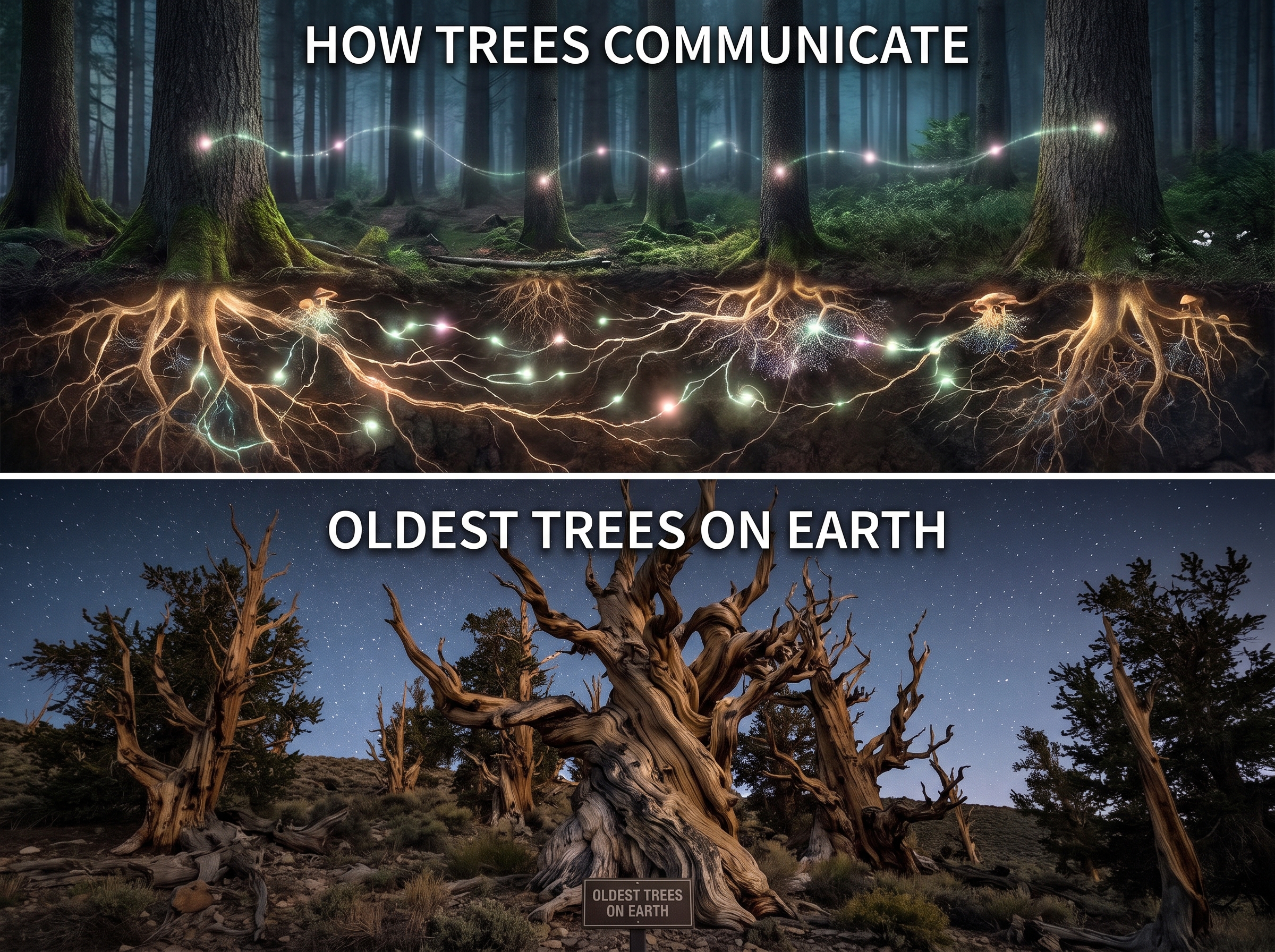
Almost every tree on Earth has a partnership with fungi living in and around its roots, called mycorrhizae (from Greek: "fungus-root"). The fungus wraps around or penetrates the tree's fine roots and extends thread-like filaments called hyphae out into the soil, far beyond where the tree's own roots can reach. In exchange for sugars the tree produces through photosynthesis, the fungus delivers water and hard-to-access minerals like phosphorus back to the tree.
Here's where it gets interesting: a single fungal network doesn't just service one tree. The same web of hyphae often connects to the roots of multiple trees at once, including trees of different species. That shared underground structure is called a common mycorrhizal network, or CMN — and it's the biological basis for what science journalists nicknamed the "Wood Wide Web," a play on the World Wide Web.
The idea gained wide attention through the work of forest ecologist Suzanne Simard, whose 1997 experiment (published in the journal Nature) traced radioactive and stable carbon isotopes moving between Douglas fir and paper birch trees through shared fungal networks. Her research suggested that carbon — essentially, food — could move from one tree to another underground, and that shaded, struggling seedlings sometimes received a boost from larger, sun-exposed "donor" trees nearby. Simard went on to popularize the idea of "Mother Trees": large, old, well-connected trees that may preferentially route resources toward their own offspring or nearby seedlings, an idea she explored further in her memoir Finding the Mother Tree.
It's a genuinely beautiful idea, and it captured public imagination — it even influenced the fictional Tree of Souls in Avatar. But like a lot of exciting science, the popular version outran the data. More on that in a moment.
Chemical Warnings Carried on the Wind
Separate from the underground fungal network, trees also communicate above ground, through the air, using volatile organic compounds (VOCs) — essentially, scent chemicals.
When a tree is attacked by insects, it doesn't just sit there. Many species release a specific blend of VOCs from the damaged leaves. Nearby trees that detect these compounds respond by ramping up their own chemical defenses — producing more tannins or other compounds that make their leaves less appetizing or harder to digest — before the pest ever reaches them. It functions less like a deliberate warning and more like eavesdropping: the "listening" tree isn't being altruistically warned by its neighbor, but it benefits from picking up the chemical chatter anyway.
One of the most cited real-world examples comes from African savannas, where acacia trees browsed by giraffes and kudu release ethylene gas. Trees downwind detect the ethylene and pump extra tannins into their leaves within about 15 minutes, making them bitter and even mildly toxic. Some game ranchers have reported livestock deaths linked to antelope grazing too long in a single stand of acacias for exactly this reason — the trees fought back chemically. A similar effect has been documented in willows attacked by tent caterpillars, and in various species in response to leaf-chewing insects more broadly, involving a plant hormone pathway called jasmonic acid signaling.
Trees also release different VOC blends specifically to attract the natural predators of whatever insect is attacking them — a chemical distress call that recruits help from parasitic wasps or other predators.
Root Grafting: When Neighboring Trees Physically Fuse
The most literal form of tree-to-tree connection isn't fungal or chemical at all — it's direct. When two trees of the same species grow close together, their roots sometimes fuse where they touch, creating a natural graft. Once grafted, the two trees can share water, sugars, and minerals directly through connected vascular tissue, the same way a single tree moves resources between its own roots and leaves.
This explains one of the stranger sights in old forests: a tree stump, cut down years or even decades earlier, with no leaves and no way to photosynthesize, that's somehow still alive — its cut surface slowly healing over rather than rotting. The stump survives because it's still root-grafted to living neighbors, who keep feeding it sugar through the connected root system, essentially life support from the surrounding forest.
Do Trees Make Sounds? The More Speculative Edge
You may have come across claims that trees "click" or make ultrasonic sounds when stressed, particularly when short on water. There is some real research behind this — cavitation, tiny air bubbles forming and collapsing inside a tree's water-conducting tissue during drought stress, does produce faint acoustic emissions, and a few studies have picked up clicking sounds from drought-stressed trees and even young corn plants. Whether other trees or organisms actually detect and respond to these sounds as a form of communication is still very much unproven and is one of the more speculative frontiers in plant bioacoustics, not an established fact — worth knowing about, but worth treating with real caution until more evidence accumulates.
How Solid Is the "Wood Wide Web," Really?
This part matters, because the Wood Wide Web has become one of those science stories that gets repeated so often in documentaries and books that its more uncertain edges tend to disappear.
In 2023, a team led by forest ecologist Justine Karst at the University of Alberta published a rigorous review in Nature Ecology & Evolution, systematically re-examining the peer-reviewed evidence behind three of the most widely repeated claims: that common mycorrhizal networks are widespread in forests, that resources flow through them in ecologically meaningful amounts, and that mature "mother trees" preferentially direct resources to their own kin. Their conclusion was more cautious than the popular narrative. They found that while mycorrhizal fungi connecting multiple trees are indeed common and well documented, the evidence that meaningful amounts of resources move through these networks in ways that measurably benefit specific seedlings — let alone that trees can recognize and favor their own offspring — was thinner and less consistent than widely believed, with many of the underlying studies suffering from small sample sizes or designs that couldn't rule out simpler explanations.
This isn't really a "debunking" — nobody disputes that mycorrhizal fungi link trees together underground, and there's decades of good evidence for that part. What's genuinely contested is the more dramatic layer built on top of it: purposeful sharing, kin recognition, and trees "parenting" their seedlings through a fungal network. That's an active, sometimes heated scientific debate right now, and honest science communication should say so rather than presenting the strongest version of the story as settled fact.
The reasonable, current summary: trees are demonstrably connected below ground, they demonstrably respond to each other's airborne chemical signals, and they can demonstrably keep each other alive through root grafts. The idea that they're running something like a coordinated support network, deliberately favoring relatives, is a compelling hypothesis that's still being tested — not a proven mechanism.
Meet the Oldest Trees on Earth
Now for the second half of the story: trees that have been quietly doing all of the above for an almost unbelievable length of time.
Figuring out a tree's exact age is harder than it sounds. The most reliable method is dendrochronology — counting annual growth rings from a thin core sample drilled into the trunk, which doesn't harm the tree. That works well for individual, non-hollow trees in climates with clear seasons. It works far less well for hollow trees, and it doesn't work at all for a very different category of "oldest" organism: clonal colonies, where what looks like a forest of many trees is genetically a single individual that has been resprouting from the same root system for thousands of years. Both categories show up on "oldest trees" lists, so it's worth keeping them separate.
Oldest Individual, Non-Clonal Trees
Methuselah, a Great Basin bristlecone pine (Pinus longaeva) in California's White Mountains, is roughly 4,850 years old based on a ring count taken in 1957 — meaning it germinated somewhere around the time Egypt's Old Kingdom pyramids were being built. Its exact location within Inyo National Forest is kept secret by the U.S. Forest Service to protect it from vandalism.
Methuselah isn't actually the oldest confirmed bristlecone — that title may belong to an unnamed tree in the same general region, cored decades ago by researchers Edmund Schulman and Tom Harlan and estimated at roughly 5,067 years old. Its precise location has also never been publicly disclosed, for the same protective reasons, which is part of why "Methuselah" remains the name most commonly cited as the world's oldest individually verified tree.
Gran Abuelo ("Great-Grandfather"), a Patagonian cypress (Fitzroya cupressoides) in Chile's Alerce Costero National Park, is a more recent and more contested contender. In 2022, climate scientist Jonathan Barichivich estimated its age at roughly 5,484 years using a statistical model that combined a partial core sample (the tree is too large and hollow-centered to core all the way through) with growth-rate data from other Fitzroya trees. If that estimate holds up, it would make Gran Abuelo the oldest known individual tree on Earth — but because it relies on modeling rather than a complete ring count, it hasn't been as broadly accepted by dendrochronologists as Methuselah's ring-counted age, and the debate over how to verify it is ongoing.
The Llangernyw Yew, in a churchyard in North Wales, is estimated at somewhere between 4,000 and 5,000 years old, though yews are notoriously difficult to date precisely since their trunks tend to hollow out and split into multiple stems with age, erasing the ring record.
Oldest Clonal Organisms
Pando, a quaking aspen colony (Populus tremuloides) in Utah's Fishlake National Forest, may be the most astonishing entry on this list. What looks like a 106-acre forest of roughly 47,000 individual aspen trunks is, genetically, a single organism — every trunk is a clone sprouting from one shared root system, making the whole colony a single individual by genetic definition. Estimating Pando's age is difficult precisely because it doesn't leave the kind of tree-ring record an individual trunk would; estimates have historically ranged from around 9,000 years to a much more speculative 80,000 years or more, depending on the method and assumptions used. A 2024 genetic study published via Nature examined mutation patterns across the colony to help refine understanding of how it has grown and persisted over time, and research into pinning down a firmer number is ongoing. Pando is also considered, by some measures, the heaviest known living organism on the planet.
Old Tjikko, a Norway spruce (Picea abies) on a mountainside in Sweden, has a root system radiocarbon-dated to about 9,550 years old — but the visible trunk you'd see if you visited is much younger, often just a few hundred years old. That's because the tree has repeatedly regrown new trunks from the same root system as older stems died back, particularly as the climate warmed after the last ice age. The root system is the ancient part; the "tree" you'd photograph is really its latest generation.
Jurupa Oak, a colony of scrub oak (Quercus palmeri) in Riverside County, California, is estimated at around 13,000 years old, similarly persisting as a clonal colony rather than a single trunk.
At a Glance
Tree Species Location Estimated Age Type Unnamed bristlecone Pinus longaeva White Mountains, California, USA ~5,067 years Individual (undisclosed location) Gran Abuelo Fitzroya cupressoides Alerce Costero NP, Chile ~5,484 years (contested/modeled) Individual Methuselah Pinus longaeva White Mountains, California, USA ~4,850 years Individual (undisclosed location) Llangernyw Yew Taxus baccata North Wales, UK ~4,000–5,000 years Individual (hard to date precisely) Old Tjikko (root system) Picea abies Fulufjället, Sweden ~9,550 years Clonal (root system, trunk much younger) Jurupa Oak Quercus palmeri California, USA ~13,000 years Clonal colony Pando Populus tremuloides Fishlake NF, Utah, USA ~9,000 years, possibly far older Clonal colony
Why Any of This Matters
Beyond pure wonder, there are real practical stakes here. Ancient trees like Methuselah and Gran Abuelo are living climate archives — each ring is a record of the specific year it grew in, including droughts, volcanic eruptions, and temperature swings going back millennia, which is exactly how dendrochronologists calibrate long-term climate and even archaeological dating records. Losing one of these trees doesn't just remove a living thing; it erases thousands of years of environmental data that can never be recreated.
Understanding tree communication matters practically too. If common mycorrhizal networks really do help forests recover after logging or fire — a live and reasonable hypothesis, even if the strongest claims about it are still being tested — that has direct implications for how forests should be replanted and managed. Clear-cutting an area and planting a single species in straight rows, the traditional forestry approach, may disrupt underground fungal networks and airborne chemical relationships that took centuries to establish. A growing number of foresters now advocate preserving "hub" trees and species diversity specifically because of this research, even as scientists continue arguing about exactly how much of the resource-sharing story is real.
And ancient clonal organisms like Pando raise genuinely strange biological questions about aging itself. A trunk of Pando might live a few hundred years before dying back, but the shared root system underneath appears to have found a way to keep resetting the clock for thousands of years running. Biologists studying extreme longevity in trees, and in a handful of other long-lived species like certain deep-sea corals and Greenland sharks, are partly motivated by exactly this question: what does it actually take, biologically, to just keep going?
Frequently Asked Questions
Can trees really "talk" to each other, or is that just a metaphor? It's best understood as a metaphor with real biology underneath it. Trees don't communicate with intent or language the way animals do. But they do detect and respond to specific chemical signals from other trees, and they are physically and biologically connected through fungal networks and root grafts in ways that move real resources and information between individuals. "Talking" is a shorthand for a genuine biological phenomenon, not literal conversation.
Is the "Mother Tree" idea scientifically accepted? Parts of it are well supported — old, large trees are indeed often more heavily connected to mycorrhizal networks than young seedlings, simply due to their size and root extent. The more specific claim that mother trees deliberately recognize and favor their own kin is still actively debated among scientists, with a significant 2023 review finding the evidence for it thinner than commonly portrayed. It's a compelling hypothesis under active study, not a settled conclusion.
What's technically the "oldest tree in the world" — Methuselah, the unnamed bristlecone, Gran Abuelo, or Pando? It depends on how you define "tree." For the oldest verified individual trunk with a complete ring count, the unnamed bristlecone pine (~5,067 years) generally takes the title, with Methuselah as the oldest publicly discussed example. Gran Abuelo may be older still, but its age relies on statistical modeling rather than a full ring count, so it's not universally accepted as verified. If you count clonal colonies as single organisms, Pando and Old Tjikko's root system are both older still, potentially by thousands of years — it just depends on whether a shared root system sprouting many trunks counts as "one tree."
Why are the locations of some of these trees kept secret? Ancient bristlecone pines like Methuselah have been targeted by vandalism in the past — a similarly ancient bristlecone nicknamed "Prometheus" was famously cut down by a researcher in 1964 before anyone realized how old it was, only discovered afterward to have been over 4,800 years old. That loss is part of why land managers now withhold exact coordinates for the most ancient specimens.
How do scientists know a tree's age without cutting it down? For most living trees, a hollow increment borer extracts a thin pencil-width core sample down to the center of the trunk, which is then counted ring by ring under magnification; the small hole heals over and doesn't harm the tree. For hollow, badly damaged, or clonal specimens where a clean core isn't possible, scientists instead use methods like radiocarbon dating of root or wood material, or statistical growth-rate modeling, both of which carry more uncertainty than a direct ring count.
The Bottom Line
The forest floor is a lot busier than it looks. Underground, fungal threads move sugar and nutrients between trees that may never touch. In the air, chemical signals warn neighbors of danger before it arrives. And below the surface in a handful of remarkable places, root systems that predate written history are still, quietly, alive — some of them older than the Great Pyramid, one possibly older than the invention of the wheel. The full picture is more nuanced than the most viral version of the story, and the most careful scientists are still working out exactly how much of it is true. But nuanced is not the same as boring. Even the conservative, fully-evidenced version of this story is genuinely remarkable: trees are connected, they respond to each other, and some of them have simply refused to stop growing for thousands of years.
References
Simard, S. W., et al. (1997). Net transfer of carbon between ectomycorrhizal tree species in the field. Nature, 388, 579–582.
Simard, S. (2021). Finding the Mother Tree: Discovering the Wisdom of the Forest. Knopf.
Karst, J., Jones, M. D., & Hoeksema, J. D. (2023). Positive citation bias and overinterpreted results lead to misinformation on common mycorrhizal networks in forests. Nature Ecology & Evolution.
CBC — Forest ecologist Suzanne Simard's research says trees talk to each other. Others aren't so sure
USDA — Methuselah, a Bristlecone Pine is Thought to be the Oldest Living Organism on Earth
Conservation International — Methuselah: Still the World's Oldest Tree?
Guinness World Records — Oldest Living Tree Species
Smithsonian Magazine — A New Candidate for Oldest Tree in the World Is Discovered in Chile
Scientific American — This Might Be the World's Oldest Tree. And It Could Die of Thirst
PBS NOVA — The World's Oldest Tree Has Competition
Nature — The World's Oldest Tree? Genetic Analysis Traces Evolution of Iconic Pando Forest
Wikipedia — Old Tjikko
Natural History Museum of Utah — What Is the Oldest Tree in the World?
Newsweek — Massive Utah Clone Forest Found To Be One of the Oldest Organisms on Earth
Article last fact-checked: September 2026. Tree-age estimates, especially for Gran Abuelo and Pando, are subject to revision as new dating methods are published — readers wanting the latest word should check current research from the cited institutions directly.