The deepest point in the ocean, a spot in the Pacific called Challenger Deep, sits nearly 11,000 meters (about 6.8 miles) below the surface — deep enough that if you dropped Mount Everest into it, the peak would still sit over a mile underwater. For a long time, the assumption was that almost nothing could survive down there: no sunlight, water pressure over a thousand times what you feel at sea level, near-freezing temperatures, and vanishingly little food. It turns out that assumption was wrong, and the more we look, the wronger it keeps turning out to be. Recent expeditions have found thriving, complex communities of animals living deeper than anyone thought possible, some of them discovered only in the last couple of years. Here's what's actually down there, and how anything survives at all.
The Ocean Has Layers, and Most Life Never Sees the Bottom
Before getting to the deepest zone specifically, it helps to know that oceanographers divide the ocean into layers based on depth and how much sunlight reaches them, and life changes dramatically at each one.
The sunlight zone (epipelagic), from the surface down to about 200 meters, is where sunlight penetrates enough for photosynthesis, and it's home to the vast majority of ocean life most people are familiar with. Below that, the twilight zone (mesopelagic), from roughly 200 to 1,000 meters, gets only faint, dim light — not enough for photosynthesis, but enough for animals to still see silhouettes, which is exactly why bioluminescence (organisms producing their own light) becomes so common starting in this zone. Deeper still, the midnight zone (bathypelagic), from about 1,000 to 4,000 meters, is in complete, permanent darkness. Below that sits the abyssal zone (abyssopelagic), roughly 4,000 to 6,000 meters, covering most of the deep ocean floor. And finally, the hadal zone — named after Hades, the Greek underworld — covers the deepest trenches on Earth, from about 6,000 meters down to nearly 11,000 meters at Challenger Deep, found almost exclusively in the narrow, steep-sided ocean trenches formed where tectonic plates collide.
The Conditions Down There Are Genuinely Extreme
At the bottom of Challenger Deep, water pressure reaches over 1,000 times what you'd feel standing at sea level — roughly comparable to the pressure of having 50 jumbo jets stacked on top of you. Temperatures hover just above freezing, typically between 1 and 4 degrees Celsius. No sunlight reaches anywhere near this deep, meaning no photosynthesis is possible, and food is scarce, since almost the entire hadal food web depends on organic material slowly drifting down from the sunlit surface far above, a phenomenon researchers call marine snow — a constant, gentle rain of dead plankton, fecal matter, and other organic debris that thins out dramatically the deeper it falls.
How Anything Survives Crushing Pressure at All
Extreme pressure is genuinely lethal to most life as we know it, mainly because it distorts proteins and cell membranes, preventing them from functioning correctly. Deep-sea organisms have evolved specific biochemical workarounds. Many produce a compound called TMAO (trimethylamine N-oxide) in increasing concentrations the deeper they live, which helps stabilize proteins and counteract the distorting effects of pressure — it's also, incidentally, part of what gives deep-sea fish their distinctive fishy smell. Most deep-sea animals also lack gas-filled body structures like swim bladders, which would simply be crushed at extreme depth; instead, many hadal species have soft, gelatinous, water-filled bodies that don't compress or collapse the way an air-filled structure would, since their internal pressure matches the crushing external pressure instead of fighting it.
Notable Residents of the Deep
The Deepest Fish Ever Recorded
Snailfish (family Liparidae) hold the record for the deepest fish ever filmed alive. In 2023, researchers filmed a snailfish at a depth of 8,336 meters in the Izu-Ogasawara Trench near Japan, edging out the previous record set by a related species, the Mariana snailfish (Pseudoliparis swirei), first formally described in 2017 living in the Mariana Trench at depths beyond 8,000 meters. These small, translucent, tadpole-shaped fish have soft, pressure-resistant bodies and no scales, and they appear to be near the absolute physiological limit of how deep a fish can survive — researchers believe pressure effects on fish biology may make it essentially impossible for any fish species to survive much beyond roughly 8,200 to 8,400 meters, even though invertebrates continue living considerably deeper than that.
Giant Amphipods
In the deepest ocean trenches, tiny shrimp-like crustaceans called amphipods, normally just a few millimeters long in shallower water, grow dramatically larger — a phenomenon called deep-sea gigantism. "Supergiant" amphipods found in hadal trenches can reach over 30 centimeters (about a foot) long, scavenging on whatever organic material drifts down or occasionally on the carcasses of larger animals that sink from above.
Xenophyophores
Among the strangest hadal residents are xenophyophores — giant single-celled organisms, some growing to over 10 centimeters across, making them among the largest single cells known to science. They build intricate shell-like structures out of sediment and mineral particles and are found scattered across deep trench floors, including some of the deepest points ever surveyed.
Anglerfish, Vampire Squid, and Dumbo Octopus
Several of the more famous deep-sea creatures, including the anglerfish with its glowing lure, the dark red vampire squid, and the ear-finned dumbo octopus, mostly inhabit the mesopelagic and bathypelagic zones rather than the very deepest hadal trenches specifically — but they're worth mentioning because they illustrate just how alien deep-ocean adaptations can look, from bioluminescent lures used to attract prey in total darkness, to the vampire squid's ability to turn itself nearly inside-out as a defensive display, to soft-bodied cephalopods adapted for a slow, low-energy lifestyle in a food-scarce environment.
Giant Tube Worms and Life Without Sunlight
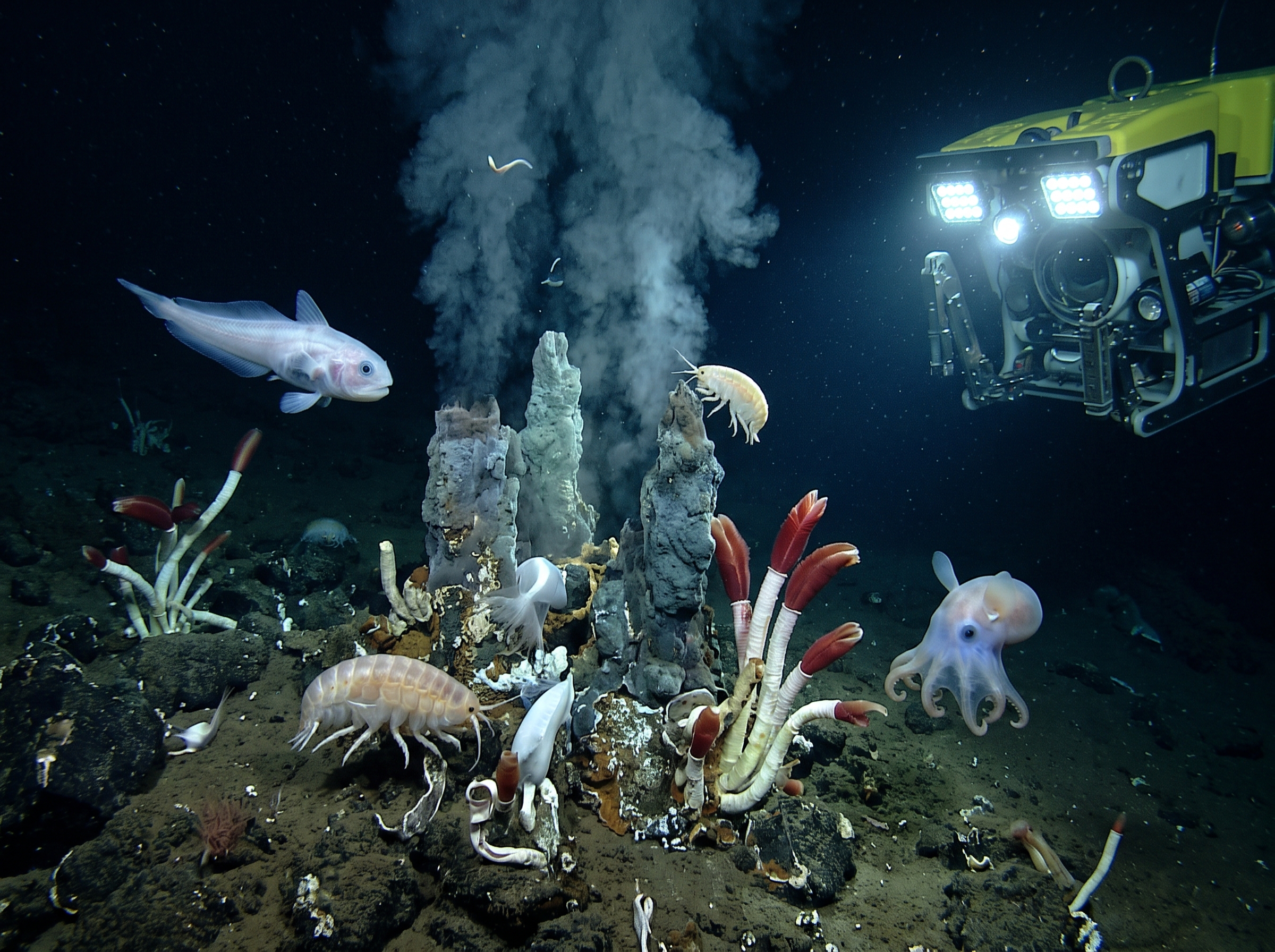
Some of the most scientifically significant deep-sea discoveries come from hydrothermal vents and cold seeps — spots on the ocean floor where mineral-rich, chemically charged fluid escapes from beneath Earth's crust. Around these vents live giant tube worms (Riftia pachyptila), which can grow over two meters long despite having no mouth, no stomach, and no digestive system at all. Instead, they host colonies of symbiotic bacteria inside a specialized internal organ, and those bacteria perform chemosynthesis — converting hydrogen sulfide from the vent fluid into usable energy, essentially playing the role photosynthesis plays at the surface, but powered by chemistry instead of sunlight. This discovery, first made in the late 1970s, fundamentally changed biology's understanding of what life requires, proving that entire food webs can exist completely independent of the sun.
Yeti Crabs and Giant Isopods
Yeti crabs, discovered near deep hydrothermal vents starting in 2005, are covered in dense, hair-like bristles that host their own colonies of bacteria, which the crabs appear to farm and feed on directly. Giant isopods, distant relatives of the small pillbugs you might find under a garden rock, can grow to over 30 centimeters on the deep ocean floor, another striking example of deep-sea gigantism, scavenging on whatever organic matter and carcasses settle to the bottom.
Major Recent Discoveries: The Deep Is More Alive Than We Thought
Deep-sea research has moved unusually fast over the past couple of years, driven by better submersible technology reaching depths that were previously impossible to survey directly.
In 2025, researchers using China's crewed submersible Fendouzhe ("Striver") surveyed hadal trenches in the northwest Pacific, including areas near the Mariana Trench, and found extensive, thriving cold-seep communities — dense clusters of tube worms, clams, and other animals living off chemosynthetic bacteria — at depths exceeding 9,500 meters, far deeper than scientists had previously documented such large, complex animal communities surviving. The finding suggests chemosynthesis-based ecosystems, once thought to be a relatively shallow-water and mid-depth phenomenon, extend much deeper into the hadal zone than previously understood, potentially reshaping how researchers think about the limits of complex life on the ocean floor.
Separately, expeditions studying the Mariana Trench, including work highlighted by the Schmidt Ocean Institute, have identified thousands of previously unknown microbial species living in trench sediments, along with a range of new invertebrate species, reinforcing a pattern researchers keep encountering: every well-funded, well-equipped expedition to hadal depths turns up substantial numbers of species entirely new to science. Some estimates arising from recent trench survey work put the total count of newly documented species from these deep expeditions in the thousands, underscoring just how little of this environment had been previously catalogued.
This pace of discovery is a direct reflection of how little of the deep ocean floor has actually been surveyed in detail. As of the most recent updates from Seabed 2030, an international initiative working to produce a complete high-resolution map of the entire ocean floor by the year 2030, roughly a quarter to a third of the global seafloor has been mapped to modern high-resolution standards so far, even as millions of additional square kilometers get added to that map every year — meaning a large majority of the ocean floor, including hadal trenches, remains less precisely mapped than the surface of the Moon or Mars.
Why This Research Actually Matters
Beyond pure scientific curiosity, deep-sea organisms have already produced genuinely useful discoveries. The pressure-stabilizing compounds and specialized enzymes deep-sea organisms rely on are of real interest to biomedical and biotechnology researchers, since molecules that remain stable and functional under extreme pressure or cold sometimes have valuable industrial or pharmaceutical applications. Hydrothermal vent ecosystems, running entirely on chemistry rather than sunlight, have also become an important reference point for astrobiologists studying where else in the solar system life might exist — moons like Europa and Enceladus are thought to have subsurface oceans and possibly their own hydrothermal activity, making Earth's vent communities one of the closest available analogs for what alien seafloor life, if it exists, might actually look like.
At the same time, growing commercial interest in deep-sea mining, particularly for mineral-rich nodules on the abyssal plain, has raised real questions from marine scientists about disturbing ecosystems that are only now being properly documented for the first time — it's a genuinely live policy and scientific debate, given how recently researchers have discovered just how much unexpected life these environments actually support.
Frequently Asked Questions
Has anyone actually been to the deepest point in the ocean? Yes. The first crewed descent to Challenger Deep happened in 1960, aboard the bathyscaphe Trieste, piloted by Jacques Piccard and Don Walsh. It was followed by film director James Cameron's solo dive in 2012, and by a series of dives during the 2018–2019 Five Deeps Expedition and subsequent expeditions, which have made the trip considerably more common in recent years, though it remains a rare and highly technical undertaking.
Do deep-sea creatures explode if brought to the surface? Many do suffer serious, sometimes fatal, decompression-related damage if brought up too quickly, particularly organisms with gas-filled body structures (like swim bladders in some deep fish), which can expand rapidly and cause fatal internal damage as pressure drops — which is part of why deep-sea specimens are typically studied in pressurized containers or examined very quickly after capture whenever researchers want to observe them alive.
Is it completely dark at the bottom of the ocean, or is there some light? Below roughly 1,000 meters (the start of the midnight zone), sunlight is completely absent — the only light present is bioluminescence generated by the organisms themselves. This is why bioluminescence is so common in deep-sea animals: light there exists only if a living thing makes it.
How do scientists even study animals that live that deep? Modern research relies heavily on remotely operated vehicles (ROVs) and autonomous underwater vehicles equipped with cameras and sampling tools, alongside a small number of specialized crewed submersibles rated for hadal depths. Sediment and water samples are also collected using pressure-sealed containers called landers, dropped to the seafloor and later retrieved, allowing researchers to study deep-sea microbial life without needing a human or vehicle to travel all the way down.
Are we likely to find even stranger life the deeper we look? Based on the pace of discovery over just the past couple of years, it's a reasonable expectation. Every major, well-resourced expedition to hadal depths in recent years has turned up unexpected findings, from animal communities living deeper than previously thought possible to large numbers of entirely new species, suggesting the deep ocean remains one of the most under-explored environments on the planet.
The Bottom Line
The deepest parts of the ocean were, for most of scientific history, assumed to be close to lifeless — too dark, too cold, too crushing, too far from any food source for anything but the hardiest microbes to bother with. That assumption has been overturned again and again, most dramatically in just the past couple of years, as expeditions keep finding thriving, complex ecosystems thousands of meters deeper than expected, running on chemistry instead of sunlight, built around creatures with no real equivalent anywhere else on Earth. We've mapped less of our own ocean floor than we have of the Moon, and every trip back down seems to prove there's a lot more waiting to be found.
References
Natural History Museum (UK) — Deepest-Ever Fish Filmed at a Depth of 8,336 Metres
NOAA Ocean Exploration — What Is the Deepest-Living Fish?
Schmidt Ocean Institute — New Species and Surprising Findings in the Mariana Trench
Phys.org — Deepest-Known Animal Communities Found Nearly 10 km Below Sea in Mariana Trench
IFLScience — In Earth's Deepest Ocean Trench, Over 7,000 New Species Have Been Discovered
Singularity Hub — Scientists Discover Thousands of New Microbial Species Thriving in the Mariana Trench
Seabed 2030 — Global Seabed Mapping Reaches New Milestone
NOAA Ocean Exploration — How Much of the Ocean Has Been Explored?
Woods Hole Oceanographic Institution — Hydrothermal Vents and Chemosynthesis research summaries.
Guinness World Records — Deepest Fish
Article last fact-checked: September 2026. Deep-sea research is advancing quickly as submersible and mapping technology improves — readers wanting the latest discoveries should check current expedition reports from Schmidt Ocean Institute, NOAA Ocean Exploration, and Seabed 2030 directly.