
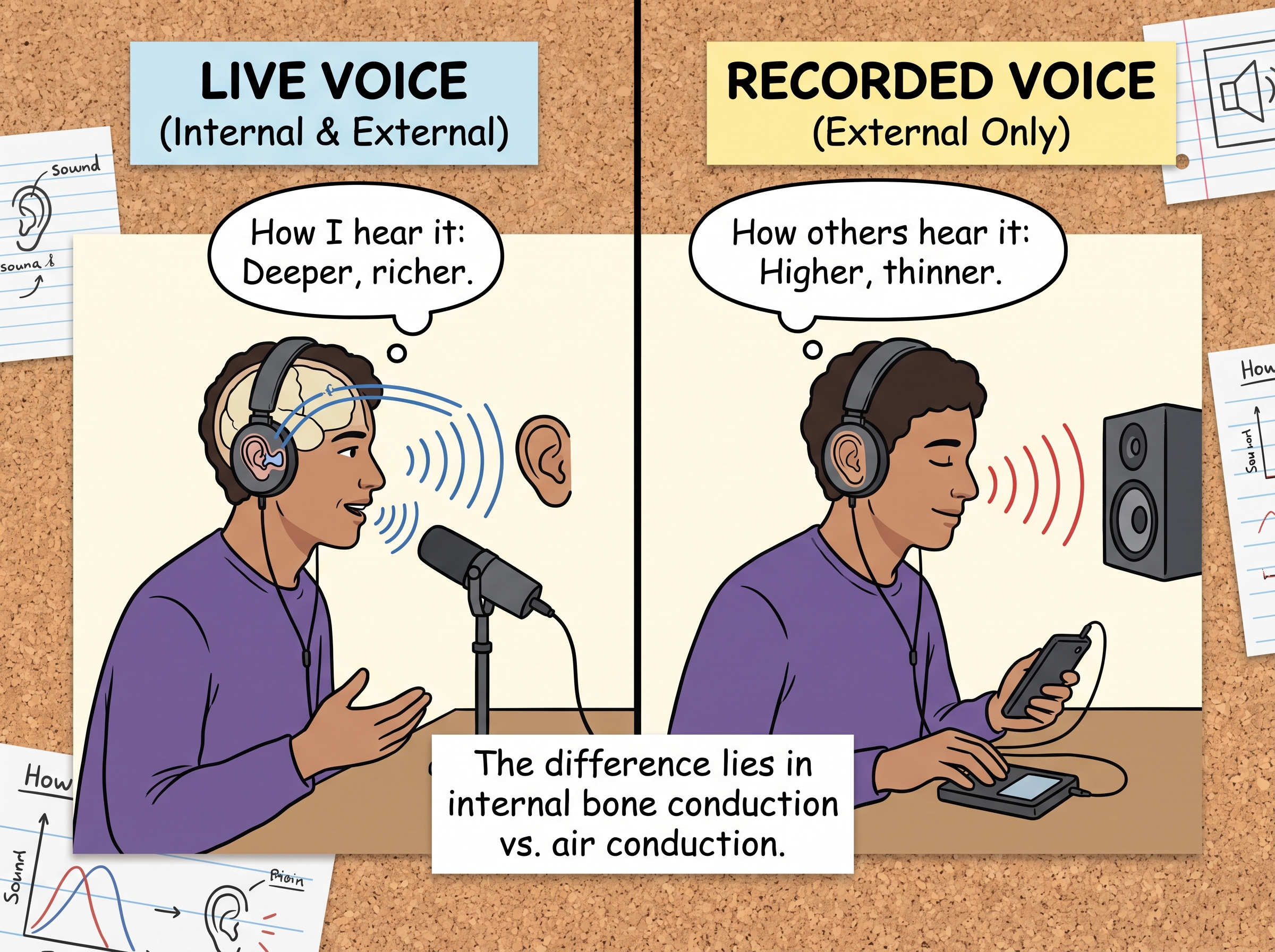
There's a very specific kind of discomfort that comes from hearing your own voice played back to you — a voicemail greeting, a recorded meeting, a video you didn't realize was capturing audio. It almost always sounds thinner, higher-pitched, and somehow just off compared to the voice you're used to hearing in your own head. And it's not your imagination, and it's not just because the recording is bad. You are, quite literally, hearing a version of your voice you almost never hear any other way — and recent research suggests the discomfort runs deeper than simple sound quality, into how your brain decides what counts as "you" in the first place.
You've Been Hearing Your Voice Through Two Different Paths This Whole Time
When you speak, the sound of your voice reaches your own ears through two completely separate physical pathways at once, and that's the foundation of everything else in this explanation.
The first is air conduction — the same way any sound reaches anyone's ears. Your vocal cords vibrate, that vibration travels as sound waves through the air, and those waves enter your ear canal and vibrate your eardrum, just like the sound of someone else's voice, music, or traffic noise would. This is the only pathway other people ever use to hear you, and it's also the only pathway a microphone ever captures, since a microphone is just a device for detecting air-conducted sound waves.
The second pathway is bone conduction, and it's unique to hearing your own voice. As your vocal cords vibrate, those vibrations don't just travel outward through the air — they also travel directly through the bones and tissues of your skull and jaw, reaching your inner ear internally, without ever leaving your head. Bone is a denser medium than air, and it happens to transmit lower-frequency vibrations especially well, so the sound that reaches your inner ear via bone conduction is enriched with extra bass and warmth that never makes it out into the air at all.
Your brain doesn't experience these two pathways separately — it blends them together in real time into a single perceived voice. The result is that the voice you're used to hearing "from the inside" is a richer, bassier, fuller-sounding blend that nobody else has ever heard and that no microphone can ever record, because a microphone only has access to the air-conducted half of that blend.
So a Recording Isn't Wrong — It's Actually More Accurate
Here's the genuinely important reframe: your recorded voice isn't a distorted version of your real voice. It's the version of your voice that everyone else has always heard, minus the internal bass boost your skull has been quietly adding just for you. In a very real sense, the recording is more accurate to how the world experiences your voice than your own internal perception has ever been — it's your internal experience that's the unusual, private, never-shared version, not the recording.
It's Not Just Acoustics — Your Brain Is Actively Involved in Recognizing "Your" Voice
For a long time, the standard explanation stopped at bone conduction and left it there: recordings sound different because they're missing the bone-conducted bass frequencies, full stop. More recent research suggests the story goes deeper, and it's a genuinely interesting expansion of the classic explanation.
A 2023 study published in Royal Society Open Science, led by researchers including Pavo Orepic, found that bone conduction doesn't just color the sound of your voice — it appears to functionally help your brain distinguish your own voice from someone else's in real time, acting almost like an authentication signal your brain uses to tag a sound as "self-generated." When that bone-conducted signal is missing, as it always is in a recording, part of what makes a recorded voice sound strange may be your brain's self-recognition system genuinely working with incomplete information, momentarily uncertain whether it's hearing you or an unfamiliar stranger who happens to sound similar.
A more recent integrative framework, published in 2026 by Orepic and Ana P. Pinheiro, pulls this together with a separate line of research on predictive brain processing. The idea is that your brain doesn't just passively receive the sound of your own speech — it actively predicts what your voice should sound like in the moment, based on the motor commands it just sent to your vocal tract, a mechanism sometimes called an efference copy. Your brain then compares that prediction against the incoming sound in real time. When you speak normally, the prediction and the actual blended (air-plus-bone) sound match closely enough that the whole process feels seamless and unremarkable. A recording breaks that match on two fronts at once: it's missing the bone-conducted component your brain expected, and it's arriving through an unfamiliar channel (a speaker or headphones) rather than the live, real-time path your brain is used to predicting against. That double mismatch is a large part of why recorded playback can feel so specifically, describably "off" rather than just quietly different.
The Equipment Adds Real Differences Too
It's worth being clear that biology isn't the only factor — the recording and playback chain itself introduces genuine, non-psychological changes to the sound. Microphones vary significantly in their frequency response, meaning different microphones naturally emphasize or de-emphasize different pitch ranges, and cheaper or poorly positioned microphones can flatten or thin out a voice in ways a good microphone wouldn't. Audio compression, used almost everywhere voice gets transmitted or stored digitally, can subtly alter tone quality, especially at lower bitrates. And the speaker or headphones used for playback matter too, since they have their own frequency response quirks, meaning the same recording can sound noticeably different depending on what it's played back through. None of this creates the core "that doesn't sound like me" reaction on its own — that reaction happens even through excellent equipment — but it does explain why recorded voice quality can vary so much between a phone voice memo, a podcast microphone, and a video call.
Why It Specifically Feels Bad, Not Just Different
Plenty of things sound "different" without triggering the specific cringe reaction people commonly report with their own recorded voice, so it's worth addressing that part directly too. Psychological research on the mere-exposure effect has repeatedly found that people generally prefer things they're more familiar with, all else being equal — and almost nobody is more constantly, continuously exposed to a version of their own voice than the internal, bone-conduction-enriched one they've heard every single time they've spoken since infancy. A recording abruptly substitutes a far less familiar version, and that unfamiliarity itself, separate from any judgment about how it sounds, appears to contribute to the discomfort. On top of that, hearing a recording tends to trigger a more self-conscious, evaluative kind of listening than usual — people report actively judging their recorded voice (too high, too nasal, too flat) in a way they essentially never do while speaking live, which adds a layer of self-critical attention that has little to do with the sound itself and a lot to do with suddenly hearing yourself the way an outside listener would.
It Does Get Easier With Repeated Exposure
If you've ever noticed that professional podcasters, voice actors, and broadcasters seem unfazed by hearing themselves played back, that's a real, well-documented pattern rather than just professional composure. Consistent with mere-exposure research, repeated exposure to your own recorded voice tends to genuinely reduce the discomfort over time, simply because the recorded version becomes more familiar the more you actually hear it. Voice professionals routinely recommend deliberately listening to your own recordings regularly, specifically to build that familiarity faster, and most people who do this — including people recording anything from work presentations to personal videos — report that the visceral cringe reaction fades substantially within weeks to months of regular exposure, even though the recording itself hasn't changed at all.
Frequently Asked Questions
Does everyone hate the sound of their recorded voice? It's an extremely common reaction, though not universal — the discomfort has been widely enough reported that it's sometimes informally called "voice confrontation," and research on self-voice perception consistently finds that people tend to rate their own recorded voice as sounding worse or more unfamiliar than their internal, live-speaking experience of it.
Is my recorded voice what other people actually hear when I talk to them? Essentially yes, since other people have only ever heard the air-conducted version of your voice, which is exactly what a microphone captures. There can be small additional differences from microphone quality, room acoustics, and playback equipment, but a decent recording is a much closer match to what others hear than your own internal experience of your voice is.
Why do some recordings of my voice sound worse than others? This usually comes down to the technical chain: microphone quality and placement, background noise, audio compression, and the speaker or headphones used for playback can all meaningfully change how a recorded voice sounds, independent of the underlying self-voice-recognition effects covered above.
Can I train myself to like my recorded voice? Not exactly "like" it on command, but genuinely get more comfortable with it, yes — research on familiarity and repeated exposure, along with widespread anecdotal experience from voice professionals, supports the idea that regular, deliberate exposure to your own recordings measurably reduces the discomfort over time.
Does this happen with other body-generated sounds too, or just voice? Voice is the most studied and most commonly reported example, partly because speech is so central to identity and social interaction, but the underlying bone-versus-air conduction mechanism technically applies to any sound generated inside your own head, including chewing sounds, which is part of why chewing can sound unexpectedly loud to you internally while being barely noticeable to someone sitting next to you.
The Bottom Line
That jarring moment of hearing your own recorded voice isn't a flaw in the recording, and it isn't just an unflattering audio quirk — it's the predictable result of finally hearing, from the outside, a sound your brain has spent your entire life quietly customizing just for you. Between the missing bone-conducted bass, a self-recognition system briefly working with less information than usual, and a predictive brain system that expected something slightly different, there's a genuinely layered explanation behind a reaction that feels, in the moment, like nothing more than "I sound weird." You don't, really. Everyone else has just always heard the real thing.
References
Orepic, P., et al. (2023). Bone Conduction Facilitates Self-Other Voice Discrimination. Royal Society Open Science, 10(2), 221561.
Orepic, P., & Pinheiro, A. P. (2026). From Voice to Self: An Integrative Framework on Self-Voice Processing. Perspectives on Psychological Science.
PsyPost — Your Own Voice "Is Not Just a Sound": Bone-Conduction Tech Offers New Insights Into Voice Perception
EPFL — Pavo Orepic Interviewed by NYT for Perception of One's Own Voice
Wikipedia — Bone Conduction
ENT and Allergy Associates — Why Does Your Voice Sound Different on Recordings?
Reznik, D., & Mukamel, R. — research on self-generated sound perception and efference copy, cited in self-voice processing literature.
British Journal of Psychology — Kirk et al. (2025). Listen to Yourself! Prioritization of Self-Associated and Own Voice Cues.
Zajonc, R. B. (1968). Attitudinal Effects of Mere Exposure. Journal of Personality and Social Psychology (foundational mere-exposure effect research).
National Institute on Deafness and Other Communication Disorders (NIDCD) — How Do We Hear? (air and bone conduction overview).
Article last fact-checked: September 2026. Self-voice perception is an active area of psychological and neuroscience research — readers wanting the latest findings should check current publications from the cited researchers directly.