Here's a sentence that sounds like science fiction but is just ordinary, tested physics: if you parked a spaceship close to a black hole for what felt to you like one hour, and then flew back to Earth, you might find that years — or with a big enough black hole, decades — had passed for everyone you left behind. This isn't a movie trick. It's a direct, measurable consequence of Einstein's general theory of relativity, and versions of it are quietly being accounted for every single day, in something as mundane as the GPS app on your phone.
So why does this happen? Why would gravity, of all things, mess with time itself? Here's the actual explanation, built up piece by piece.
Time Isn't as Fixed as It Feels
For most of human history, time was assumed to be a universal backdrop — a steady, ticking clock running the same way everywhere in the universe, completely separate from space, matter, and gravity. Isaac Newton's physics worked this way, and it matched everyday experience well enough that nobody had reason to question it.
Albert Einstein broke that assumption twice, about a decade apart. In 1905, his special theory of relativity showed that time runs differently for observers moving at different speeds relative to each other — the faster you move, the slower your clock ticks compared to someone standing still. Then in 1915, his general theory of relativity went further, showing that gravity itself also affects the flow of time — and it does this by revealing that gravity isn't really a force in the way Newton imagined it, pulling objects together across empty space. Instead, general relativity describes gravity as the curvature of a combined four-dimensional fabric called spacetime, where the three dimensions of space and the one dimension of time are woven together into a single structure that mass and energy physically bend.
Massive objects — planets, stars, and especially black holes — warp this spacetime fabric around them, the way a heavy ball placed on a stretched rubber sheet creates a dip that a smaller ball would roll toward. It's an imperfect analogy since a rubber sheet only shows curved space, not curved time, but it captures the basic idea: mass doesn't reach out and pull; it reshapes the space and time around it, and everything nearby, including light and the flow of time itself, has to follow that new shape.
Gravitational Time Dilation, in Plain Terms
Here's the key consequence: the more intensely spacetime is curved at a given location — meaning the stronger the gravity there — the slower time passes at that location, compared to somewhere with weaker gravity. This effect is called gravitational time dilation, and it isn't a perceptual illusion or a measurement error. It's a real difference in how much time actually elapses in one place versus another.
Crucially, if you were the one sitting deep in a strong gravitational field, your own clock would feel completely normal to you — you wouldn't notice your heartbeat slowing down, your thoughts taking longer, or anything subjectively different at all. Time dilation only becomes apparent when you compare your clock to someone else's, from somewhere with different gravity. From the outside, a distant observer watching your clock (through a telescope, say) would see it ticking slower than their own. From your point of view, it would be their clock that looked like it was running fast. Both perspectives are simultaneously, genuinely correct — that's the strange part that trips people up. There's no single, universal "real" time both of you are secretly deviating from; each of you is experiencing your own valid, locally normal flow of time, and the difference only shows up when the two get compared.
This Isn't Hypothetical — It's Already Been Measured
Gravitational time dilation isn't a black-hole-only curiosity; it happens everywhere, all the time, just too subtly to notice in daily life. The most concrete, unavoidable proof most of us rely on without realizing it is GPS.
GPS satellites orbit roughly 20,000 kilometers above Earth, where gravity is noticeably weaker than it is down here on the surface. That weaker gravity means their onboard atomic clocks actually run faster than identical clocks on the ground, gaining about 45 microseconds per day due to gravitational time dilation alone. At the same time, because the satellites are moving very fast relative to us, special relativity's velocity-based time dilation kicks in in the opposite direction, causing their clocks to lose about 7 microseconds per day. The net effect is that GPS satellite clocks run about 38 microseconds per day faster than clocks on Earth's surface — a tiny-sounding number, but because GPS relies on precise timing to calculate your location from signal travel time, an uncorrected 38-microsecond daily drift would translate into position errors piling up by several kilometers within a single day. Engineers correct for this by deliberately tuning the satellite clocks to run slightly slow before launch, specifically so that once they're in orbit, real gravitational and velocity effects bring them back into sync with ground time. In other words, your phone's map app works accurately today because Einstein's equations for gravity and time are built directly into its infrastructure.
Now Turn Up the Gravity, All the Way
A black hole is what happens when gravity gets pushed to its most extreme physically possible limit. It forms when enough mass gets compressed into a small enough space that the resulting spacetime curvature becomes so severe that nothing — not even light, the fastest thing in the universe — can escape from within a certain distance of it. That boundary is called the event horizon, and its radius (called the Schwarzschild radius, after physicist Karl Schwarzschild, who solved Einstein's equations for this exact scenario just months after general relativity was published in 1915) marks the point of no return.
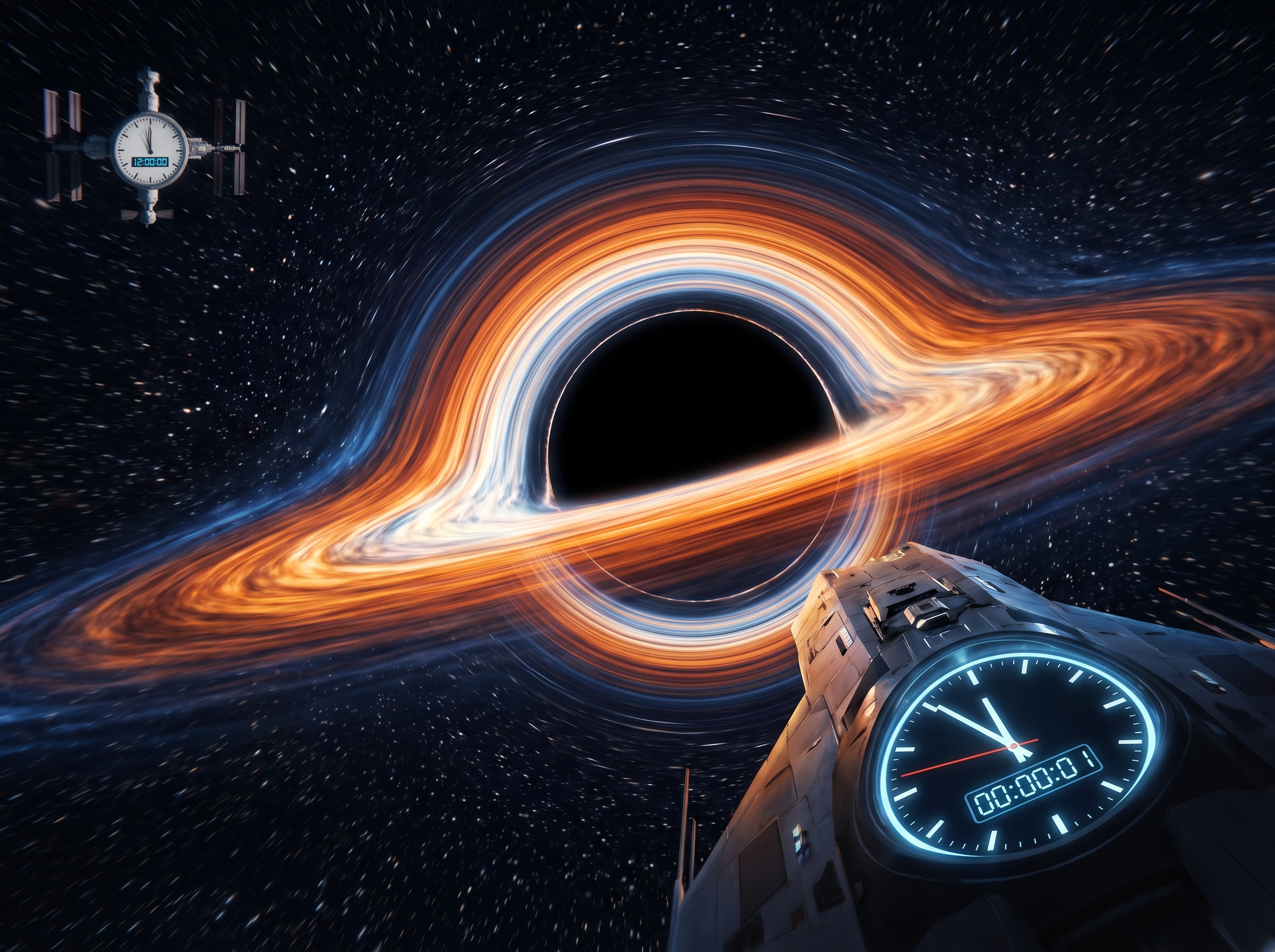
As you get closer to a black hole's event horizon, gravitational time dilation intensifies dramatically, in a way that's genuinely different from the mild effect near a planet or star — it doesn't just increase gradually, it approaches a mathematical extreme. Picture two people: one, call her Mira, cautiously orbiting close to a black hole in a spacecraft; the other, call him Deshawn, watching from a safe distance far away, say back on a space station. From Deshawn's point of view, as Mira's ship gets closer and closer to the event horizon, her clock appears to tick slower and slower — and light from her ship gets increasingly redshifted (stretched to longer, redder wavelengths) as it climbs back out of the intensifying gravity well to reach him. If Mira could somehow reach the event horizon itself, Deshawn would see her clock appear to freeze completely, and her image would redshift into invisibility, essentially fading out rather than visibly crossing the boundary — from his outside vantage point, she'd never quite seem to finish arriving.
But from Mira's own perspective, inside her ship, nothing would feel frozen or slow at all. Her watch, her heartbeat, her thoughts would all feel completely ordinary to her the entire time, right up until she actually crossed the event horizon (assuming the black hole is large enough that the approach itself doesn't kill her first — more on that below). This is the same "each observer's own clock feels normal" principle from before, just taken to its most dramatic possible extreme. The closer to the black hole she orbits, the more real, measurable time will have passed for Deshawn by the time she returns to compare notes — she will have genuinely aged less than he did, not just seemed to.
The "Interstellar" Example, and Why It's Actually Solid Science
If this setup sounds familiar, it's because the 2014 film Interstellar used almost exactly this scenario as a plot point, and did so with real scientific rigor — theoretical physicist Kip Thorne, who later shared the 2017 Nobel Prize in Physics for his work on gravitational waves, served as the film's science consultor and insisted the black hole physics be as accurate as visual storytelling allowed. In the film, a crew visits a planet in extremely close orbit around a massive black hole called Gargantua, where the intense gravitational time dilation means that one hour spent on the planet's surface corresponds to roughly seven years passing for anyone who stayed farther away. When the crew returns to their ship, one crew member has aged decades while the away team has barely aged at all. It's dramatized for a two-hour movie, and the specific numbers depend on the details of that fictional planet's orbit — but the underlying physics, an object in a sufficiently tight, sufficiently strong gravitational field experiencing dramatically less elapsed time than a distant observer, is completely real general relativity, not artistic license.
An Important Caveat: Time Dilation Isn't What Would Actually Kill You
It's worth separating two different black hole effects that often get blurred together. Gravitational time dilation is about the rate at which time passes; it doesn't hurt you. What would actually be dangerous for a human getting close to most black holes is a separate effect called spaghettification — the result of tidal forces, meaning the difference in gravitational pull between the near and far sides of your body. Near a small black hole, that difference can become so extreme over just a few feet that it stretches an object apart lengthwise while compressing it sideways, hence the name. Interestingly, for a sufficiently enormous supermassive black hole — like Gargantua in Interstellar, or the real supermassive black hole at the center of our own galaxy — the event horizon is so large that tidal forces at the horizon itself are actually much gentler than for a small black hole, meaning a hypothetical traveler could, in principle, cross the event horizon of a very large black hole without being torn apart on the way in, even though escape would still be permanently impossible. Time dilation and spaghettification are both real consequences of extreme gravity, but they're separate phenomena governed by different aspects of the underlying math.
What Happens to Time Right at the Center Is Still Not Fully Settled
Deep inside a black hole, at the singularity predicted by Einstein's equations, general relativity's math describes spacetime curvature becoming infinite — and the equations start behaving in ways that many physicists suspect signal the theory reaching the edge of where it's still valid, rather than a literal physical infinity actually existing in nature. Some solutions to the equations even suggest that space and time swap certain mathematical roles inside the event horizon, though physicists are careful about how literally to interpret that. What actually happens at a black hole's singularity is one of the genuinely unresolved questions in physics, widely believed to require a full theory of quantum gravity — merging general relativity with quantum mechanics — that doesn't fully exist yet. So while gravitational time dilation approaching and even crossing the event horizon is solid, experimentally grounded physics, what happens at the very center remains an open frontier rather than settled science.
What Research Looks Like Right Now
Black holes have gone from purely theoretical objects to things astronomers can now directly image and probe. The Event Horizon Telescope collaboration, which released the first-ever image of a black hole's shadow (the supermassive black hole in galaxy M87) in 2019 and followed it with an image of Sagittarius A*, the supermassive black hole at the center of our own Milky Way, in 2022, has continued refining its observations, including recent released imagery of M87's powerful particle jet, giving researchers an increasingly detailed picture of how matter and light behave in these extreme gravitational environments.
Separately, gravitational wave observatories — which detect ripples in spacetime itself produced by events like colliding black holes — have continued using extreme events to test general relativity's predictions with increasing precision; a notably strong gravitational wave detection reported in early 2026 gave researchers one of their most rigorous tests yet of whether Einstein's century-old equations still hold up exactly as predicted under the most extreme conditions the universe can produce. Researchers have also been studying how spinning black holes twist the surrounding spacetime itself, a related but distinct relativistic effect called frame-dragging, adding to the broader picture of just how thoroughly a black hole reshapes everything, including time, in its vicinity.
Frequently Asked Questions
If I got close to a black hole and came back, would I actually be younger than everyone on Earth? Yes, genuinely — not just apparently. Assuming you survived tidal forces and could safely return, you would have experienced less elapsed time than people who stayed far away in weaker gravity, and this would be a real, physical age difference, not an illusion or a matter of perspective. This is a real-world version of what's sometimes called the "twin paradox."
Does time dilation mean time actually stops at the event horizon? Only from a distant outside observer's point of view, and only in the limit as an object gets infinitely close without quite reaching it — to that outside observer, an infalling object's clock appears to approach a stop and its light fades to invisibility. From the infalling object's own perspective, time continues to pass completely normally, and it would cross the event horizon in a finite amount of its own experienced time.
Could I see a black hole "turn on" time dilation as I got close? No — locally, time dilation isn't something you'd feel or notice happening to yourself; your own clock, heartbeat, and thoughts would always feel normal to you. You'd only notice a discrepancy by later comparing notes with someone who experienced different gravity, such as returning to find more time had passed for them than for you.
Is gravitational time dilation the same thing as the time dilation from moving fast? They're related but distinct effects, both coming out of relativity. Special relativity's time dilation depends on relative velocity — how fast you're moving compared to someone else. General relativity's gravitational time dilation depends on the strength of the gravitational field, or equivalently, spacetime curvature, at your location. Near a black hole, both effects are often happening simultaneously, especially if you're also orbiting at high speed, and they can partially reinforce or partially offset each other depending on the specific situation — exactly as they do for GPS satellites.
Has gravitational time dilation actually been tested, or is it still theoretical? It's been tested repeatedly and precisely, not just near black holes but right here on Earth. Beyond the GPS example, extremely precise atomic clock experiments have measured gravitational time dilation over height differences as small as a couple of feet, confirming that a clock on a lower shelf in a lab genuinely ticks very slightly slower than one on a higher shelf, exactly matching general relativity's predictions.
The Bottom Line
Time slowing down near a black hole isn't a strange side effect bolted onto physics as an afterthought — it falls directly out of treating gravity as the curvature of spacetime itself, an idea Einstein worked out over a century ago and that's been tested and confirmed again and again since, right down to the satellites keeping your GPS accurate today. Push that same effect to its logical extreme, at the edge of a black hole, and the result is one of the most genuinely strange and well-supported predictions in all of physics: two clocks, two completely valid experiences of "normal" time, and a real difference between them the moment they're brought back together to compare.
References
Einstein, A. (1915). Die Feldgleichungen der Gravitation (The Field Equations of Gravitation). Sitzungsberichte der Preussischen Akademie der Wissenschaften.
Schwarzschild, K. (1916). On the Gravitational Field of a Point Mass According to Einstein's Theory. Sitzungsberichte der Königlich Preussischen Akademie der Wissenschaften.
Ohio State University Astronomy — Real-World Relativity: The GPS Navigation System
Physics Today — Relativity and the Global Positioning System
Event Horizon Telescope Collaboration — Astronomers Reveal First Image of the Black Hole at the Heart of Our Galaxy
NASA Science — First Image of a Black Hole
Universe Today — The Collaboration That Brought You the First Image of a Black Hole Just Released Photos of Its Massive Jet
ScienceDaily — A Record-Breaking Gravitational Wave Is Helping Test Einstein's Theory of General Relativity
ScienceDaily — Astronomers Just Watched a Black Hole Twist Spacetime
Thorne, K. S. (2014). The Science of Interstellar. W. W. Norton & Company.
Article last fact-checked: September 2026. Black hole research moves quickly — readers wanting the latest findings should check current publications from the Event Horizon Telescope Collaboration and major gravitational-wave observatories directly.