That split-second at the top of a roller coaster hill, where your stomach seems to float up into your chest and you rise slightly off your seat, isn't a trick of the mind. Something real and measurable is happening to your body in that moment — the same underlying physics, in fact, that makes astronauts float around the inside of the International Space Station. You're not actually weightless. You're doing something arguably more interesting: falling.
Weight Isn't What You Think It Is
To understand what's happening, it helps to first get clear on what "weight" actually means to your body, because it's not quite what most people assume. Gravity is constantly pulling you downward, at a steady 9.8 meters per second squared here on Earth, whether you're standing still, riding a coaster, or sound asleep. That pull never switches off and never changes based on what you're doing.
What you actually feel as "weight" isn't gravity itself — it's the resistance pushing back against gravity. When you stand on the ground, the ground pushes back up on your feet (physicists call this the normal force) to stop you from falling through it, and it's that upward push you feel and interpret as your body's weight. A bathroom scale works on exactly this principle: it's not measuring gravity directly, it's measuring how hard your feet are pressing down on it, which is how hard it's pressing back up on you.
Here's the key insight: if that upward push suddenly disappeared, even though gravity was still pulling on you exactly as strongly as ever, you would feel weightless — not because gravity stopped, but because nothing is pushing back against it anymore. This exact scenario happens for a few seconds any time you're in free fall.
The Elevator Test
You've probably experienced a small version of this without realizing it. If you've ever been in an elevator that starts descending quickly, there's a brief, slightly unsettling moment where your stomach seems to lift and you feel momentarily lighter. That's because the elevator floor briefly accelerates downward faster than your body was already moving, meaning the floor is pushing up on your feet with less force than usual for that instant — you're not truly weightless, but you're partway there, and your body notices immediately.
A roller coaster does the exact same thing, just far more dramatically and deliberately.
What's Actually Happening on the Hill
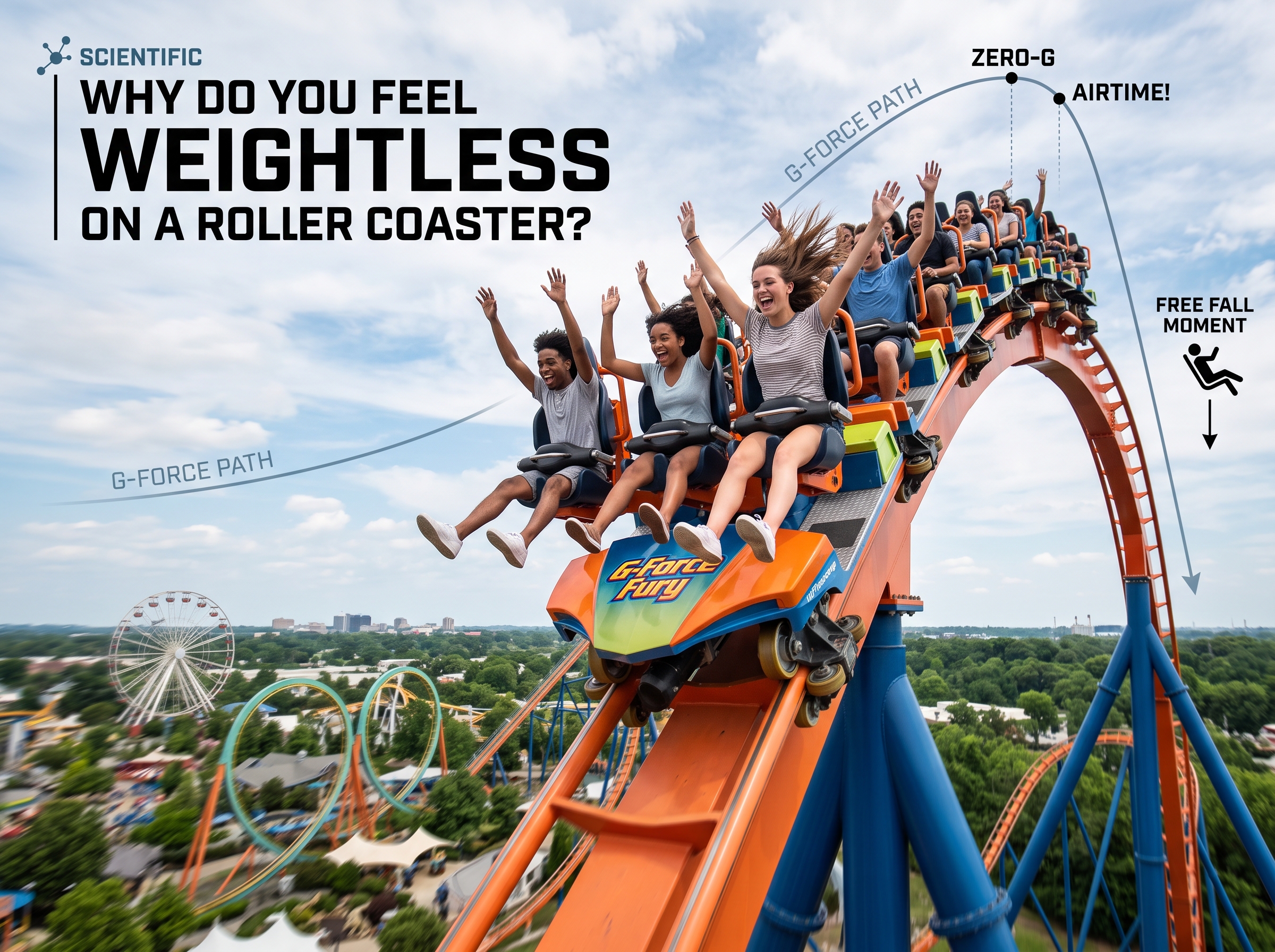
Roller coaster designers build specific sections into a track, usually just past the crest of a hill, called airtime hills, shaped so the track curves downward more sharply than the natural arc your body would follow if it were simply falling under gravity alone. Because the track (and the car attached to it) drops away from underneath you faster than gravity alone is pulling you down, the seat can't keep up with you — for a brief moment, it's not pushing up against you with its usual force, or in the most extreme cases, it stops pushing on you entirely. Since the seat isn't pressing back, you're essentially in true free fall for a second or two, and your body reads that missing push exactly the way it would read actual weightlessness: your stomach feels like it's floating, loose items rise off your lap, and you lift slightly off your seat, only held down by the safety restraint.
Engineers actually design toward this deliberately, and different kinds of airtime feel meaningfully different depending on exactly how the hill is shaped. "Floater airtime" happens on a more gently curved hill, where you experience something close to genuine weightlessness (around 0g), gently rising off the seat in a smooth, sustained way. "Ejector airtime," found on more sharply curved hills, briefly pushes you into slightly negative g-forces — meaning the track is curving downward faster than gravity alone would carry you, so for an instant you're being accelerated downward faster than free fall, which throws you more forcefully up against your restraint rather than gently lifting you. It's a subtle engineering distinction, but frequent coaster riders can usually tell the two apart immediately.
Measuring It: G-Forces
Engineers describe all of this using g-forces, a unit describing acceleration relative to normal Earth gravity. Standing still, you experience 1g. At the bottom of a steep drop or through a tight loop, riders can experience 3 to 4g or more, where you feel significantly heavier than normal as the seat pushes up on you with several times its usual force. At the crest of a well-designed airtime hill, riders can experience close to 0g, or even briefly negative g-force readings on the most aggressive designs — this is the exact range where the "weightless" floating sensation happens, and it's a genuine, physically real, measurable state, not just a psychological impression.
This Is the Same Physics as Space
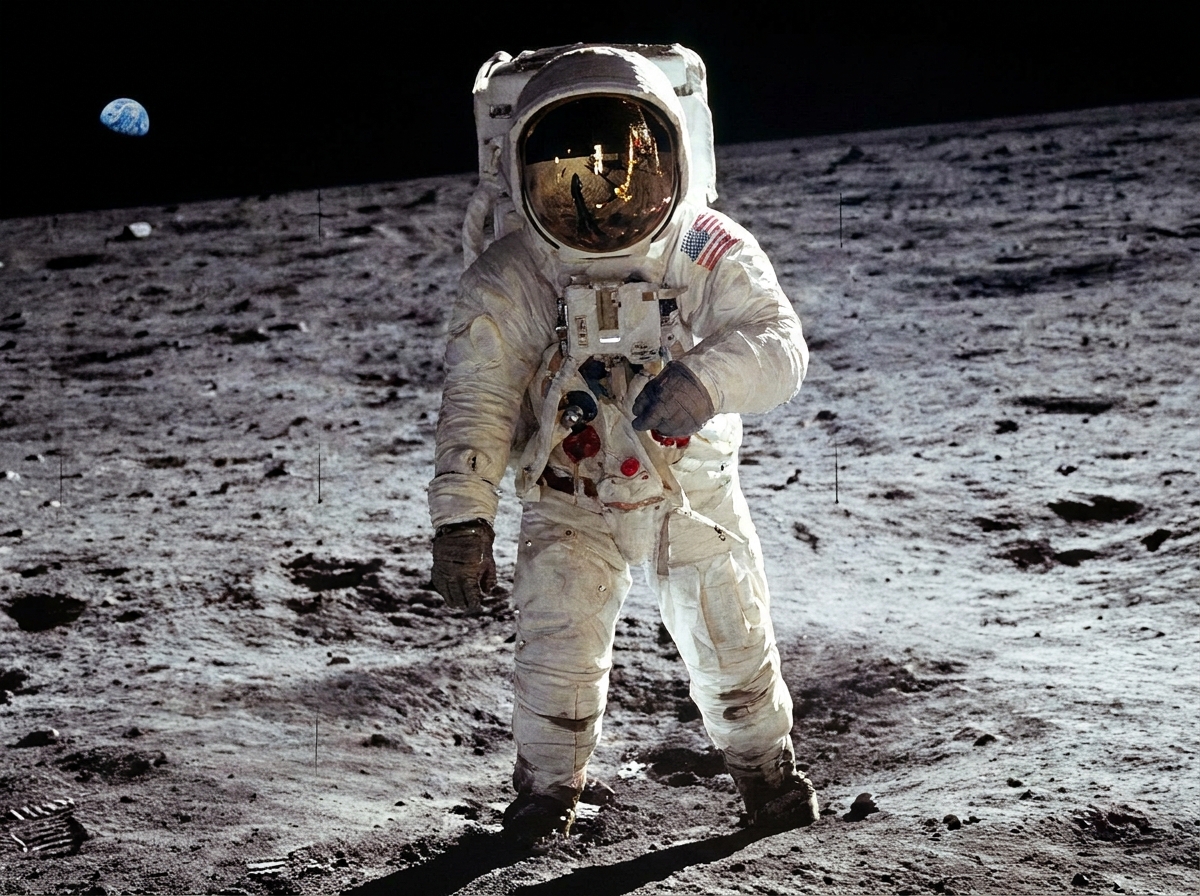
Here's the part that tends to surprise people: astronauts orbiting Earth aren't in a gravity-free zone at all. At the altitude of the International Space Station, roughly 400 kilometers up, Earth's gravity is still about 90% as strong as it is at the surface — nowhere close to zero. Astronauts float because they, and their entire spacecraft, are continuously falling toward Earth, but moving forward fast enough sideways that the curve of their fall matches the curve of the planet beneath them, so they perpetually fall without ever actually hitting the ground. It's the exact same free-fall mechanism as a roller coaster's airtime hill; it just never stops, because orbital speed keeps the "fall" going indefinitely instead of the track curving back upward after a second or two.
This is also exactly how astronaut training aircraft, sometimes nicknamed "vomit comets," simulate weightlessness on Earth: the aircraft flies a steep parabolic arc and, for about 20 to 30 seconds at the top of that arc, essentially becomes a giant, controlled free-fall machine, giving everyone inside a genuinely weightless experience using precisely the same physics as both a roller coaster hill and an orbiting spacecraft — just held for much longer than any coaster could manage, and without a track to curve back upward and end it.
Why It Sometimes Makes You Feel Sick
The floating sensation itself doesn't inherently cause nausea, but the rapid transitions in and out of it often do. Your inner ear's vestibular system constantly tracks your body's motion and orientation using fluid-filled canals, and it normally works in close coordination with what your eyes see and what your muscles and joints feel (called proprioception) to build a coherent sense of how you're moving. Roller coasters, especially ones with rapid, repeated shifts between heavy g-forces and near-weightlessness, can create real mismatches between these signals — your inner ear registering one thing, your eyes registering another — and that sensory conflict is a well-established trigger for motion sickness in susceptible people. This is also part of why closing your eyes sometimes makes coaster-induced queasiness worse rather than better: it removes one of the signals your brain could otherwise use to help resolve the conflict.
Modern Coasters Are Engineered Around This Exact Feeling
Airtime has become such a deliberately sought-after sensation that ride designers now use dedicated simulation software to precisely model a coaster's g-force profile before a single support beam is built, fine-tuning hill shapes specifically to hit target airtime durations and intensities. The result has been a wave of increasingly extreme, purpose-built coasters. Falcon's Flight, which opened at the Qiddiya theme park in Saudi Arabia, currently holds the title of both the world's tallest and fastest roller coaster, reaching speeds over 150 mph using a steep, gravity-driven drop rather than a traditional motorized launch. In the United States, Six Flags Over Texas has announced Tormenta Rampaging Run, a new spinning launch coaster set to open in 2026 and designed specifically to break six separate world records at once, reflecting just how competitive and specialized modern coaster engineering has become, with airtime and g-force design now treated as core, carefully calculated features rather than happy accidents.
Frequently Asked Questions
Are you actually weightless on a roller coaster, or does it just feel that way? You're genuinely, physically in free fall during an airtime moment, which is the same real physical state that produces weightlessness anywhere else, including orbit. The g-force reading during a strong airtime hill can be very close to true zero g, meaning it's not just a sensory illusion — your body's relationship with gravity in that moment is essentially identical to an astronaut's.
Why do some roller coaster hills feel more "floaty" than others? This comes down to exactly how sharply the track curves downward relative to a natural free-fall path. A gentler curve produces smoother, longer "floater" airtime closer to 0g, while a sharper, more aggressive curve produces shorter, more forceful "ejector" airtime that briefly pushes riders into negative g-forces against their restraints.
Is it safe to experience negative g-forces on a coaster? Yes, within the ranges used on properly designed, regulated amusement rides — coaster designers work within well-established safety limits for both g-force intensity and duration, and modern restraint systems are specifically engineered to keep riders securely in place through exactly these forces. Extended or extreme g-force exposure well beyond what coasters produce can pose real risks, which is part of why ride engineering keeps airtime moments brief.
Why does the front seat or the back seat feel different on the same hill? Because different cars in the same train cross the same hill's crest at slightly different speeds and moments, especially on hills near the middle or end of a layout, where the train's own momentum and the track's downward pull interact differently depending on position — this is part of why coaster enthusiasts often have strong opinions about which seat produces the best airtime on a given ride.
Does everyone experience airtime the same way? Not entirely — individual differences in inner-ear sensitivity, prior riding experience, and general motion tolerance all affect how intensely someone perceives the same physical g-force profile, which is part of why the same hill can feel thrilling to one rider and mildly nauseating to another.
The Bottom Line
That floating, stomach-dropping sensation on a roller coaster isn't a clever illusion or a trick your brain is playing on you — it's a genuine, briefly engineered state of free fall, built into the track by designers who understand exactly how fast a hill needs to curve away beneath you to make gravity feel like it's momentarily let go. It's the same physics keeping astronauts afloat in orbit, just compressed into a couple of thrilling seconds and immediately followed by a restraint bar reminding you gravity never actually left.
References
Wikipedia — Physics of Roller Coasters
Wikipedia — Air Time (Rides)
Physics World — Twists, Turns, Thrills and Spills: The Physics of Rollercoasters
Britannica — Negative G-Force
NASA — Reduced Gravity (Parabolic Flight) Research Program overview, NASA Johnson Space Center.
NASA — What Is Microgravity?
Wikipedia — Falcon's Flight
CBS News — Six Flags Over Texas Announces Record-Breaking 2026 Roller Coaster, Tormenta Rampaging Run
ThrillZing — How G-Forces Work on Roller Coasters (And What the Limits Are)
CoasterForce — Roller Coaster Physics & G Forces
Article last fact-checked: September 2026. Roller coaster records change frequently as new parks and rides open — readers wanting the latest record-holders should check current rankings from major coaster enthusiast and industry sources.