Somewhere in your body right now, cells you'll never consciously feel are quietly patrolling for threats, ready to mount a coordinated, multi-stage defense the instant a virus gets past your skin. It's easy to only notice your immune system when it's losing — the sore throat, the fever, the days spent on the couch. But those symptoms are usually a sign the system is working exactly as designed, not a sign of failure. Here's what's actually happening inside you, from the first few minutes of an infection to the lasting protection that follows.
Two Defense Systems, Working Together
Your immune system isn't one single mechanism — it's really two overlapping systems that work together, each with a different job. The innate immune system is your fast-response team: broad, non-specific, and ready to act within minutes of detecting almost any threat, but not particularly precise about what it's fighting. The adaptive immune system is your specialist team: slower to get going, taking several days to fully activate, but capable of recognizing one specific invader with remarkable precision and remembering it for years, sometimes for life. A viral infection typically triggers both, in a rough sequence, with the innate system buying time while the adaptive system builds a targeted response.
Line One: Keeping the Virus Out in the First Place
Before any of this internal machinery even gets involved, your body relies on physical and chemical barriers to stop viruses from getting in at all. Skin is a genuinely effective wall against most pathogens, which is exactly why viruses tend to enter through openings — the nose, mouth, eyes, and lungs — where the barrier is thinner. Even there, your body has backup: mucus in your nose and airways physically traps incoming particles, tiny hair-like structures called cilia sweep trapped particles up and out, saliva and tears contain enzymes that can break down some pathogens, and stomach acid is harsh enough to destroy many viruses and bacteria that get swallowed. This is technically the least glamorous part of the immune system, but it stops the vast majority of potential infections before your body ever has to mount a real internal response.
Line Two: The Innate Immune System Sounds the Alarm
When a virus does get past those barriers and infects a cell, the innate immune system kicks into action almost immediately.
Infected Cells Send Out a Distress Signal
A cell that's been infected by a virus doesn't just sit there — it detects the presence of viral genetic material inside itself and responds by releasing signaling proteins called interferons. Interferons work in two directions at once: they warn neighboring, still-healthy cells to raise their internal defenses and make it harder for the virus to replicate inside them if it spreads there next, and they also send out a call for help, recruiting other immune cells to the site of infection. This is part of why early flu-like symptoms — the achy, run-down, "coming down with something" feeling — often show up before you have any obvious localized symptoms; interferons and related signaling molecules are part of what produces that whole-body response.
The Cellular Cleanup Crew
Several types of white blood cells respond to the interferon alarm and head toward the infection. Macrophages ("big eaters," from the Greek) engulf and digest viral particles and infected cellular debris directly, a process called phagocytosis. Dendritic cells do something similar, but with an extra, crucial function: after engulfing viral material, they travel to the lymph nodes and display fragments of the virus, called antigens, on their surface — effectively acting as messengers that hand off a "wanted poster" to the adaptive immune system, which is the critical link between the innate and adaptive responses.
Natural Killer Cells Hunt Down Hijacked Cells
One particularly clever innate immune cell is the natural killer (NK) cell. Many viruses try to hide from detection by suppressing the normal identification markers a healthy cell displays on its surface. NK cells are specifically tuned to notice when a cell's identification markers look suspicious or absent altogether, and when they find one, they destroy that infected cell directly, cutting off the virus's ability to keep using it as a replication factory — all without needing to first identify exactly which virus is involved.
The Complement System and Inflammation
A separate group of blood proteins, called the complement system, works alongside these cells, capable of directly puncturing the outer membrane of some viruses and marking pathogens for easier destruction by other immune cells. Meanwhile, the general inflammatory response — the redness, swelling, warmth, and fever associated with being sick — is itself a deliberate immune strategy, not just an uncomfortable side effect. Increased blood flow brings more immune cells to the site of infection faster, and fever specifically raises your core body temperature into a range that slows down the reproduction of many viruses while enhancing certain immune cell functions, which is part of why a moderate fever during an infection is generally a sign the immune system is doing its job, not something to reflexively suppress the moment it appears.
Line Three: The Adaptive Immune System Builds a Precision Response
While the innate system is holding the line, the adaptive immune system is assembling a far more targeted response — one built specifically around the exact virus involved, not just "a virus in general." This process typically takes several days to fully ramp up, which is part of why illness often follows a pattern of getting a bit worse before it gets better: the innate response is doing its broad, immediate best while the adaptive response is still being built.
Helper T Cells: The Command Center
When a dendritic cell arrives at a lymph node carrying viral antigen fragments, it presents them to helper T cells (also called CD4 T cells). If a helper T cell's receptor happens to match that specific antigen — and your body maintains an enormous, diverse pool of T cells with different receptors specifically so that a match for almost anything is statistically likely to exist somewhere in that pool — it activates and starts multiplying rapidly, then coordinates the rest of the adaptive response by releasing signaling chemicals called cytokines. Helper T cells don't kill infected cells directly; their role is closer to a field commander, activating and directing the other specialized cells described below.
Cytotoxic T Cells: The Direct Killers
Cytotoxic T cells (also called CD8 T cells, or "killer T cells") are the adaptive system's direct enforcers. Once activated and multiplied under helper T cell direction, they circulate through the body searching specifically for cells displaying the matching viral antigen on their surface — meaning cells that are actively infected with that exact virus — and destroy them directly, triggering the infected cell to self-destruct in a controlled way before it can produce more viral copies. This is a notably different mechanism from an antibody's job (described next): cytotoxic T cells deal with viruses that are already inside cells, hidden from antibodies entirely.
B Cells and Antibodies: Precision Weapons Against the Virus Itself
B cells, once activated (with help from helper T cells), transform into plasma cells, which function essentially as antibody factories, churning out enormous quantities of a specific protein called an antibody, precisely shaped to bind to one particular viral antigen. Antibodies work in a few complementary ways: they can neutralize a virus directly by physically blocking the specific part it needs to attach to and enter a healthy cell, they can clump multiple virus particles together to make them easier for other immune cells to sweep up, and they can tag a virus for destruction by other parts of the immune system, including the complement proteins mentioned earlier. Different classes of antibodies serve different roles — IgM is typically the first type produced during a new infection, IgG is the long-lasting, most abundant type responsible for durable protection, and IgA is specialized for protecting mucous membranes, including the ones lining your respiratory and digestive tracts, which is why it shows up prominently in saliva and breast milk.
The Part That Makes Vaccines Possible: Immune Memory
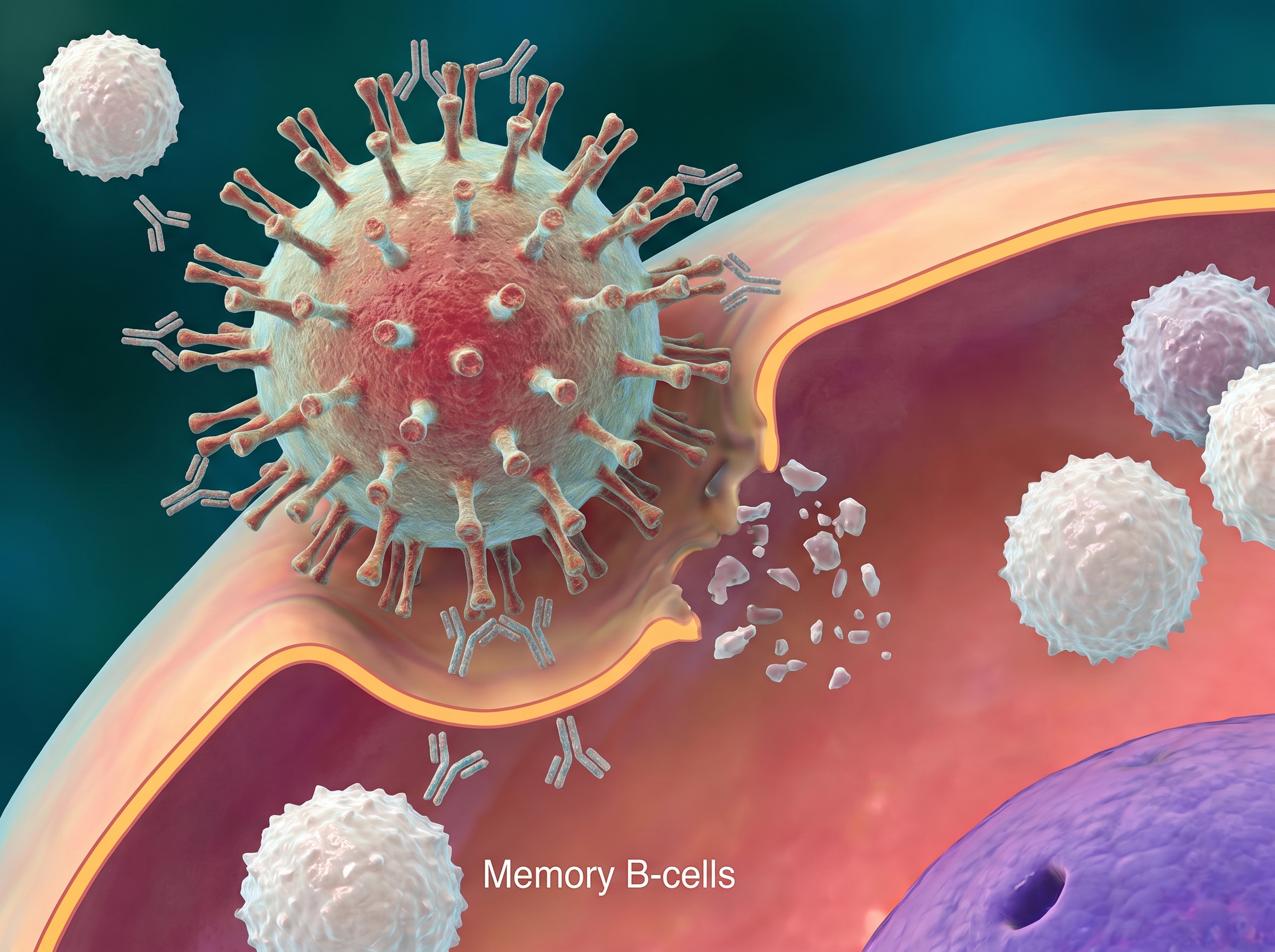
Here's what makes the adaptive immune response so powerful in the long run: after an infection is cleared, most of the specialized T cells and B cells that were mass-produced to fight it die off, since maintaining that entire massive army indefinitely would be metabolically expensive. But a smaller population of memory T cells and memory B cells sticks around, sometimes for decades, essentially keeping a permanent record of that specific virus's antigen signature. If the same virus shows up again, these memory cells can recognize it and mobilize an adaptive response far faster and more powerfully than the original, first-time response — often fast enough to neutralize the virus before you ever develop noticeable symptoms. This is the biological basis for why you typically don't get chickenpox a second time, and it's exactly the mechanism vaccines are designed to exploit: a vaccine trains your adaptive immune system to build this same memory against a specific virus, without requiring you to go through an actual, potentially serious infection first.
This is also why mRNA vaccine technology, first widely deployed during the COVID-19 pandemic, has continued expanding into other diseases. Rather than injecting a weakened or inactivated version of a virus, an mRNA vaccine delivers genetic instructions that prompt a small number of your own cells to temporarily produce a single, harmless viral protein fragment, which is enough to trigger the full antigen-presentation and memory-building process described above, without ever involving the actual virus. In August 2026, the FDA approved Moderna's mFlusiva, the first mRNA-based influenza vaccine, following earlier mRNA vaccine approvals for COVID-19 — part of a broader push in the field toward faster-to-update, more precisely targeted vaccine platforms, including ongoing research toward a longer-sought "universal" flu vaccine designed to provide broader protection across many flu strains at once, rather than needing to be re-formulated every single year.
When the Immune Response Itself Becomes the Problem
It's worth being honest that the immune system, for all its sophistication, isn't purely beneficial in every case. In rare but serious situations, an excessive, poorly regulated immune response — sometimes called a cytokine storm — can cause more damage to the body than the virus itself, which is part of why some serious viral illnesses are dangerous not just because of direct viral damage, but because of the immune system's own overreaction to it. Separately, autoimmune conditions, where the immune system mistakenly targets the body's own healthy cells, are a distinct and more chronic category of immune dysfunction, involving different underlying mechanisms than the acute antiviral response described in this article.
What Actually Supports Immune Function Day to Day
While no specific food, supplement, or habit can "supercharge" your immune system beyond its normal healthy range — a claim worth being skeptical of whenever you see it in marketing — a number of everyday factors are well supported by research as genuinely important for keeping your immune system functioning as well as it's designed to. Sleep is one of the most consistently supported: several studies have found that people who are sleep-deprived mount a measurably weaker antibody response to vaccination and are more susceptible to catching a cold after viral exposure than well-rested people. Chronic stress is linked to elevated cortisol levels that can suppress certain immune functions over time, distinct from the short, useful stress responses your body handles well. Adequate nutrition, including sufficient protein and key micronutrients like vitamin C, vitamin D, and zinc, supports normal immune cell production and function, though taking megadoses beyond what your body needs generally doesn't provide extra benefit and can occasionally cause harm. Regular moderate exercise is associated with better immune surveillance and lower chronic inflammation, and age itself matters too — immune function, including the strength of the adaptive response and vaccine efficacy, generally declines somewhat with older age, which is part of why higher-dose flu vaccines and additional booster recommendations are specifically targeted at older adults.
Frequently Asked Questions
Why do I feel worse a few days into being sick, rather than right away? This often reflects the shift from the innate to the adaptive immune response. The innate response is fast but limited; as the adaptive system fully ramps up over several days, increased immune cell activity and inflammation in the infected area can intensify certain symptoms, even as the body is actually gaining the upper hand against the virus.
Why doesn't having had one cold protect me from the next cold? Because "the common cold" isn't one virus — it's a symptom pattern caused by over 200 different virus strains, spanning several unrelated virus families, most commonly rhinoviruses. Immune memory is specific to the exact virus (and often the exact strain) your adaptive immune system previously encountered, so recovering from one cold-causing virus provides little or no protection against a genetically different one causing the same symptoms.
Do antibiotics help fight viral infections? No — antibiotics are designed to target mechanisms specific to bacteria and have no effect on viruses, which have an entirely different biological structure. Taking antibiotics for a viral infection doesn't help you recover and contributes to the separate, serious public health problem of antibiotic resistance, which is why appropriate antibiotic use depends on an accurate diagnosis of whether an infection is actually bacterial.
Is a fever something I should always try to bring down right away? Not necessarily, since a moderate fever is a deliberate, generally useful part of the immune response rather than a malfunction. That said, fever management is a genuinely individual medical question that depends on the fever's severity, duration, and the person involved (young children and people with certain health conditions warrant more caution), so specific guidance is best gotten from a healthcare provider rather than a general rule.
How long does immune memory actually last? It varies significantly depending on the specific virus and the type of immune response involved. Some infections, like measles, tend to produce very long-lasting, sometimes lifelong immune memory. Others, including several respiratory viruses, produce protection that gradually wanes over months to a few years, which is part of why certain vaccines are recommended as periodic boosters rather than a single one-time dose.
The Bottom Line
Your immune system's response to a virus isn't a single event — it's a coordinated, multi-stage operation, starting with barriers that stop most threats before they start, moving through a fast, broad innate response that buys critical time, and culminating in a precise, virus-specific adaptive response that not only clears the current infection but often leaves behind lasting memory against it. The uncomfortable symptoms that come with being sick — the fatigue, the fever, the general misery — are, more often than not, evidence of a system doing exactly what it evolved to do, not a system failing. Given how much of this happens invisibly, without you ever consciously directing any of it, it's a genuinely remarkable piece of biological engineering running quietly in the background of an ordinary sick day.
References
National Institutes of Health (NCBI/StatPearls) — Physiology, Immune Response
Annual Reviews — Bidirectional Communication Between the Innate and Adaptive Immune Systems
Janeway, C. A., et al. Immunobiology: The Immune System in Health and Disease. Garland Science.
STAT News — FDA Approves Moderna's mRNA Flu Vaccine, the First to Use the Technology
NBC News — FDA Approves 1st mRNA Flu Shot, From Moderna
Nature — Will the mRNA Flu Shot Work Better Than a Regular Seasonal One? What the Science Says
Frontiers in Virology — Editorial: Innate and Adaptive Immune Responses to Viral Infection
Centers for Disease Control and Prevention (CDC) — How Vaccines Work
National Institute of Allergy and Infectious Diseases (NIAID) — Overview of the Immune System
Article last fact-checked: September 2026. Immunology is an active research field — readers with specific health concerns or questions about their own immune function should consult a healthcare provider rather than relying on general educational content like this article.