Every single night, your brain does two genuinely strange things almost nobody thinks twice about. First, at some point after you drift off, it starts generating a fully immersive, often bizarre story starring you — one you'll mostly forget by breakfast. And sometimes, right on the edge of sleep, it does the opposite: it yanks you back awake with a full-body jolt and the unmistakable sensation that you just missed a step and are falling through space, even though you're lying perfectly still in bed.
Both of these are so common that most people stop questioning them by adulthood. But they're genuinely interesting mysteries, and modern sleep science has real, evidence-backed answers for both — along with a few gaps nobody has fully closed yet. Here's what's actually going on.
Why Do We Dream?
Here's the honest starting point: there is no single, universally agreed-upon answer to why humans dream. Sleep scientists have spent over a century collecting real evidence, and multiple explanations have held up well enough to still be taken seriously today. Most researchers now think dreaming likely serves several overlapping functions at once, rather than one tidy purpose. Here are the leading, evidence-backed theories.
Dreaming Helps File Away Memories
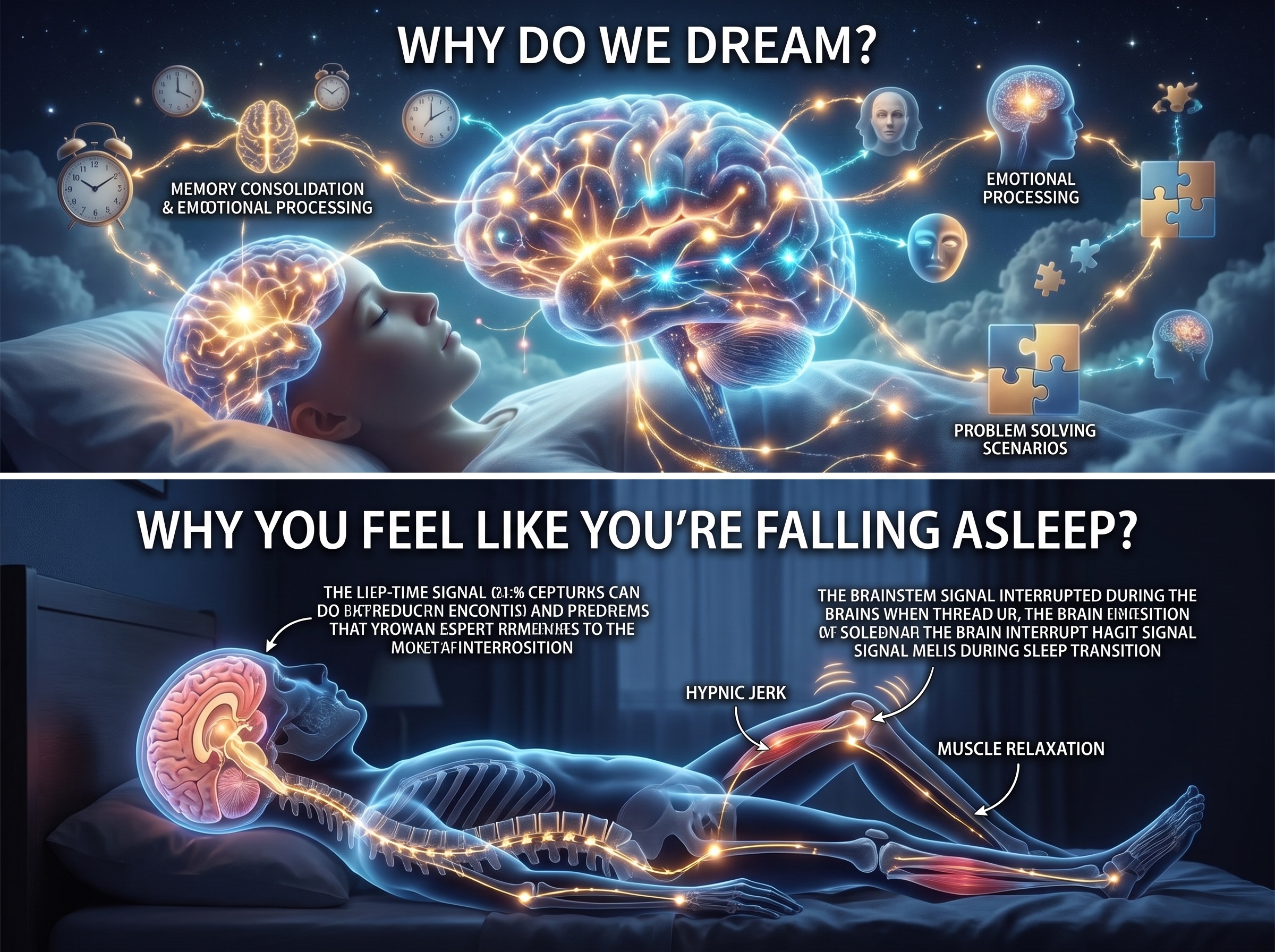
One of the best-supported ideas is that dreaming is tied to memory consolidation — the process by which your brain sorts through the day's experiences, strengthens the connections worth keeping, and discards the noise. This mostly happens during REM sleep (the stage most associated with vivid dreaming), when brain regions involved in memory and emotion, like the hippocampus and amygdala, become highly active, while activity in the prefrontal cortex — the region responsible for logic and self-control — actually decreases.
That drop in prefrontal activity is a big part of why dreams feel so weird. Your brain is running the same story-building, memory-linking machinery it uses while you're awake, just without your usual internal editor keeping things logical. Studies on learning and sleep have repeatedly found that people who sleep, and specifically get enough REM sleep, after learning a new skill or piece of information tend to retain it better than people who are kept awake, which lines up with dreaming being at least partly a side effect of the brain's overnight filing process.
Dreaming as a Rehearsal Space for Danger
A second major idea, called threat simulation theory, was proposed by Finnish cognitive neuroscientist Antti Revonsuo in the early 2000s. The theory holds that dreaming evolved as a kind of low-cost flight simulator — a way for our ancestors' brains to rehearse responses to dangerous situations (being chased, falling, confronted, lost) without any real-world risk. Consistent with this idea, research on dream content across cultures has found that threatening or anxiety-provoking events show up in dreams far more often than they occur in real waking life, and people who've experienced real trauma tend to dream about threat-related scenarios even more frequently. The theory has since been broadened by some researchers into a wider "social simulation" idea — that dreams rehearse not just physical danger, but the full range of emotionally significant situations we might need to handle, including social and relational ones.
Dreaming as Emotional Processing
A third well-supported explanation is that dreaming helps regulate emotion. Sleep researcher Rosalind Cartwright and others have found that dreaming, particularly REM dreaming, seems to help take the emotional edge off difficult memories overnight, essentially processing them so they sting less by morning. Brain imaging studies have shown that during REM sleep, the brain reactivates emotionally charged memories while stress-chemical (noradrenaline) levels drop to their lowest point of the whole day — a combination some researchers describe as letting the brain process the memory of an experience without re-triggering the full emotional intensity of it. This may explain why sleep deprivation hits emotional resilience so hard, and why dream content often circles back to unresolved stress or worry.
The Brain Trying to Make Sense of Its Own Noise
An older but still influential idea is the activation-synthesis hypothesis, proposed by Harvard researchers J. Allan Hobson and Robert McCarley in 1977. Their theory suggested that dreams start as essentially random electrical activity generated by the brainstem during REM sleep, and that the higher-thinking parts of your brain, faced with this flood of internal noise, do what they always do: try to construct a coherent narrative out of it. In this view, a dream isn't a message with hidden meaning — it's your cortex's best real-time attempt to make sense of static, which is part of why dream logic can be so disjointed and why dream plots often shift abruptly without you noticing anything's wrong until you wake up.
So Which Theory Is Right?
Probably some combination of all of them, applied differently depending on the night, the person, and even the specific sleep stage. Modern sleep researchers, including prominent voices like Matthew Walker and the team of Robert Stickgold and Antonio Zadra (whose 2021 book When Brains Dream is considered one of the more current syntheses of the field), tend to treat these theories as complementary rather than competing — memory consolidation, threat rehearsal, and emotional regulation could easily all be different angles on the same underlying overnight process. What's genuinely settled is that dreaming isn't random or purposeless noise your brain throws away; it's tightly linked to memory, learning, and emotional health. What's still open is exactly how much of dreaming is the mechanism itself doing useful work, versus a byproduct of other, more essential processes happening during sleep.
Why Does It Feel Like You're Falling as You Fall Asleep?
Now for the second mystery: that sudden jolt — sometimes just a leg or arm twitch, sometimes your whole body — paired with a vivid sensation of falling, that yanks you back from the edge of sleep. It has a name: a hypnic jerk (also called a sleep start or myoclonic jerk). Surveys suggest most people experience one occasionally, and it's considered a completely normal part of falling asleep, not a disorder.
What's Actually Happening in Your Body
As you drift from wakefulness into sleep, your body goes through a coordinated shutdown: your breathing slows, your heart rate drops, your muscles relax, and your brain shifts from the alert wave patterns of wakefulness into the slower patterns of early sleep. A hypnic jerk is essentially a glitch in that transition — for reasons not fully understood, the brainstem occasionally sends a sudden, unexpected burst of activity right in the middle of this power-down sequence, triggering a quick, involuntary muscle contraction, most often in the legs.
The falling sensation that frequently comes with it isn't a coincidence. Your inner ear's vestibular system, which manages your sense of balance and body position, is also in the process of powering down at exactly this moment. Some researchers believe that as your muscles suddenly relax during the sleep transition, your brain briefly misreads the change in body position and muscle tone as an actual fall, essentially firing off an emergency "catch yourself" response, similar to what happens if you genuinely trip. That's why it's a jerk-plus-a-story, rather than just a twitch — your brain reflexively constructs the sensation of falling to explain the sudden movement it just triggered.
An Evolutionary Leftover?
One popular hypothesis, though it remains speculative rather than firmly proven, suggests hypnic jerks might be an evolutionary holdover from our tree-dwelling primate ancestors. The idea is that as muscles relax during the transition into sleep, a brain evolved for sleeping in trees may have kept a built-in reflex that fires when it detects the loss of muscle tone associated with slipping off a branch, jerking the body upright before an actual fall could happen. It's an appealing story, and some sleep researchers find it plausible, but it's genuinely difficult to test directly, and not everyone in the field treats it as settled fact — it sits closer to "reasonable evolutionary hypothesis" than "proven mechanism."
What Makes Hypnic Jerks More Likely
Hypnic jerks themselves aren't dangerous and don't need treatment, but a few everyday factors make them noticeably more frequent:
Caffeine and stimulants late in the day can leave your nervous system more excitable right as you're trying to power it down. Sleep deprivation and irregular sleep schedules also seem to increase their frequency, possibly because an overtired brain transitions through sleep stages less smoothly. High stress, anxiety, and vigorous exercise too close to bedtime are commonly reported triggers as well. None of this means an occasional hypnic jerk signals a problem — but if they're happening constantly, disrupting sleep every night, or come with other symptoms like leg discomfort during the day, that's worth mentioning to a doctor, since a small number of cases are linked to separate conditions like restless legs syndrome rather than an ordinary hypnic jerk.
Frequently Asked Questions
Do animals dream too? Evidence strongly suggests at least some do. Studies on cats, rats, and other mammals have found REM-sleep brain activity patterns that closely mirror waking activity related to specific learned behaviors — famously, rats that ran a maze during the day showed hippocampal activity during subsequent REM sleep that matched the exact maze-running pattern, strongly suggesting a kind of replay. We obviously can't ask an animal what it experienced, but the underlying neural machinery for dreaming appears to be shared fairly widely among mammals.
Why don't I remember most of my dreams? Memory formation and REM sleep don't cooperate well. The brain chemical most needed for forming new long-term memories, noradrenaline, is at its lowest level during REM sleep, which is also when most vivid dreaming happens. Unless you wake up directly out of a dream, or soon after, the memory of it tends to fade within minutes, sometimes before you're even fully conscious.
Is it bad if I never remember dreaming at all? No — dream recall varies enormously between people and doesn't reflect whether you're actually dreaming. Nearly everyone cycles through REM sleep and dreams multiple times a night regardless of whether they remember any of it; recall mostly comes down to how and when you wake up relative to a REM period, along with individual differences in memory and personality traits.
Can you stop hypnic jerks from happening? Not entirely, since they appear to be a normal part of the sleep-onset process for most people, but reducing caffeine later in the day, keeping a consistent sleep schedule, managing stress, and avoiding late intense exercise can all make them less frequent.
Is falling in a dream connected to hypnic jerks? They're related but distinct phenomena. A hypnic jerk with a falling sensation typically happens right at sleep onset, before a full dream has developed, and wakes you up almost immediately. Falling dreams that occur later in a full REM dream cycle are a separate, very common dream theme, and some researchers connect their frequency back to threat simulation theory — falling being one of the most universally dangerous, and therefore most commonly rehearsed, scenarios in human dream content.
The Bottom Line
Neither of these nightly experiences is fully solved science, and that's part of what makes them interesting rather than settled trivia. Dreaming looks like it's doing real, useful work — sorting memories, rehearsing danger, processing emotion — even if researchers are still arguing about the exact division of labor between those functions. The falling jolt at the edge of sleep looks like a small, harmless miscommunication between a shutting-down brainstem and a not-quite-finished balance system, possibly with some very old evolutionary wiring behind it. Both are reminders that "asleep" isn't really an off switch. Your brain stays remarkably busy the entire time — it just stops telling you about most of it.
References
Hobson, J. A., & McCarley, R. W. (1977). The brain as a dream state generator: An activation-synthesis hypothesis of the dream process. American Journal of Psychiatry, 134(12), 1335–1348.
Revonsuo, A. (2000). The reinterpretation of dreams: An evolutionary hypothesis of the function of dreaming. Behavioral and Brain Sciences, 23(6), 877–901.
Stickgold, R., & Zadra, A. (2021). When Brains Dream: Exploring the Science and Mystery of Sleep. W. W. Norton & Company.
Walker, M. (2017). Why We Sleep: Unlocking the Power of Sleep and Dreams. Scribner.
National Institutes of Health (NCBI/PMC) — Investigation on Neurobiological Mechanisms of Dreaming in the New Decade
Sleep Foundation — Hypnic Jerk: Why You Twitch When You Sleep
Medical News Today — Hypnic jerk: Why you twitch before falling asleep
Forbes — Why Your Body Jerks Right Before You Fall Asleep — A Biologist Explains The 'Hypnic Jerk'
Cartwright, R. (2010). The Twenty-four Hour Mind: The Role of Sleep and Dreaming in Our Emotional Lives. Oxford University Press.
Harvard Medical School, Division of Sleep Medicine — Why Do We Sleep, Anyway?
Article last fact-checked: September 2026. Dream science and sleep-onset research are active fields — readers wanting the latest findings should check current publications from the cited researchers and institutions directly.