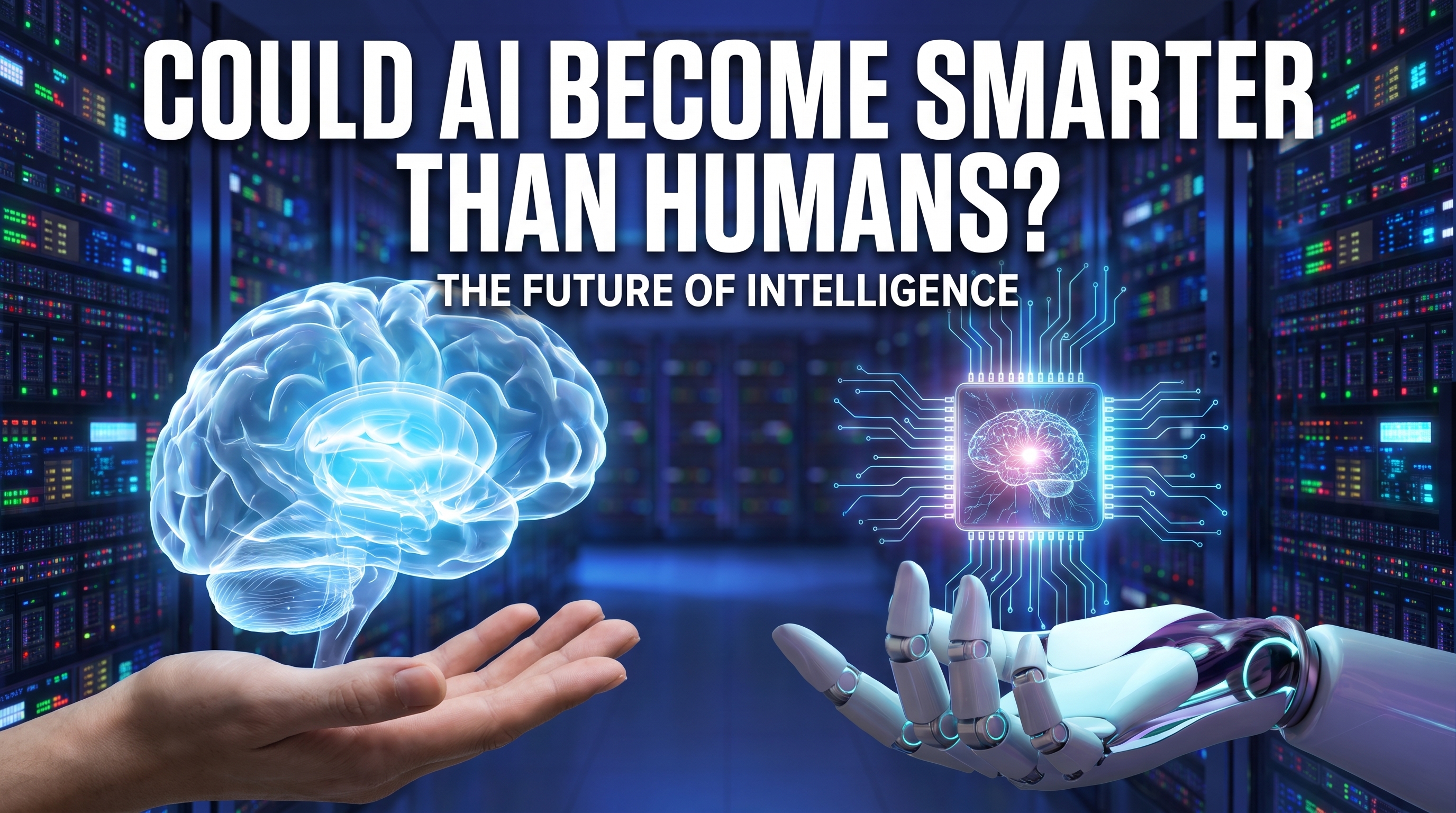
Ask ten of the world's leading AI researchers whether artificial intelligence could ever become smarter than humans, and you won't get ten similar answers wrapped in different words. You'll get genuinely opposed camps, some of them led by people who've won Nobel Prizes and Turing Awards for building the very systems they now disagree about. One camp believes we're on a fast, mostly clear path toward machines that outthink us across the board, possibly within years. Another believes today's dominant approach is fundamentally missing something and could hit a wall well short of that goal. A third isn't confident about the timeline at all, but argues the stakes are high enough that we should prepare seriously regardless of which camp turns out to be right. This isn't a settled scientific question with one correct answer waiting to be looked up — it's a live, genuinely contested debate, and understanding it means understanding all three positions, not just the loudest one.
First, What Would "Smarter Than Humans" Even Mean?
Before wading into the debate, it's worth being precise about terms, because a lot of the disagreement quietly hinges on definitions rather than facts.
Narrow AI refers to systems that outperform humans at one specific, well-defined task — and this isn't speculative at all, it's already been true for decades in an expanding list of domains. Chess engines have outplayed the best human grandmasters since IBM's Deep Blue defeated Garry Kasparov in 1997. Google DeepMind's AlphaFold can predict how proteins fold into their three-dimensional shapes with an accuracy that took structural biologists years of laboratory work to match by hand, a breakthrough that earned its creators a share of the 2024 Nobel Prize in Chemistry. Modern AI systems can outperform humans on many benchmark exams, image recognition tasks, and increasingly, on competitive programming and mathematics problems. None of this is controversial — it's already happened, repeatedly, in an ever-growing list of narrow domains.
Artificial General Intelligence (AGI) refers to something categorically different: a system with the broad, flexible, transferable intelligence of a human, able to learn and reason across essentially any domain the way a person can, rather than excelling narrowly at whatever it was specifically trained for. Artificial Superintelligence (ASI) goes further still, describing a hypothetical system that doesn't just match general human intelligence but substantially exceeds it across the board. Neither AGI nor ASI currently exists by most rigorous definitions, and that's precisely where the real disagreement lives — not over whether narrow superhuman AI is real (it obviously is), but over whether, when, and how the current approach to AI actually gets us to the general, human-like version, let alone beyond it.
The Case for "Yes, and Soon": The Scaling Believers
One influential camp in the AI field, including leadership at several of the largest AI labs, argues that the path to increasingly general, increasingly capable AI is already visible and underway, built on a pattern researchers call scaling laws: consistent, measurable improvements in AI capability that have followed from training larger models on more data with more computing power, again and again, across the past several years. This camp points to genuinely rapid, concrete progress: newer "reasoning" models that work through multi-step problems methodically rather than just pattern-matching an instant answer, AI agents that can carry out longer, multi-step tasks with real tool use and comparatively less human hand-holding, and steadily rising performance on increasingly difficult scientific, mathematical, and coding benchmarks that were considered serious challenges just a couple of years ago. To this camp, the trend line itself is the evidence — capability has climbed steadily and, in their view, shows no clear sign of stopping, and forecasting surveys have shown some experts and professional forecasters shortening their predicted AGI timelines over the past few years as this progress has continued.
The Case for "Not So Fast": The Skeptics
A second camp, including some of the very researchers who helped build the foundations of modern AI, argues that today's dominant approach — large language models trained primarily on text — is missing something essential that scaling alone won't fix. The most prominent recent example: Yann LeCun, one of the founding figures of deep learning and a Turing Award winner, left his long-standing position leading Meta's AI research in late 2025 specifically to pursue a different architecture he calls "world models," raising over a billion dollars in funding for a new venture built around the bet that pure large language models are, in his own characterization, close to a dead end for reaching genuine general intelligence. His core argument is that language models learn to predict text convincingly without necessarily building the kind of grounded, physical, cause-and-effect understanding of the world that even young children and animals develop naturally through direct experience — and that without that kind of grounded world-model, no amount of additional scaling fully closes the gap to general intelligence. Skeptics in this camp also point to persistent, stubborn weaknesses in even the most advanced current systems: they still make confident factual errors (commonly called hallucinations), still struggle with genuinely novel problems well outside their training patterns, and still show inconsistent performance on tasks requiring reliable long-horizon planning and real-world common sense — the kind of everyday practical judgment a young child manages effortlessly and today's most advanced AI systems often don't.
The Case for "We Don't Know, So Prepare Anyway": The Safety-Focused Camp
A third position, held by a range of researchers including Geoffrey Hinton, another founding figure of deep learning who left Google in 2023 specifically to speak more freely about AI risk, and 2018 Turing Award winner Yoshua Bengio, doesn't stake a confident claim on exactly when or whether AGI or superintelligence will arrive. Instead, this camp argues that given genuine, serious disagreement among top experts about the timeline, and given how high the stakes would be if powerful, general AI did arrive faster than society is prepared for, it's rational to invest heavily in safety and alignment research now rather than waiting for consensus that may never fully arrive before the technology does. This isn't necessarily a prediction that superintelligence is imminent — it's closer to an argument about decision-making under genuine uncertainty, similar in structure to buying insurance against a serious risk you can't precisely quantify but also can't responsibly ignore. Notably, this camp includes people who hold quite different personal views on timelines and even on how current systems work, united mainly by the shared judgment that the uncertainty itself, combined with the scale of what's at stake, justifies serious preparation.
What Surveys of the Field Actually Show
It's tempting to just ask "what do most experts think" and treat that as the answer, but the honest picture is messier than a single number. Surveys of AI researchers and professional forecasters have generally found wide, persistent disagreement rather than convergence — some individual predictions for when AGI-level systems might arrive cluster within the next decade, others extend many decades further out, and the range between optimistic and skeptical experts remains large even as specific benchmark capabilities keep improving. One notable pattern that's been reported: executives and leaders at some of the largest AI companies have, on average, expressed more confident, nearer-term timelines than the broader population of AI researchers and independent forecasters surveyed separately, a gap worth being aware of given that company leaders also have a direct commercial interest in generating excitement about their own products' trajectory. None of this means either group is simply right or wrong — it means the honest state of expert opinion is a genuine spread, not a hidden consensus that one side is failing to admit.
What's Actually Changed Recently, and What Hasn't
Stepping back from the competing predictions, a few things are reasonably well established. AI capability in specific, measurable domains has continued to improve rapidly and concretely in the past couple of years — newer reasoning-focused models, better tool use, and expanding real-world deployment in coding, scientific research assistance, and complex analysis are genuine, verifiable developments, not hype. At the same time, some challenges have proven surprisingly persistent across model generations: reliable common-sense reasoning about the physical world, consistent truthfulness without fabricated details, and robust performance on genuinely novel problems that don't resemble anything in a model's training data all remain active, unsolved research challenges as of 2026, even in the most advanced systems available. Whether those remaining gaps represent a fundamental architectural limitation, as skeptics like LeCun argue, or simply the next set of problems that scaling and better techniques will progressively close, as the more bullish camp argues, is exactly the part nobody has definitively settled yet.
Why the Question Matters Even Without a Settled Answer
Regardless of which camp eventually turns out to be closer to right, the debate itself already has real, practical consequences today. It shapes how much money and talent flows into different research directions, including LeCun's own decision to bet a large venture on an alternative architecture rather than the dominant approach. It shapes government and international policy conversations about AI regulation, safety testing, and preparedness, most of which are being designed under genuine uncertainty about timelines rather than settled predictions. And it shapes labor market and economic planning, since even AI systems that never reach full general intelligence are already reshaping specific industries and job categories through their narrow, superhuman capabilities in areas like coding, writing, and data analysis. In that sense, "could AI become smarter than humans" isn't only a question about a possible future — it's already an active force shaping decisions being made right now, under exactly the kind of uncertainty this whole debate reflects.
Frequently Asked Questions
Is today's AI already smarter than humans? In specific, narrow domains, often yes — AI has outperformed humans at chess, certain scientific prediction tasks, and a growing range of benchmark exams for years now. In the broad, general, flexible sense most people mean when they ask this question — matching or exceeding overall human intelligence and judgment across essentially any domain — no current AI system meets that bar, and whether or when one will is exactly what the experts described above disagree about.
Do the researchers who disagree about this actually understand the technology equally well? Yes — this isn't a case of informed experts versus uninformed skeptics on either side. People like Geoffrey Hinton, Yoshua Bengio, and Yann LeCun are among the most credentialed, foundational figures in the entire field of deep learning, and their disagreement reflects genuinely different technical judgments and interpretations of the same underlying evidence, not a knowledge gap on either side.
Why do AI company leaders seem more confident than independent researchers? Multiple factors likely contribute, and it's genuinely hard to cleanly separate them: company leaders often have the most direct, hands-on visibility into their own latest unreleased systems, which could make their confidence better-informed in some respects — but they also have a clear commercial incentive to project confidence and excitement about their products' future trajectory, which independent academic researchers and forecasters generally don't share to the same degree. Reasonable people weigh these competing explanations differently.
Could AI become dangerous even without reaching full general intelligence? Yes, and this is a point of much broader agreement across the different camps than the AGI timeline question itself — narrow AI systems already raise real, present-day concerns around misinformation, security vulnerabilities, job displacement in specific sectors, and reliability failures in high-stakes applications, all of which are active concerns regardless of whether or when broader general intelligence ever arrives.
Is there a way to know for certain who's right? Not currently, and that's really the core of the debate rather than a gap in it — this is a forward-looking technical and scientific question about a technology still under active development, not a settled matter with a hidden correct answer that one side is simply overlooking. The most intellectually honest position, held to varying degrees by researchers across all three camps described above, is that meaningful uncertainty is the accurate state of current knowledge, not a cop-out from taking a position.
The Bottom Line
Nobody credible is claiming to know for certain whether or when AI will become smarter than humans in the full, general sense — what genuinely divides the field's leading researchers is how much weight to put on the trend lines we already have, whether the current dominant architecture has a fundamental ceiling or just more scaling ahead of it, and how much to prepare for a possibility that remains genuinely uncertain rather than either imminent or dismissible. That's not a satisfying, clean answer, but it's the honest one — and given that the people disagreeing most sharply are the ones who built the field in the first place, a healthy dose of humility about this question is probably more accurate than confidence in either direction.
References
Gizmodo — Big Tech Says Superintelligent AI Is in Sight. The Average Expert Disagrees
Forecasting Research Institute — Experts and Superforecasters Update Their AI Timelines
WebProNews — Yann LeCun Leaves Meta to Launch AMI Labs, Critiques LLM Hype
Crypto Briefing — Yann LeCun Says Large Language Models Are a Dead End, Gives Them Five Years
The Nobel Prize — The Nobel Prize in Chemistry 2024 (AlphaFold, Demis Hassabis and John Jumper)
The Nobel Prize — The Nobel Prize in Physics 2024 (Geoffrey Hinton and John Hopfield)
Effective Altruism Forum — Survey of AI Safety Leaders on X-Risk, AGI Timelines, and Related Questions
AIMultiple — AGI/Singularity: 10,000 Predictions Analyzed
Association for Computing Machinery — A.M. Turing Award citations for Geoffrey Hinton, Yoshua Bengio, and Yann LeCun (2018).
Stanford Institute for Human-Centered AI — AI Index Report, capability benchmark trends.
Article last fact-checked: September 2026. This is a fast-moving, genuinely contested area of both technology and expert opinion — readers wanting the latest developments and viewpoints should follow current reporting and primary statements from the researchers and organizations named above.