Quantum computers get talked about like they're magic supercomputers about to make every other computer obsolete. That's not quite right, and the truth is more interesting anyway. A quantum computer isn't a faster version of your laptop — it's a fundamentally different kind of machine, built on rules of physics that don't apply to anything you interact with in daily life, useful for a specific, narrow class of problems rather than everything, and still, as of 2026, very much under construction. Here's what one actually is, how it works, and where the real progress has actually happened.
The Basic Building Block: Bits vs. Qubits
Every computer you've ever used — phone, laptop, server — stores and processes information as bits, and a bit can only ever be one of two values: 0 or 1. All of modern computing, no matter how sophisticated it looks, ultimately comes down to enormous numbers of these simple on/off switches.
A quantum computer uses a different unit of information called a qubit (quantum bit). Like a regular bit, a qubit can be measured as a 0 or a 1. But until it's actually measured, a qubit can exist in a state that's a mix of both 0 and 1 at once, a phenomenon called superposition. This isn't a metaphor for "we don't know which one it is yet" the way an unflipped, hidden coin is either heads or tails, we just haven't looked — superposition is a genuinely different physical state, mathematically described as a combination of both possibilities simultaneously, and quantum mechanics has been tested repeatedly enough that this isn't seriously in scientific dispute.
Superposition: More Than Just "Being Two Things at Once"
The common shorthand you'll see everywhere is that superposition lets a quantum computer "try every possible answer at the same time." It's an appealing idea, but it's also a common misconception that overstates what's actually going on, and it's worth getting the more accurate picture, because the real mechanism is arguably more interesting.
A group of qubits in superposition really does represent a combination of an enormous number of possible states simultaneously — a mere 50 qubits can represent a superposition spanning over a quadrillion (10^15) combinations at once. But you can't just peek in and read out "the answer" from that superposition; the moment you measure a qubit, it randomly collapses to a single 0 or 1, and any information encoded in the rest of the superposition can be lost.
The actual trick of quantum computing is something called quantum interference. A quantum algorithm is carefully designed so that the different possibilities within a superposition interfere with each other, the way overlapping ripples in water can either reinforce or cancel each other out. A well-designed quantum algorithm steers the "wrong answer" possibilities to interfere destructively and cancel each other out, while steering the "right answer" possibilities to interfere constructively and reinforce each other. When you finally measure the system, you're much more likely to read out the correct answer than a wrong one. It's less like trying every door at once and more like engineering the hallway so that all the wrong doors quietly shut themselves while the right one swings open. This is also exactly why quantum computers aren't simply faster at everything — the interference trick only works for specific problems where mathematicians have actually figured out how to structure the wrong answers so they cancel out, and for most everyday computing tasks, nobody has found such an algorithm, so a classical computer remains the better tool.
Entanglement: Correlated Qubits
The second essential quantum phenomenon is entanglement, a special connection between qubits where the state of one becomes linked to the state of another, no matter the distance between them. When two qubits are entangled, measuring one instantly tells you something certain about the other — if an entangled pair is set up so that measuring one always gives the opposite result of the other, then measuring one as a 0 guarantees the other will be a 1, every single time, even though before measurement, neither qubit had a definite value at all.
Einstein famously and skeptically called this "spooky action at a distance," and for decades some physicists suspected there might be a simpler, more conventional explanation hiding underneath it — some kind of shared, predetermined information the particles were secretly carrying all along. That possibility has since been experimentally ruled out, repeatedly, through a category of experiments called Bell tests; the 2022 Nobel Prize in Physics was awarded to Alain Aspect, John Clauser, and Anton Zeilinger specifically for experiments demonstrating that entanglement is real and can't be explained by any such hidden, pre-agreed information. Entanglement lets quantum computers create correlations between qubits that have no classical equivalent, and it's an essential ingredient, alongside superposition and interference, in how quantum algorithms gain their advantage over classical ones for the specific problems where they work.
Why Building One Is So Brutally Hard
If superposition and entanglement are the useful ingredients, decoherence is the enemy standing in the way of using them. Qubits are extraordinarily fragile — the delicate quantum state they depend on can be disrupted by the tiniest interference from the outside world: stray heat, vibration, electromagnetic noise, even cosmic rays passing through the hardware. When that happens, a qubit "decoheres," collapsing out of its useful quantum state and effectively becoming useless mid-calculation, introducing an error into the computation.
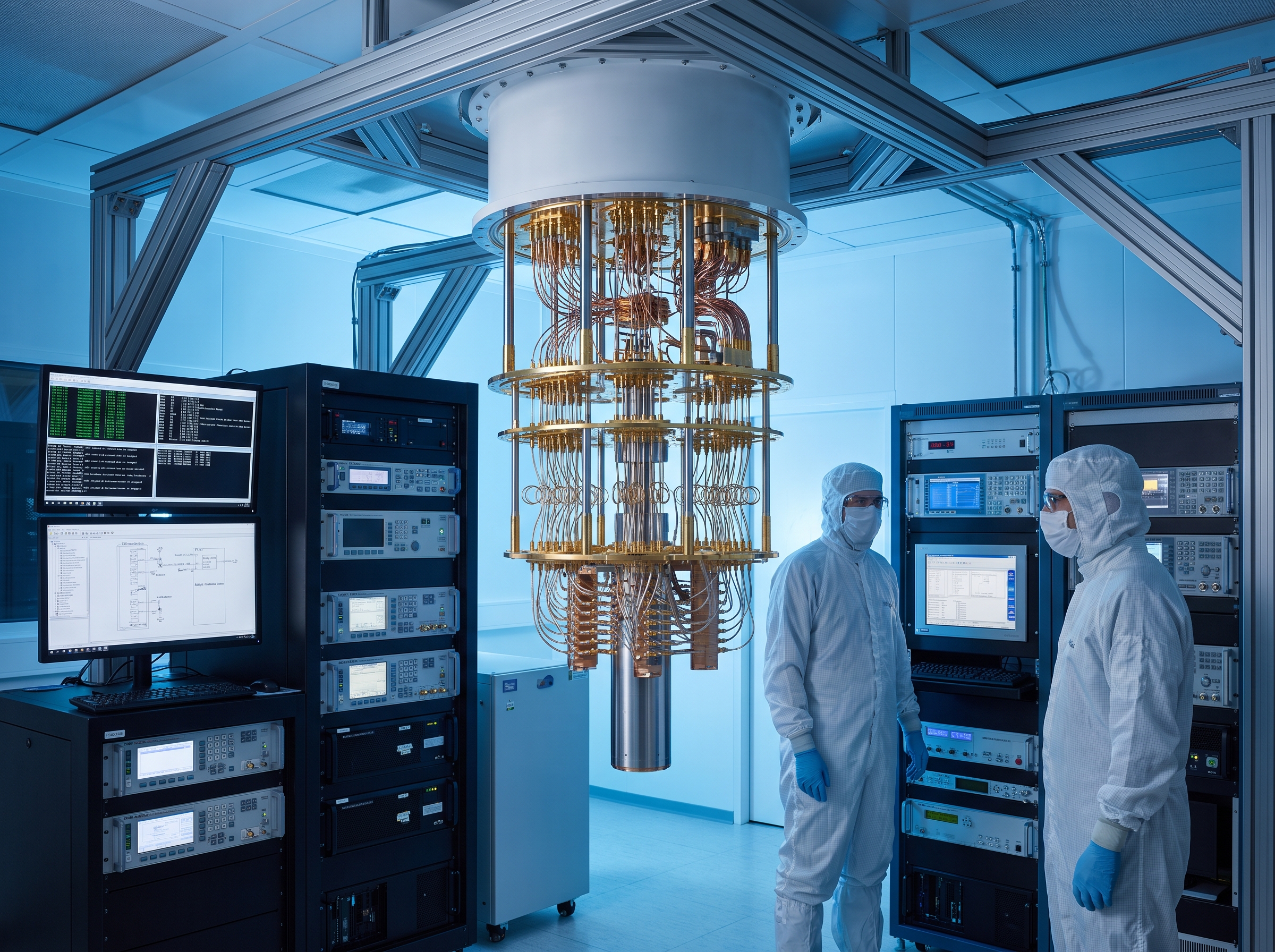
This is why quantum computers, despite doing genuinely subatomic-scale physics, tend to be enormous, elaborate machines: superconducting qubits (the approach used by Google and IBM) need to be cooled to temperatures colder than deep space, just above absolute zero, inside refrigerator units that look like enormous gold chandeliers, specifically to minimize the thermal noise that would otherwise scramble the qubits. Other approaches try to sidestep some of these problems differently: trapped-ion qubits (used by companies like IonQ and Quantinuum) hold individual charged atoms in place using electromagnetic fields and manipulate them with lasers, generally achieving lower error rates at the cost of being slower to operate; photonic approaches (like PsiQuantum's) encode qubits in particles of light, which don't need extreme cooling but are hard to store and manipulate reliably; and Microsoft has been pursuing a more speculative approach called topological qubits, designed to be inherently more resistant to noise by encoding information in an exotic physical property rather than a fragile quantum state directly — though Microsoft's 2025 claims of a working topological qubit chip, called Majorana 1, drew real skepticism from parts of the physics community, partly because an earlier, related claim from Microsoft-funded research had to be retracted in 2021 after other scientists couldn't verify it. It's a genuinely contested area where the company's claims are ahead of the field's full independent confirmation.
Quantum Error Correction: The Real Bottleneck, and Real Recent Progress
Because individual qubits are so error-prone, a useful quantum computer can't just rely on raw, uncorrected qubits, called physical qubits. Instead, the field has worked for years toward a technique called quantum error correction, where many imperfect physical qubits are combined and cross-checked against each other to form a single, much more reliable logical qubit — conceptually similar to how you might repeat an important message multiple times over a noisy phone line so the listener can figure out the correct version even if parts get garbled.
The trouble is that for a long time, adding more physical qubits to build a more reliable logical qubit actually introduced more total opportunities for error, not fewer — a losing trade that made scaling up seem impractical. That changed with a genuinely significant milestone: in December 2024, Google's Quantum AI team announced their new Willow chip had crossed what's called the error correction "below threshold" point — meaning that for the first time, adding more physical qubits to a logical qubit made the overall error rate go down exponentially, rather than up. That's the mathematical condition researchers have been chasing for decades, because it means scaling up the hardware, rather than just adding more sources of noise, is now expected to make the system reliably more capable, which is the entire premise fault-tolerant, large-scale quantum computing depends on.
Google separately reported that Willow performed a specific, narrowly defined benchmark computation (called random circuit sampling) in under five minutes, claiming it would take one of today's fastest classical supercomputers an estimated 10 septillion years to replicate. It's worth being precise about what that kind of claim does and doesn't mean: random circuit sampling is a benchmark specifically chosen because it's hard for classical computers and doesn't require solving a real-world useful problem, and history in this exact field (going back to Google's original 2019 "quantum supremacy" claim with its earlier Sycamore chip) has shown that classical algorithms sometimes get cleverer over time and close gaps that once looked insurmountable. The error correction milestone is the more broadly significant part of the Willow announcement; the speed comparison headline is real but narrower than it might sound.
What Quantum Computers Are Actually Good For (and Not)
Given all this, it's worth being direct about where quantum computing is expected to actually matter, because it's genuinely not "replacing regular computers."
Quantum computers show real promise for simulating molecules and chemical reactions, since molecules themselves behave according to quantum mechanics — meaning a quantum computer can, in principle, model them far more naturally and efficiently than a classical computer forcing quantum behavior through approximation. This has real potential for drug discovery, new battery chemistries, and materials science. They also show promise for certain classes of complex optimization problems — like finding efficient routes across huge logistics networks or optimizing financial portfolios — though for many such problems, it's still an open question how large a practical advantage quantum approaches will ultimately provide over the best classical algorithms and specialized classical hardware. And they pose a specific, serious threat to a category of encryption: a mathematician named Peter Shor showed back in 1994 that a sufficiently large, fully error-corrected quantum computer could run an algorithm (now called Shor's algorithm) capable of breaking the mathematical problem underlying RSA encryption and similar systems that a huge amount of today's internet security depends on, in a fraction of the time a classical computer would need.
What quantum computers are not expected to do is replace ordinary computers for everyday tasks like browsing the web, running spreadsheets, or gaming — for the vast majority of computing tasks, classical computers remain faster, cheaper, and more practical, and that's expected to remain true indefinitely, not just until quantum computers "catch up."
We're Still in the Early, In-Between Era
Researchers describe the current period as the NISQ era — Noisy Intermediate-Scale Quantum computing — meaning today's quantum computers have enough qubits to be interesting and useful for research, but not yet enough reliable, fully error-corrected logical qubits to run the large, deep, genuinely game-changing algorithms (like a full-scale Shor's algorithm attack on real-world encryption) that the field is ultimately aiming for. IBM's public roadmap has targeted reaching a genuine, practically useful "quantum advantage" — a real-world problem solved meaningfully better than any classical alternative — around 2026, with a longer-term goal of large-scale, fully fault-tolerant systems (its planned Starling system) later in the decade. Different companies and research groups offer different timelines, and predictions in this field have a track record of slipping, so it's reasonable to treat specific target years as informed estimates rather than certainties.
Why Governments and Companies Are Already Preparing
Even though a quantum computer capable of actually breaking modern encryption doesn't exist yet, the security world isn't waiting for one to show up before acting, because of a specific risk sometimes called "harvest now, decrypt later" — the concern that adversaries could be quietly collecting encrypted data today, betting that they'll be able to decrypt it once sufficiently powerful quantum computers exist years from now. This is exactly why the U.S. National Institute of Standards and Technology (NIST) finalized its first set of standardized post-quantum cryptography algorithms in 2024, and why governments, banks, and major tech companies have been actively working through 2025 and 2026 to migrate critical systems to these new, quantum-resistant encryption standards well ahead of whenever a cryptographically relevant quantum computer — sometimes informally called "Q-Day" — actually arrives.
Frequently Asked Questions
Will quantum computers replace regular computers? No, and that's not really the goal. Quantum computers are expected to remain specialized machines for specific problem types — chemistry simulation, certain optimization problems, cryptography — working alongside classical computers rather than replacing them for general everyday computing.
Can I use a quantum computer today? In a limited sense, yes — several companies, including IBM, offer cloud access to real quantum hardware for researchers, students, and developers to experiment with, though today's machines are still in the noisy, error-limited NISQ era rather than offering the large-scale, fault-tolerant power the field is ultimately working toward.
Is my encrypted data at risk right now from quantum computers? Not from an existing quantum computer today — no machine currently in operation is powerful or reliable enough to break modern encryption standards like RSA. The real, present-tense risk is the "harvest now, decrypt later" scenario, where currently encrypted data could be exposed years down the line, which is exactly why the shift to post-quantum cryptography standards is already underway rather than something being left until a capable quantum computer actually exists.
What's the difference between quantum computing and quantum annealing? They're related but distinct approaches. What's typically meant by "quantum computer" in most of this article, and in most research toward Shor's algorithm-style breakthroughs, is a gate-based, universal quantum computer, capable in principle of running any quantum algorithm. Quantum annealing, the approach used by companies like D-Wave, is a more specialized technique specifically designed for solving certain optimization problems, and it isn't considered a universal quantum computer capable of the same broad range of algorithms.
How many qubits does a quantum computer need to actually break encryption? Current estimates suggest breaking widely used RSA encryption would require on the order of many thousands to millions of high-quality, fully error-corrected logical qubits, depending on the specific encryption key size and algorithm efficiency — a substantially larger and more reliable machine than anything that exists today, which is a big part of why researchers generally don't expect this capability for at least several more years, even under optimistic timelines.
The Bottom Line
A quantum computer isn't a faster laptop — it's a fundamentally different kind of machine that uses superposition, entanglement, and carefully engineered interference to tackle a narrow but genuinely important set of problems that classical computers handle poorly. The field has moved from purely theoretical physics to real, working hardware clearing real technical milestones, especially Google's below-threshold error correction result in 2024 — the first solid evidence that scaling this technology up will make it more reliable rather than less. But the honest, current picture is still one of impressive, hard-won progress rather than a finished revolution: we're in the noisy middle chapter of this story, not the ending, and the organizations paying closest attention are the ones already preparing for what comes after, rather than waiting for the headline that says it's arrived.
References
Shor, P. W. (1994). Algorithms for Quantum Computation: Discrete Logarithms and Factoring. Proceedings of the 35th Annual Symposium on Foundations of Computer Science.
Google Quantum AI — Meet Willow, Our State-of-the-Art Quantum Chip
Nature — Quantum error correction below the surface code threshold, Google Quantum AI (2024).
The Nobel Prize — The Nobel Prize in Physics 2022: Aspect, Clauser, Zeilinger
National Institute of Standards and Technology (NIST) — NIST Releases First 3 Finalized Post-Quantum Encryption Standards
IBM Quantum — IBM Quantum Roadmap
Microsoft — Microsoft's Majorana 1 Chip Carves New Path for Quantum Computing
MIT Technology Review — Building a Practical Path to Post-Quantum Cryptography
Arute, F., et al. (2019). Quantum Supremacy Using a Programmable Superconducting Processor. Nature, 574, 505–510.
Article last fact-checked: September 2026. Quantum computing is a fast-moving field with frequent, sometimes contested claims — readers wanting the latest verified milestones should check current peer-reviewed publications and major labs' technical announcements directly.