There's something almost magical-sounding about a solar panel: sunlight hits a flat piece of glass on your roof, and somehow your refrigerator runs. No moving parts, no fuel, no combustion. It's easy to either wave it off as unexplainable tech-magic or assume it's too complicated to bother understanding. It's neither. The actual mechanism is genuinely elegant, and once you see the pieces, the whole thing clicks into place. Here's exactly what's happening, from the sunlight hitting the glass to the electricity reaching your outlet.
The Short Version First
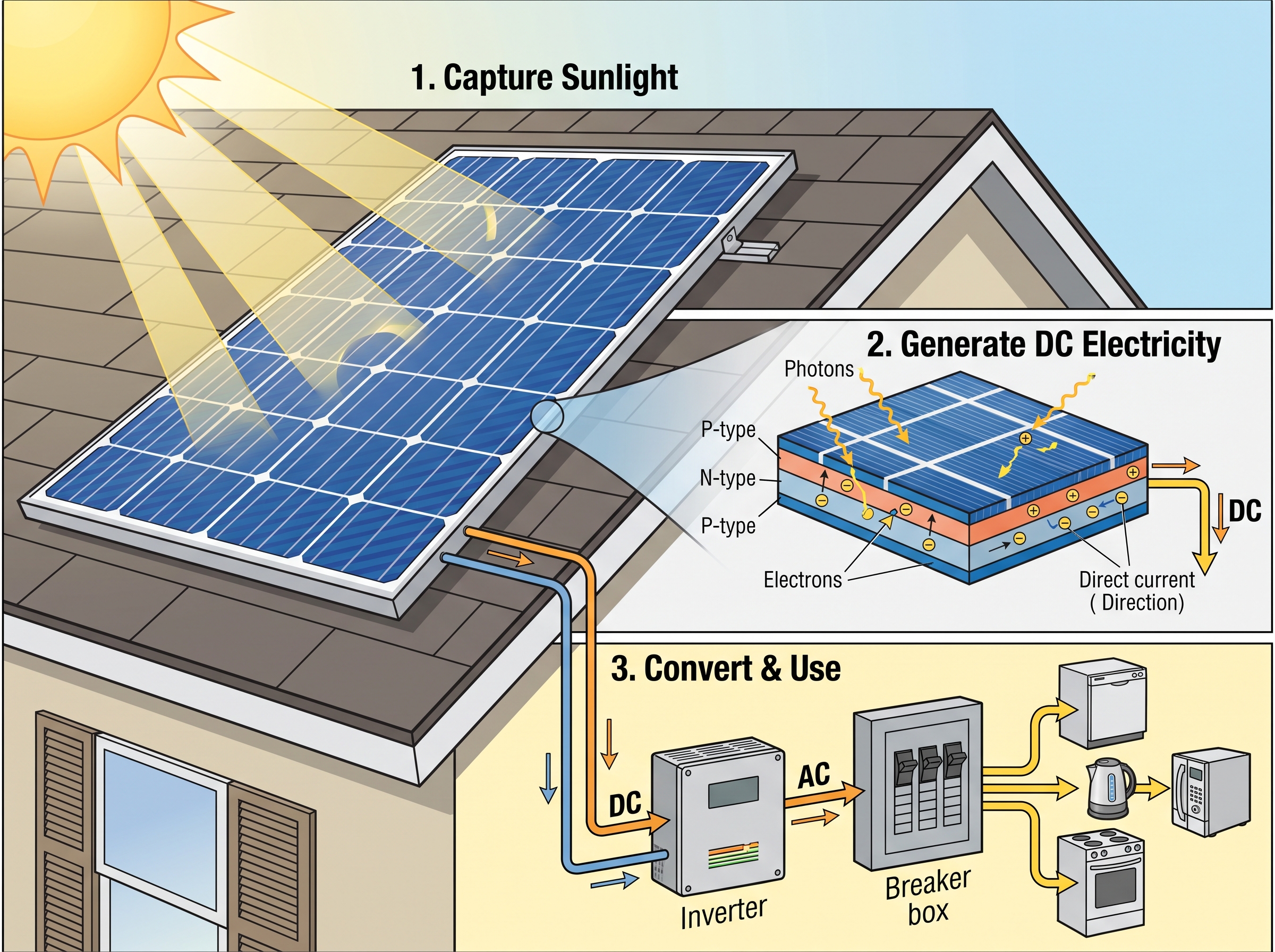
A solar panel converts sunlight directly into electricity using a phenomenon called the photovoltaic effect. Photons from sunlight strike a specially engineered layer of silicon and knock electrons loose from their atoms. A built-in electric field inside the silicon then pushes those loose electrons in one direction, creating a flow of electricity — the same thing that happens in any electrical circuit, just powered by light instead of a battery or generator. That's the whole idea in one sentence. Now let's actually unpack it, because the details are what make it interesting.
It Starts With a Very Old Discovery
The underlying physics isn't new. French physicist Edmond Becquerel first observed the photovoltaic effect back in 1839, as a teenager working in his father's lab, when he noticed that certain materials produced a small electric current when exposed to light. For over a century it stayed a scientific curiosity with no practical use. That changed in 1954, when three researchers at Bell Labs — Daryl Chapin, Calvin Fuller, and Gerald Pearson — built the first practical silicon solar cell, converting about 6% of sunlight into usable electricity. It was a breakthrough, but solar cells remained expensive and niche for decades afterward, mostly reserved for satellites and space missions where cost barely mattered. The version on your roof today traces directly back to that 1954 cell, just enormously refined.
The Real Engine: What's Happening Inside the Silicon
This is the part worth actually understanding, because it explains everything else about how panels are built and why they're designed the way they are.
Step 1: Two Layers of Engineered Silicon
Ordinary silicon, on its own, is a poor conductor — that's actually the point, since it's classified as a semiconductor, meaning its conductivity can be precisely controlled. To make a solar cell, manufacturers take silicon and deliberately contaminate it with tiny amounts of other elements, a process called doping.
The top layer gets doped with phosphorus, which has one more electron than silicon does. Those extra electrons aren't tightly bound, so this layer ends up with loose, mobile negative charge carriers — it's called n-type silicon (n for negative).
The bottom layer gets doped with boron, which has one fewer electron than silicon. That creates "holes" — missing-electron spots that behave like mobile positive charge carriers. This layer is called p-type silicon (p for positive).
Step 2: Where They Meet, an Electric Field Forms
Where the n-type and p-type layers touch, something automatically happens: electrons from the n-side drift across and fill some of the holes on the p-side, right near the boundary. This creates a region called the p-n junction, and importantly, it leaves behind a permanent, built-in electric field right at that junction — because the n-side near the boundary is now slightly positively charged (having lost electrons) and the p-side is slightly negatively charged (having gained them). This tiny, fixed electric field is the engine of the whole device. It's already there, wired into the material itself, before any sunlight ever hits it.
Step 3: Sunlight Knocks Electrons Loose
Sunlight is made of photons — discrete packets of light energy. When a photon with enough energy strikes the silicon, it can knock an electron loose from its atom, leaving behind a hole where it used to be. This is the photovoltaic effect in action: light energy converting directly into a free electron and a free hole, a pair of mobile charge carriers that didn't exist a moment before.
Step 4: The Built-In Field Sorts the Traffic
Left alone, that freed electron and hole would just wander randomly and eventually recombine, releasing their energy as heat and accomplishing nothing useful. But if this happens near the p-n junction, the built-in electric field steps in and sweeps the electron toward the n-side and the hole toward the p-side — sorting the traffic, so to speak. Do this to billions of photons per second across the surface of a panel, and you get a steady, one-directional buildup of electrons on one side and holes on the other. That separation of charge is, by definition, voltage.
Step 5: Metal Contacts Complete the Circuit
Thin metal strips (you can see them as the fine grid lines on a solar cell's surface) collect the accumulated electrons from the top layer. When those contacts are connected through an external circuit — wires, an inverter, eventually your home's electrical system — the electrons flow through that circuit to get back to the p-side and recombine with the holes waiting there, and that flow of electrons through the circuit is exactly what electric current is. As long as light keeps hitting the cell, the process resets continuously, producing a steady direct current (DC).
From a Single Cell to the Panel on Your Roof
A single silicon solar cell only produces about 0.5 to 0.6 volts — nowhere near enough to be useful on its own. So manufacturers wire many individual cells together in series (positive to negative, like batteries stacked end to end) to build up voltage, and often in parallel groups as well to build up current. A standard residential solar panel today typically contains 60 to 72 cells wired this way, together producing somewhere around 300 to 450 watts under ideal sunlight, depending on the panel's size and technology.
Multiple panels are then wired together into what's called an array, mounted on a frame on your roof or on ground-mounted racking, all feeding their combined DC output toward the next piece of essential hardware: the inverter.
Why You Need an Inverter (and What It Actually Does)
Solar panels produce direct current (DC) electricity — power that flows in one constant direction, the same type a battery produces. The problem is that homes, and the electrical grid itself, run on alternating current (AC), where the direction of flow rapidly switches back and forth (60 times per second in the US, 50 in most of the rest of the world). Nearly everything you own, from your refrigerator to your phone charger, is built to run on AC power drawn from a wall outlet.
That's the inverter's job: it takes the DC electricity coming from the panels and electronically converts it into clean, grid-compatible AC electricity. There are two common approaches. A string inverter is a single, larger unit that takes the combined DC output from an entire "string" of panels wired together and converts it all at once — cheaper, but if one panel is shaded or underperforming, it can drag down the output of the whole string. Microinverters, by contrast, are small units attached to each individual panel, converting DC to AC right at the source — more expensive per panel, but each panel then operates independently, so shading or a fault on one panel doesn't affect the others.
Once converted to AC, the electricity flows into your home's electrical panel just like grid power would, running your appliances directly. If your system produces more than you're using at that moment, the surplus typically flows back out onto the utility grid, often earning you a credit through a program called net metering, depending on your utility and location. Add a home battery to the system, and instead of (or in addition to) sending surplus power to the grid, you can store it for use after dark.
Not All Solar Panels Are the Same
Walk through the different panel types available today and you're really looking at different trade-offs between efficiency, cost, and appearance.
Monocrystalline panels are cut from a single, continuous crystal of silicon, giving electrons a very uniform, obstruction-free path to travel — which is why they're the most efficient mainstream option, with commercial panels typically in the 20–22% efficiency range. They have a distinctive uniform black appearance and are the most common choice for residential rooftops today, though they're also generally the most expensive per panel.
Polycrystalline panels are made by melting together multiple silicon fragments rather than growing one clean crystal, which is cheaper to manufacture but leaves more internal boundaries for electrons to get lost at, bringing typical efficiency down to roughly 15–17%. They have a recognizable blue, speckled look.
Thin-film panels skip crystalline silicon wafers entirely, instead depositing a very thin layer of light-absorbing material (commonly cadmium telluride, or CIGS — copper indium gallium selenide) onto a backing. They're lightweight, flexible, and cheaper to produce, with efficiency typically in the 10–13% range — a real trade-off, but useful for applications where weight or flexibility matters more than squeezing out maximum power, like some commercial rooftops or portable solar products.
Perovskite-silicon tandem cells are the newest major development, and the one generating the most excitement in the industry right now. Instead of relying on silicon alone, these stack a perovskite crystal layer (a class of materials with a specific crystal structure) on top of a traditional silicon cell. Because the two layers absorb different parts of the light spectrum, they capture more total energy from the same sunlight than either layer could alone. In 2026, Chinese manufacturer LONGi set a new world record with a perovskite-silicon tandem cell reaching 35.5% efficiency in lab testing, and Oxford PV, a UK-based perovskite specialist, has been racing to commercialize similar tandem technology for residential and utility-scale panels. As of 2025–2026, this technology is moving from research labs into early commercial production, though it hasn't yet become the mainstream residential option — durability and long-term stability under real-world weather are still being proven out at scale, and that track record takes years to build.
Why 100% Efficiency Is Physically Impossible
You might reasonably wonder why even the best solar panels only capture a third of the sunlight hitting them, rather than nearly all of it. The answer is a hard physical limit called the Shockley-Queisser limit, named after the two physicists who calculated it in 1961. In simple terms: sunlight arrives as photons carrying a wide range of energy levels, but a single-material solar cell can only efficiently use photons within a fairly narrow energy band. Lower-energy photons don't have enough punch to knock an electron loose at all, and their energy is wasted as heat instead. Higher-energy photons do knock electrons loose, but any energy beyond what's needed for the job is also wasted as heat rather than converted to electricity. For a single-junction silicon cell, this caps theoretical maximum efficiency at around 33.7% under standard sunlight, no matter how well-engineered the cell is. This is exactly why tandem cells matter: stacking two different materials that each respond best to a different slice of the light spectrum lets the combined cell capture more of the total energy available, pushing past what any single material could achieve alone.
What Actually Affects How Much Power You Get
In the real world, a handful of everyday factors matter more than most people expect.
Sunlight intensity is the obvious one — more direct sun means more power, which is why solar output swings dramatically between a clear day and an overcast one, and drops close to zero at night (though panels still generate a small amount from diffuse skylight on cloudy days).
Panel angle and orientation matter because panels perform best when sunlight hits them as close to perpendicular as possible; installers calculate an optimal tilt based on your latitude, and in the Northern Hemisphere, roughly south-facing installations typically perform best.
Temperature has a genuinely counterintuitive effect: solar cells actually lose efficiency as they get hotter, typically losing about 0.3–0.5% of output for every degree Celsius above 25°C (77°F). This is why panels are mounted with a small air gap for cooling, and why a scorching summer afternoon isn't always your system's single best-performing moment — a cool, bright spring day can sometimes outperform it.
Shading is a bigger deal than people expect, because when even one cell in a series-wired string is shaded, it can restrict current flow for the whole string, not just that one cell — like one kinked section slowing an entire hose. Modern panels include small components called bypass diodes specifically to reroute current around a shaded section and limit the damage, and microinverters or power optimizers can isolate the problem panel-by-panel.
Dust, pollen, snow, and general grime (called soiling in the industry) block light and reduce output until cleaned or washed off by rain, and panels slowly lose a small amount of output year over year regardless of maintenance — typically around 0.5% per year for quality modern panels — which is why manufacturers commonly guarantee panels will still produce at least 80–85% of their original output after 25 years.
What Happens to Solar Panels at the End of Their Life
Most solar panels are warrantied for 25 to 30 years and often keep producing meaningful power well beyond that, just at reduced output. When a panel is finally retired, it can be recycled — the aluminum frame, glass, and copper wiring are relatively straightforward to recover, and specialized recycling processes can extract the silicon and small amounts of silver as well. As the first large wave of panels installed during the 2000s and 2010s solar boom starts reaching end-of-life, building out efficient, large-scale recycling infrastructure has become a growing focus for the industry, since the volume of retired panels is expected to increase substantially over the coming years.
Frequently Asked Questions
Do solar panels work on cloudy days? Yes, just at reduced output. Panels still generate electricity from diffuse and scattered sunlight on overcast days, typically producing somewhere around 10–25% of their clear-sky output, depending on how thick the cloud cover is.
Do solar panels work at night? No — without light, there are no photons to knock electrons loose, so panels produce essentially nothing after dark. This is exactly why battery storage or a grid connection matters for round-the-clock power.
How long do solar panels actually last? Most quality panels are warrantied for 25–30 years and continue producing usable power beyond that, just at a gradually reduced output due to slow, predictable degradation of around 0.5% per year.
Is solar panel efficiency the same as how much power a panel produces? Not quite. Efficiency describes what percentage of the sunlight hitting a panel's surface gets converted to electricity, which mainly determines how much power you can get from a given roof area. A larger, lower-efficiency panel can still produce more total power than a smaller, higher-efficiency one — efficiency matters most when roof space is limited.
What's the difference between a solar panel and a solar cell? A solar cell is the individual silicon unit that performs the actual photovoltaic conversion — usually just a few inches across. A solar panel (or module) is the complete product you'd see on a roof: dozens of cells wired together, sealed under protective glass, and framed for mounting.
Are perovskite solar panels available to buy yet? Mostly not for typical residential installations as of 2026 — the record-breaking efficiencies you'll read about are lab results on small test cells, and manufacturers like Oxford PV are still in the early stages of scaling perovskite-silicon tandem production up to full-size, weatherproof, long-lasting commercial panels. It's a technology to watch over the next several years rather than something on most installers' shelves today.
The Bottom Line
Once you break it down, a solar panel isn't magic — it's a very cleverly engineered slab of two differently doped silicon layers, exploiting a physical effect discovered nearly two centuries ago, wired together by the thousands, and backed by an inverter that translates its output into something your house can actually use. What's genuinely remarkable isn't that it works; it's how much better it's gotten. A cell that converted 6% of sunlight into electricity in 1954 has a direct descendant, seven decades later, quietly clearing 35% in a lab and pushing toward panels that could reshape how the whole grid is powered.
References
Britannica — Edmond Becquerel and the Discovery of the Photovoltaic Effect
U.S. Department of Energy — The History of Solar
National Renewable Energy Laboratory (NREL) — Best Research-Cell Efficiency Chart
Shockley, W., & Queisser, H. J. (1961). Detailed Balance Limit of Efficiency of p-n Junction Solar Cells. Journal of Applied Physics, 32(3), 510–519.
pv magazine — Longi Sets New World Record with 35.5%-Efficient Perovskite-Silicon Tandem Cell
Oxford PV — Oxford PV Sets New Solar Panel Efficiency World Record
American Ceramic Society — Perovskite Solar Cells: Progress Continues in Efficiency, Durability, and Commercialization
U.S. Department of Energy — How Does Solar Work?
EnergySage — Solar Panel Cost in 2026
Article last fact-checked: September 2026. Solar technology, efficiency records, and pricing shift quickly — readers wanting the latest figures should check current data from NREL and manufacturer press releases directly.