Here's a strange fact to sit with for a second: everything you've ever seen — every star, every planet, every galaxy, your own body — is made of the same handful of ingredients. Protons, neutrons, electrons. The stuff chemistry class is built on.
And it adds up to less than 5% of the universe.
The other 95% is split between two things nobody has ever directly touched, seen, or captured in a lab: dark matter and dark energy. One holds galaxies together. The other is tearing the universe apart, faster every year. We know they're out there because of what they do — the fingerprints they leave on everything around them — but we still don't know what they actually are. That's not a small gap in our knowledge. It might be the biggest one in all of physics.
This guide walks through what we actually know, how scientists figured it out, and where the hunt stands right now.
The Universe You Can See Is Basically a Rounding Error
Think of the universe as a pie. Slice it up by what it's made of, and here's roughly what you get, based on precision measurements from the European Space Agency's Planck satellite:
Ordinary matter (atoms): about 5%
Dark matter: about 27%
Dark energy: about 68%
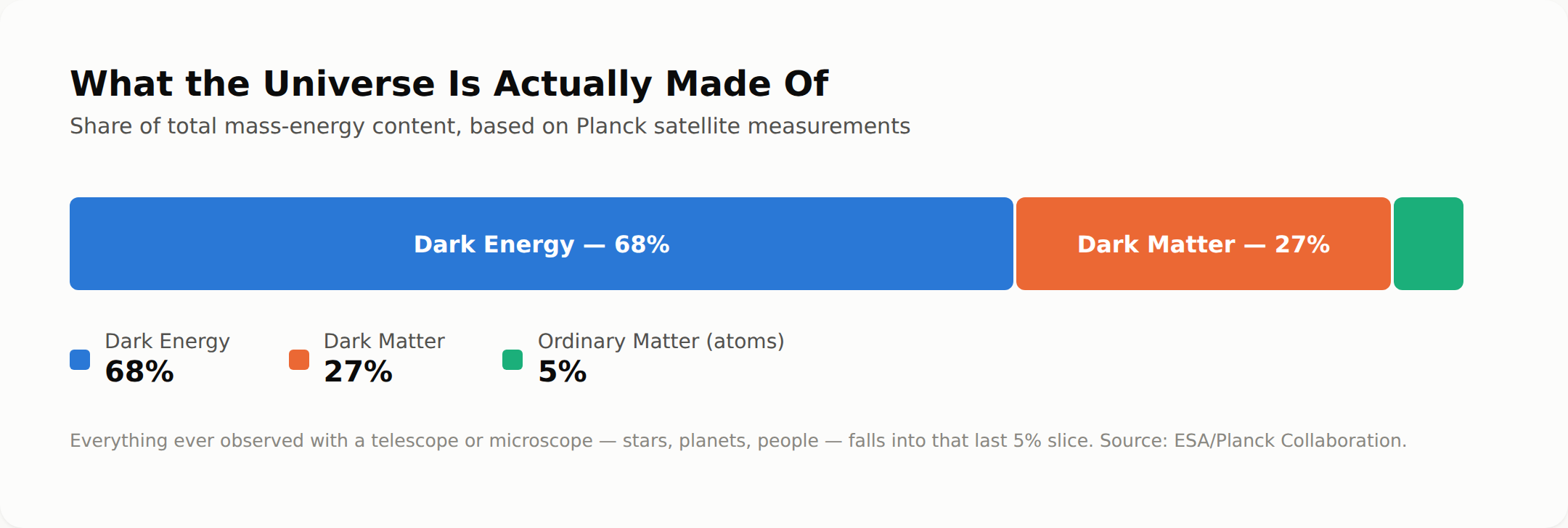
Everything humanity has ever studied with a microscope, a telescope, or a particle accelerator — every element on the periodic table, every star ever photographed — falls into that first 5%. The rest is a near-total blank.
It gets stranger. Some newer measurement techniques, combining data from multiple sky surveys, put the split closer to 69% dark energy and 31% total matter (dark plus ordinary). The exact numbers shift slightly as instruments improve, but the headline never changes: we are the minority stakeholders in our own universe.
What Is Dark Matter?
Dark matter is a form of matter that has mass and exerts gravity, just like the atoms you're made of — but it doesn't emit, absorb, or reflect light. It's not "dark" in the sense of being black or shadowy. It's dark in the sense of being completely invisible to every instrument that detects light, radio waves, X-rays, or any other part of the electromagnetic spectrum. As far as we can tell, it doesn't interact with normal matter or light at all, except through gravity.
That raises an obvious question: if you can't see it, how do you know it's there?
The Galaxy Rotation Problem
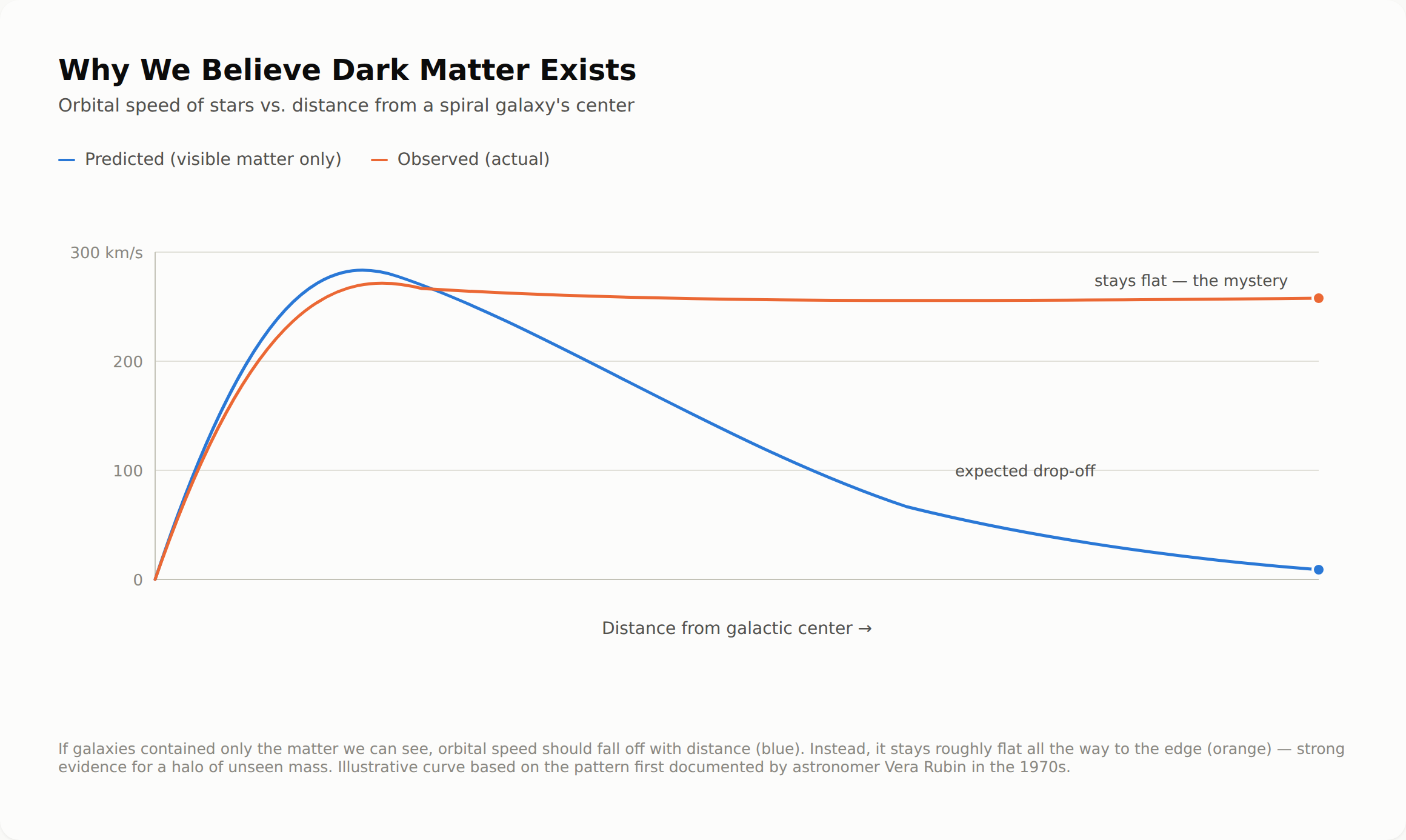
In the 1970s, astronomer Vera Rubin was measuring how fast stars orbit around the edges of spiral galaxies. Basic physics says stars farther from a galaxy's center should orbit more slowly, the same way Pluto crawls around the sun far more slowly than Mercury does. That's how gravity is supposed to work when most of the mass is concentrated in the middle.
Rubin found the opposite. Stars way out at the edges of galaxies were orbiting almost as fast as stars near the center. By the standard math, galaxies should be flying apart — there simply isn't enough visible mass to hold them together at those speeds.
Unless there's a lot more mass out there than what we can see. A vast, invisible halo of matter surrounding each galaxy, adding enough gravity to keep everything in orbit. Rubin's rotation curves became one of the strongest pieces of evidence that dark matter is real, and her work is now considered some of the most important astronomy of the 20th century.
Gravitational Lensing: Weighing the Invisible
Einstein's general relativity predicts that massive objects bend the path of light passing near them, the way a bowling ball bends a stretched rubber sheet. Galaxy clusters are massive enough to visibly warp the light from more distant galaxies behind them, smearing it into arcs and multiple images — a phenomenon called gravitational lensing.
When astronomers measure exactly how much a cluster bends light, they can calculate exactly how much mass it contains. Again and again, that number comes out far higher than the mass of all the visible stars and gas combined. The extra mass is there. It's just invisible.
The Bullet Cluster: The Smoking Gun
If you want the single most convincing piece of evidence for dark matter, it's the Bullet Cluster — two galaxy clusters that collided millions of years ago. When galaxy clusters collide, the visible gas (which makes up most of the ordinary matter) crashes together, slows down, and heats up, glowing brightly in X-rays. But gravitational lensing maps show that most of the mass sailed straight through the collision, separated from the glowing gas, barely slowed down at all.
That's a very hard thing to explain unless most of each cluster's mass is made of something that doesn't interact with gas — something that just passes through, unaffected. Dark matter fits perfectly. It's one of the reasons most physicists rule out simpler explanations, like the idea that we've just gotten gravity wrong.
So What Is It, Actually?
Here's the honest answer: nobody knows yet. But there are leading candidates.
WIMPs (Weakly Interacting Massive Particles) were, for decades, the favorite guess — hypothetical particles that interact through gravity and the weak nuclear force but nothing else. Huge underground detectors, shielded from cosmic rays by miles of rock, have spent years waiting for a WIMP to bump into an atom. So far, the search has mostly come up empty, which has pushed some physicists toward other ideas.
Axions are a much lighter hypothetical particle, originally proposed to solve an unrelated problem in particle physics. They've become a serious contender, and several experiments are now purpose-built to detect them.
Primordial black holes — black holes formed in the first fractions of a second after the Big Bang, rather than from collapsed stars — are a less mainstream but still-debated candidate for at least part of the dark matter budget.
MOND (Modified Newtonian Dynamics) takes a completely different approach: instead of adding invisible matter, it proposes that gravity itself behaves differently at very large scales. Most cosmologists find MOND hard to reconcile with evidence like the Bullet Cluster, but it remains a minority position worth knowing about.
As recently as late 2025 and into 2026, several research teams announced tantalizing new leads — from a possible detection reported by an underground xenon experiment, to new theoretical models suggesting dark matter might not be one single particle at all, but two different kinds interacting through their own hidden force. None of this counts as a confirmed discovery yet, and every "found it" headline in this field deserves a healthy dose of skepticism until independent teams replicate the result. But the pace of new claims is a sign of how active the search has become.
What Is Dark Energy?
If dark matter is the universe's invisible glue, dark energy is closer to a foot permanently pressed on the accelerator.
For most of the 20th century, cosmologists assumed the universe's expansion — which we've known about since Edwin Hubble's observations in the 1920s — should be slowing down over time. Gravity pulls everything together, so the mutual gravitational tug of every galaxy on every other galaxy should be gradually braking cosmic expansion, the same way tossing a ball upward slows it down as gravity fights it.
In 1998, two independent teams studying distant exploding stars called Type Ia supernovae — which reliably burn with a known brightness, making them useful as "standard candles" for measuring cosmic distances — found the opposite. The expansion of the universe isn't slowing down. It's speeding up. Distant galaxies are receding from us faster than they should be, and the farther back in time you look, the more this acceleration shows up.
That discovery won the 2011 Nobel Prize in Physics, and it forced physicists to accept that some kind of repulsive force, acting against gravity on cosmic scales, is pushing space itself apart. Nobody had predicted it. Nobody fully understands it. They named it dark energy simply because "energy" is what you call something that can do work against gravity, and "dark" because — like dark matter — it can't be seen directly.
The Leading Theory: The Cosmological Constant
The simplest explanation, and the one that fits observations best so far, is that dark energy is a property of space itself — a constant energy density baked into the vacuum of empty space. Ironically, Einstein proposed something almost identical decades earlier, called the cosmological constant, as a mathematical fudge factor to keep his equations describing a static universe. He later called it his "biggest blunder" when Hubble showed the universe was expanding, not static. It turned out he might have stumbled onto something real for entirely the wrong reason.
The trouble is that when physicists try to calculate how much energy empty space should theoretically contain, using quantum field theory, the answer comes out roughly 10^120 times larger than what we actually observe. That's not a rounding error — it's one of the largest unresolved discrepancies in all of science, sometimes called the "cosmological constant problem" or, less politely, "the worst prediction in the history of physics."
The Alternative: Maybe It's Not Constant at All
This is where things got genuinely exciting in 2024 and 2025. The Dark Energy Spectroscopic Instrument (DESI), a survey that has mapped the 3D positions of tens of millions of galaxies and quasars, released results suggesting that dark energy might not be constant after all — it may be gradually weakening over cosmic time. If that holds up under further scrutiny, it would overturn a core assumption of the standard cosmological model that's held for over two decades.
This idea, often grouped under "quintessence" models, treats dark energy as a dynamic field that changes in strength rather than a fixed property of empty space. As of 2025 and 2026, the evidence for evolving dark energy is intriguing but not yet at the gold-standard confidence level physicists require to call something a discovery. More data — from DESI's continued survey and from the European Space Agency's Euclid telescope, which is building an enormous 3D map of galaxies specifically to probe both dark matter and dark energy — should help settle the question over the next few years.
Dark Matter vs. Dark Energy: What's the Difference?
It's easy to lump these two together since they share a name and a mystery, but they behave in almost opposite ways.
Dark Matter Dark Energy What it does Pulls things together (gravity) Pushes things apart Where it's concentrated Clumped around galaxies and clusters Spread evenly throughout space Effect over time Its pull is diluting as the universe expands Its push seems to be winning, and winning by more Share of the universe About 27% About 68% Best evidence Galaxy rotation curves, gravitational lensing, the Bullet Cluster Accelerating supernova redshifts, cosmic microwave background data Leading candidates WIMPs, axions, primordial black holes Cosmological constant, quintessence
Dark matter behaves like matter — it has gravity, it clumps, it forms structure. Dark energy behaves like nothing else we know — it doesn't clump, it doesn't dilute the way matter does as space expands, and its effect actually grows stronger relative to gravity as the universe gets bigger and emptier. That's the reason cosmic expansion is accelerating rather than leveling off.
Why Any of This Actually Matters
It's fair to ask: if we can't touch it, weigh it in a lab, or point to it in the sky, why should anyone outside a physics department care?
A few reasons. First, dark matter isn't just an abstract curiosity — it's the scaffolding that let galaxies form in the first place. Without its extra gravity in the early universe, the gas clouds that became stars and galaxies likely wouldn't have clumped together fast enough, and the universe we live in — including the conditions that eventually allowed life on Earth — probably wouldn't exist in a recognizable form.
Second, dark energy determines the universe's ultimate fate. If it stays constant, current models point toward a "Big Freeze" — galaxies drifting apart faster than light can ever bridge the gap again, stars burning out one by one, the universe ending not with a bang but a very long, very cold silence, trillions of years from now. If dark energy is strengthening over time, some more dramatic scenarios, like a "Big Rip" that tears apart galaxies, stars, and eventually atoms themselves, become possible in the far future. If it's weakening, as the newest DESI hints suggest, the story could look different still. This is one of the very few questions in science where the answer literally determines how the universe ends.
Third, and maybe most importantly: this is one of the last truly wide-open frontiers in physics. Most of what undergraduates learn in a physics degree was worked out decades or centuries ago. Dark matter and dark energy are live mysteries, being actively fought over in research papers published this year. Whoever eventually identifies what dark matter actually is, or explains why dark energy exists at all, will very likely win a Nobel Prize — and will have rewritten our understanding of what the universe is fundamentally made of.
Frequently Asked Questions
Is dark matter the same thing as a black hole? No. Black holes are made of ordinary matter (or possibly formed in extreme conditions from the early universe) that's collapsed into an extremely dense point; they emit no light because gravity traps it, but they interact with normal matter constantly, pulling in gas and bending light dramatically at close range. Dark matter is a different substance entirely, one that barely interacts with anything except through gravity, and is spread out rather than collapsed.
Has dark matter ever been directly detected? Not conclusively, as of 2026. Several underground and satellite experiments are actively hunting for it, and there have been promising signals over the years, but nothing has been confirmed and independently replicated to the standard required for a genuine discovery. What we have is very strong indirect evidence, from multiple independent methods, that something with mass and gravity is out there.
Could dark matter and dark energy just be a sign that we have gravity wrong? It's a fair question, and a small number of physicists do pursue modified-gravity theories instead. But evidence like the Bullet Cluster is hard to explain with modified gravity alone, since it shows an actual separation between visible mass and the location of the gravitational effect. Most cosmologists currently find that dark matter and dark energy, as real substances, fit the evidence better than modified gravity does — though the debate isn't fully closed.
Why are they both called "dark" if they're completely different things? Purely because neither one can be observed directly with light or any other form of electromagnetic radiation. The shared name is really just a shared admission of ignorance — "dark" here means "invisible to our instruments," not that the two phenomena are related.
When will we know what dark matter and dark energy actually are? Nobody can say for sure. Detector sensitivity for dark matter particles has improved by orders of magnitude over the past two decades, and missions like Euclid and the ongoing DESI survey are gathering the most precise cosmological data ever collected. Many physicists are cautiously optimistic that the coming decade could bring real answers, but this field has a long history of promising leads that didn't pan out, so patience is part of the process.
The Bottom Line
Ninety-five percent of the universe is made of something we still can't name. That should be a genuinely unsettling thought — and also a thrilling one. Every galaxy you've ever seen in a photograph is held together by an invisible substance no one has identified. Every measurement of cosmic acceleration is being driven by a force no equation fully explains. We're not just filling in details at the edges of physics here; we're missing most of the picture.
The good news is that the tools to find answers exist right now, and they're actively being used. Between underground detectors hunting for dark matter particles, space telescopes mapping billions of galaxies, and surveys tracking how the universe's expansion has changed over billions of years, we're closer than any previous generation to actually solving this. Whether the final answer turns out to be a new particle, a new force, or something nobody has thought of yet, one thing is certain: the universe still has its biggest secret left to tell.
References
Rubin, V. C., & Ford, W. K. Jr. (1970). Rotation of the Andromeda Nebula from a Spectroscopic Survey of Emission Regions. The Astrophysical Journal — foundational galaxy rotation curve research.
NASA — Dark Energy, Dark Matter
ESA — The Dark Universe
ESA/Planck — Planck's New Cosmic Recipe
Berkeley Lab / DESI Collaboration — New DESI Results Strengthen Hints That Dark Energy May Evolve
Fermilab News — New DESI Results Strengthen Hints That Dark Energy May Evolve
Euclid Consortium — New Science Results and Images from Euclid Quick Data Release 1
NASA — ESA Previews Euclid Mission's Deep View of the Dark Universe
Max Planck Society — First Comprehensive Data Release of the Euclid Space Telescope
UC Riverside News — James Webb Space Telescope Reveals New Details About Dark Matter in the Universe
NASA/JPL — NASA Reveals New Details About Dark Matter's Influence on Universe
The Nobel Prize — The Nobel Prize in Physics 2011: Perlmutter, Schmidt, Riess — for the discovery of the accelerating expansion of the universe
Universe Today — A New Technique Confirms the Universe Is 69% Dark Energy, 31% Matter
Chandra X-ray Observatory (NASA) — The Bullet Cluster: Direct Evidence for Dark Matter
Wikipedia — Dark Matter (general overview and further reading)
Article last fact-checked: August 2026. Given how fast this field moves, readers interested in the latest developments should check current results from the DESI and Euclid collaborations directly.