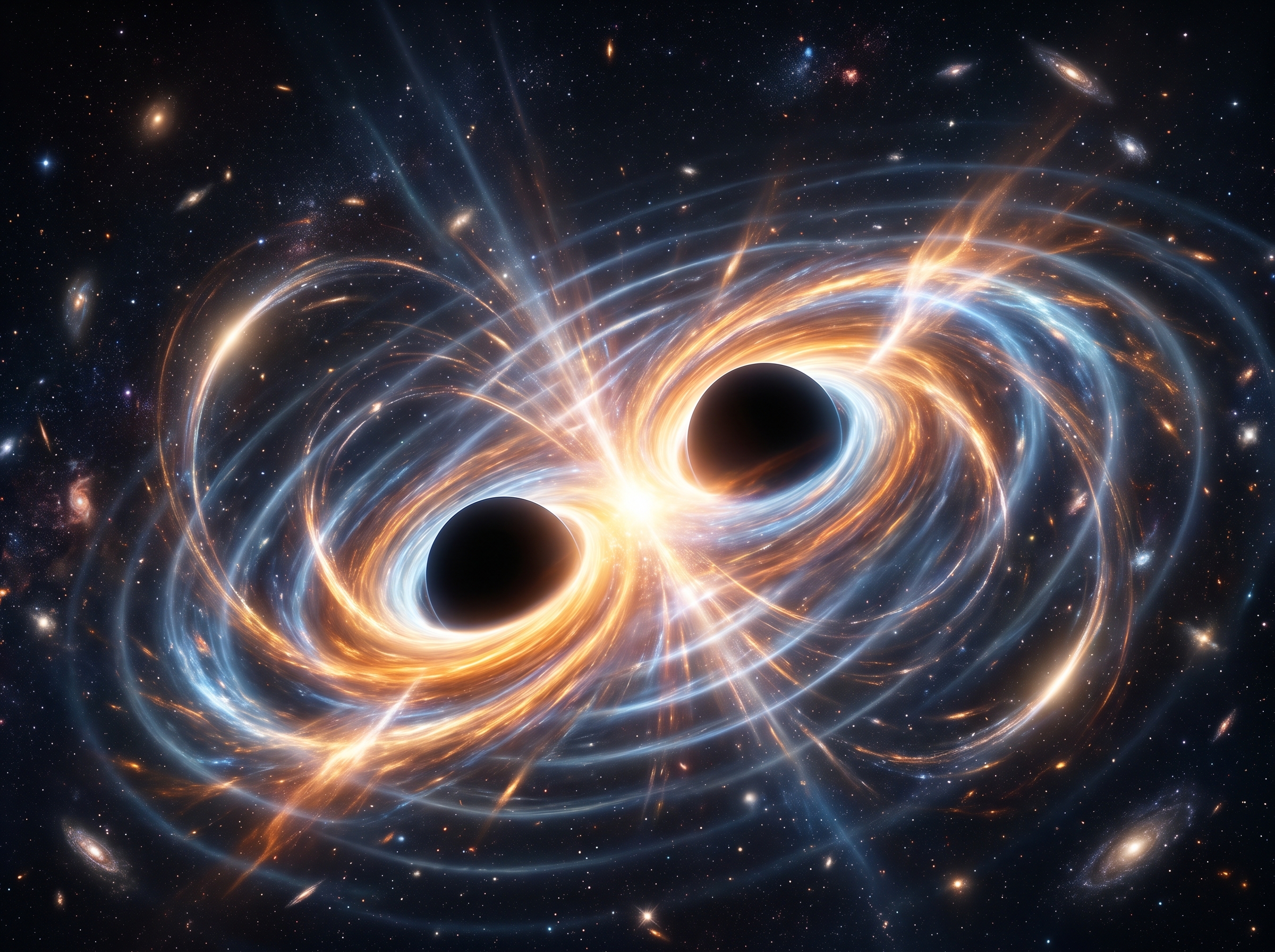
Somewhere in the universe, roughly once every few minutes, two black holes finish a dance that's been going on for millions or billions of years and finally slam together. It's arguably the single most violent event physics knows how to describe — for a fraction of a second, the collision can outshine every star in the observable universe combined, radiating more raw power than all the light from all the galaxies we can see. And yet, if you pointed every telescope on Earth directly at it, you would see nothing at all. No flash, no glow, no light of any kind. The entire event happens in pure darkness, and for exactly one hundred years after Albert Einstein predicted it was possible, humanity had no way to detect it whatsoever. Here's what's actually happening in one of these collisions, and how we finally learned to listen for something we could never hope to see.
Two Black Holes Spend an Eternity Circling Each Other First
A black hole collision doesn't happen suddenly out of nowhere — it's the final act of a process that typically plays out over millions to billions of years. Binary black holes usually form in one of two ways: either from a pair of massive stars that were already orbiting each other as a binary star system, both of which eventually collapsed into black holes after their stellar lives ended, or through a dynamical process in extremely dense stellar environments, like the crowded core of a globular star cluster, where two black holes can gravitationally capture each other after a close encounter.
However the pair forms, they begin orbiting one another, and general relativity predicts something Newtonian gravity never would: a binary system like this constantly radiates a tiny amount of energy away as gravitational waves — ripples in the fabric of spacetime itself. That energy loss is normally so small it's utterly negligible, but over enormous timescales, it steadily shrinks the orbit, pulling the two black holes closer together. As they get closer, they orbit faster, which means they radiate gravitational waves more intensely, which shrinks the orbit further still — a runaway feedback loop that, over the final seconds before collision, accelerates dramatically.
The Three Acts of a Collision: Inspiral, Merger, Ringdown
Physicists studying these events describe them in three distinct phases.
During the inspiral, the two black holes spiral into each other at increasing speed, eventually reaching a meaningful fraction of the speed of light in the final moments before contact. The gravitational waves produced during this phase rise steadily in both frequency and amplitude, producing a distinctive rising tone that scientists nicknamed a "chirp," since when converted to an audible sound wave, it genuinely resembles a bird's chirp sliding upward in pitch.
The merger is the actual collision — the moment the two event horizons touch and combine into one single, larger event horizon. This is the most violent and complex part of the process, involving spacetime curvature so extreme that it can only be accurately modeled using supercomputer simulations solving Einstein's full equations of general relativity, rather than simpler approximations. It happens astonishingly fast, typically completing within a fraction of a second.
The ringdown follows immediately after. The newly merged black hole doesn't settle instantly into its final, stable shape — it briefly "rings" like a struck bell, its event horizon oscillating through a series of specific vibration patterns called quasinormal modes before settling down into a smooth, stable, rotating black hole described by what's called the Kerr solution. Just like a bell's ringing pattern reveals information about its shape and material, a black hole's ringdown pattern encodes precise information about its final mass and spin, which is part of why this phase is so valuable to physicists studying the event afterward.
An Almost Incomprehensible Amount of Energy, Released as Pure Spacetime Ripples
Here's the detail that tends to stop people in their tracks: in the collision that produced the very first gravitational wave detection, an event called GW150914, two black holes of roughly 36 and 29 times the mass of our Sun merged into a single black hole of about 62 solar masses. Simple arithmetic says 36 plus 29 should equal 65 — but the final black hole was noticeably lighter than that. The missing mass, roughly three entire Suns' worth, wasn't destroyed; following Einstein's famous E=mc², it was converted directly into energy and radiated away entirely as gravitational waves, in about a fifth of a second. During that brief peak, the power radiated by this single collision, though carried purely as spacetime distortion rather than light, briefly exceeded the combined light output of every star in the observable universe.
Because that entire, staggering release of energy takes the form of gravitational waves rather than light, radio waves, or any form of electromagnetic radiation, a typical black hole merger produces no visible signature whatsoever. Telescopes, by design, only detect electromagnetic radiation — light in its many forms — and a "normal" black hole merger, occurring in otherwise empty space, simply doesn't produce any. The only known exception is a merger that happens to occur inside a dense environment already full of surrounding gas, such as the swirling accretion disk around a supermassive black hole at a galaxy's core; in that specific, comparatively rare scenario, the merger's violent recoil (described next) can plow through the surrounding gas and potentially trigger a detectable flare of light, and astronomers have reported a small number of tentative, still-debated candidate detections of exactly this kind of event.
The Kick: When a Newborn Black Hole Gets Violently Launched
One of the stranger consequences of an asymmetric merger — meaning two black holes of different mass or misaligned spin — is something called a gravitational wave recoil, or more informally, a "kick." Because gravitational waves aren't emitted perfectly symmetrically in every direction during a lopsided merger, they carry away a small net amount of momentum in one preferred direction, and by simple conservation of momentum, the newly formed black hole gets launched in the opposite direction as a result — similar in principle to the recoil of a fired gun, just happening to spacetime itself rather than a physical object. In extreme cases, this recoil can send a newly merged black hole flying at speeds of many hundreds, or even several thousand, kilometers per second, potentially fast enough to be ejected entirely from its host galaxy. It's a genuinely strange thought: a brand-new black hole, born mid-collision, immediately hurled out into intergalactic space by the very event that created it.
A Landmark Confirmation: Hawking's Theorem, Tested for Real
For decades, black hole physics rested heavily on elegant mathematical theorems that had never been directly, experimentally tested. One of the most famous is Stephen Hawking's 1971 area theorem, which predicts that the total surface area of a black hole's event horizon can never decrease — meaning that when two black holes merge, the horizon area of the resulting single black hole must be greater than or equal to the combined horizon areas of the two black holes that merged to form it.
In January 2025, on the tenth anniversary of the very first gravitational wave detection, the LIGO-Virgo-KAGRA collaboration observed an exceptionally clean, high-precision merger event called GW250114, and used it to directly test Hawking's area theorem for the first time with enough precision to matter. The result confirmed the theorem: the final black hole's horizon area was indeed measurably greater than the sum of its two progenitors', matching Hawking's decades-old prediction with real observational data, and the same event also allowed for one of the most precise tests yet of whether the merged remnant matches the specific mathematical form (called the Kerr solution) that general relativity predicts for any spinning black hole. It's the kind of result that turns a beautiful piece of theoretical mathematics into confirmed physical law.
How We Actually Detect an Event We Can't See
Gravitational waves were a firm prediction of Einstein's general relativity, published in 1916, but Einstein himself doubted they would ever be detectable, since the ripples they produce are almost inconceivably faint by the time they reach Earth from a distant collision. It took a full century of technological development to prove him only half right.
The Laser Interferometer Gravitational-Wave Observatory (LIGO), along with its European counterpart Virgo and Japan's KAGRA detector, works by splitting a laser beam down two long perpendicular tunnels, each several kilometers long, bouncing the light off mirrors at the far end, and recombining the beams to see if they still line up perfectly. A passing gravitational wave stretches space in one direction while squeezing it in the perpendicular direction, however briefly, throwing the two beams very slightly out of sync — by an amount smaller than one ten-thousandth the width of a proton, an almost unimaginably tiny distortion that these instruments are nonetheless precise enough to catch. On September 14, 2015, LIGO detected exactly this kind of signal for the first time in history, the chirp of two black holes merging roughly 1.3 billion light-years away, a discovery formally announced in February 2016 and honored with the 2017 Nobel Prize in Physics.
The Field Has Exploded Since Then
What began as a single, history-making detection has since become a rapidly growing, increasingly detailed catalog of the universe's most violent events. As of the most recent update to the LIGO-Virgo-KAGRA gravitational wave catalog (GWTC-5.0), released in 2026, the collaboration has now confirmed several hundred gravitational wave events, the vast majority of them black hole mergers, building the first real statistical picture of how common these collisions are and what kinds of black holes tend to merge with each other.
One especially striking recent discovery is GW231123, detected in November 2023 and reported in detail through 2025, which involved the two most massive black holes ever observed merging — individually weighing in at roughly 100 and 140 times the mass of the Sun, combining into a single black hole of around 225 solar masses. Black holes in that specific mass range are theoretically difficult to produce through the ordinary collapse of a single massive star, since stars that large are thought to blow themselves apart in a specific kind of supernova before they can collapse into a black hole at all, a predicted gap in the black hole mass distribution nicknamed the "pair-instability mass gap." Finding merging black holes sitting squarely inside that supposedly forbidden range is strong evidence that at least some black holes are themselves the product of earlier mergers — hierarchical mergers, where a black hole formed from one collision goes on, later, to merge again with another, building up mass across multiple generations of collisions rather than a single star's collapse. Growing evidence for exactly this kind of hierarchical merger population has been one of the standout findings of the newest detection catalog.
What Comes Next
Current detectors like LIGO, Virgo, and KAGRA are ground-based, and their sensitivity is fundamentally limited by things like seismic noise and the physical length of their laser tunnels. The next generation of gravitational wave astronomy is already in development: the Laser Interferometer Space Antenna (LISA), a European Space Agency-led mission planning to place three spacecraft in a triangular formation millions of kilometers apart, is designed to detect much lower-frequency gravitational waves than ground-based detectors can, including signals from the mergers of colossal supermassive black holes at the centers of colliding galaxies. Meanwhile, proposed next-generation ground detectors, including the Einstein Telescope in Europe and Cosmic Explorer in the United States, aim to be sensitive enough to detect nearly every black hole merger occurring anywhere in the observable universe, a dramatic leap from catching only the loudest, closest events as current detectors mostly do today.
Why Any of This Matters
Beyond the sheer spectacle, black hole mergers have become one of the most powerful tools physicists have for testing general relativity under the most extreme conditions the universe can produce — conditions that can never be replicated in any laboratory on Earth. Each new merger tests Einstein's century-old equations a little further, and so far, remarkably, they keep holding up. The growing catalog of detected mergers is also rewriting astrophysicists' understanding of how black holes form and grow throughout cosmic history, revealing populations and mass ranges nobody was fully expecting before gravitational wave astronomy existed. And on a more fundamental level, every confirmed detection is proof of something extraordinary in its own right: that humanity figured out how to listen to the universe in an entirely new way, one that requires no light at all — just spacetime itself, quietly ringing.
Frequently Asked Questions
Would a black hole merger be dangerous to a nearby planet? Extremely so, if a planet happened to be close enough, mainly due to the intense gravitational and tidal forces involved rather than any kind of explosion or radiation, since the event itself produces no light. In practice, this isn't a realistic threat to Earth — the black hole mergers gravitational wave detectors observe are typically hundreds of millions to billions of light-years away, and by the time their gravitational waves reach us, the distortion is far too faint to have any physical effect on anything here.
Can you actually "hear" a black hole merger? Not directly, since gravitational waves aren't sound waves and don't travel through air. However, scientists commonly convert the frequency pattern of a detected gravitational wave signal into an audible tone for illustration and public communication purposes, and the resulting "chirp" sound has become one of the more recognizable and widely shared representations of a black hole merger, even though it's a translation rather than a literal recording.
How often do black hole mergers actually happen? Based on the current detection rate and catalog, mergers detectable by LIGO-Virgo-KAGRA-class instruments are now confirmed at a rate of roughly one every few days when the detectors are actively observing, and the true rate of mergers happening throughout the entire observable universe, including ones too faint or distant to detect with current technology, is understood to be far higher still.
Do all black hole mergers eventually happen, or can two black holes orbit each other forever? Given enough time, general relativity predicts that essentially any bound binary black hole system will eventually merge, since gravitational wave emission continuously drains orbital energy with no natural stopping point short of collision. The timescale can be enormous, however — some binary systems are expected to take longer than the current age of the universe to finally merge, depending on their initial separation and mass.
Is this the same kind of event that creates a black hole in the first place? No — those are two different processes. A black hole is typically formed by the collapse of a single massive star at the end of its life (or possibly by other more exotic mechanisms in the early universe). A merger, by contrast, is what happens when two black holes that already exist, each formed independently, eventually collide and combine into one larger black hole.
The Bottom Line
Two black holes colliding is, by almost every measure, the most powerful event physics knows how to describe — an eventually inevitable collision, built up over unfathomable stretches of time, that briefly outshines the entire visible universe in raw power without producing a single visible photon. For a hundred years, it was a spectacular event we could only predict on paper. Now, thanks to detectors precise enough to notice spacetime flexing by less than the width of a proton, we've listened to hundreds of them, confirmed some of the strangest predictions Einstein and Hawking ever made, and found black holes bigger and stranger than theory alone said should exist. And by every indication, the catalog is only getting started.
References
Abbott, B. P., et al. (LIGO Scientific Collaboration and Virgo Collaboration) (2016). Observation of Gravitational Waves from a Binary Black Hole Merger. Physical Review Letters, 116, 061102.
LIGO Laboratory, Caltech — LIGO-Virgo-KAGRA Detect Most Massive Black Hole Merger to Date
Wikipedia — GW231123
LIGO-Virgo-KAGRA Collaboration (2025). GW250114: Testing Hawking's Area Law and the Kerr Nature of Black Holes. Physical Review Letters.
Cornell Department of Astronomy — On 10th Anniversary, LIGO Verifies Hawking's Theorem
LIGO Laboratory, Caltech — GWTC-5.0: Updated LIGO-Virgo-KAGRA Catalog Sets New Records in Precision Gravitational Wave Astronomy
Physics (APS) — Landmark Black Hole Test Marks Decade of Gravitational-Wave Discoveries
Hawking, S. W. (1971). Gravitational Radiation from Colliding Black Holes. Physical Review Letters, 26(21), 1344–1346.
LISA (Laser Interferometer Space Antenna) Consortium — Mission Overview
The Nobel Prize — The Nobel Prize in Physics 2017: Weiss, Barish, Thorne
Article last fact-checked: September 2026. Gravitational wave astronomy is one of the fastest-moving fields in physics right now — readers wanting the latest confirmed detections should check current updates from the LIGO-Virgo-KAGRA collaboration directly.