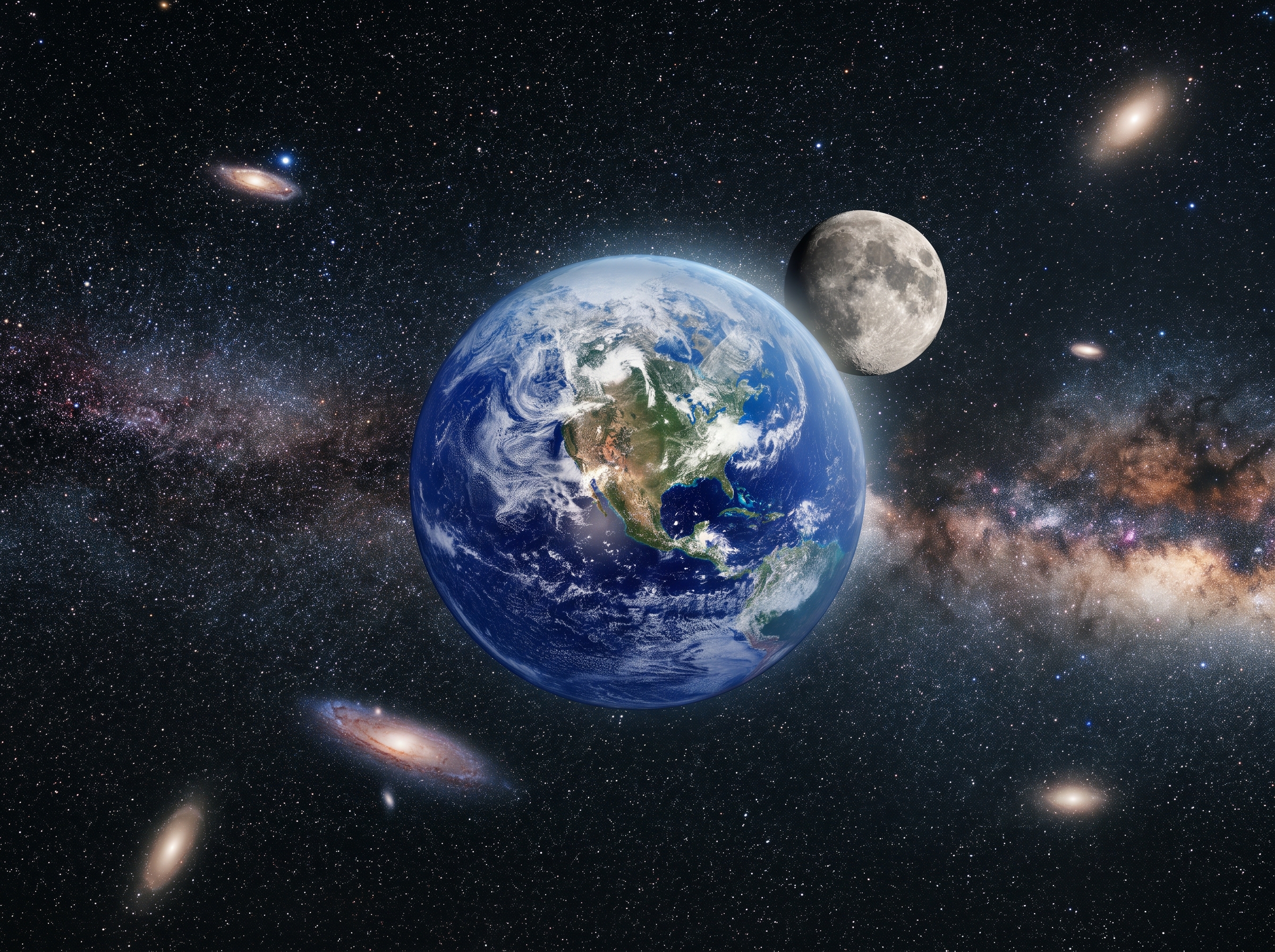
Before getting into what would happen, it's worth being upfront about something: the Moon can't actually just disappear. Mass and energy don't blink out of existence — that would violate some of the most fundamental laws of physics we have. So this is, and always will be, a thought experiment: imagine the Moon is instantly removed from our sky, with no explanation for how, and trace through what would genuinely happen to Earth afterward. It turns out to be a great way to understand just how much quiet influence our nearest neighbor actually has — and it's also a great opportunity to correct a few popular myths that have outlived the science behind them.
Tides Would Shrink, Not Vanish
The most immediate, noticeable effect would be on the oceans. Ocean tides are caused by the gravitational pull of both the Moon and the Sun, but they're not equal contributors — the Moon accounts for roughly two-thirds of Earth's tidal force, with the Sun responsible for the remaining third, even though the Sun is vastly more massive, simply because it's so much farther away that its gravitational tidal effect is weaker.
Without the Moon, tides wouldn't disappear entirely, since solar tides would still exist. But the overall tidal range — the difference between high and low tide — would shrink dramatically, likely to somewhere around a third to a half of what we experience today, and the timing would shift to follow the Sun's daily cycle rather than the Moon's roughly 24-hour-and-50-minute cycle. This isn't a minor detail: a huge amount of coastal ecology depends on the specific rhythm and range of tides, from intertidal organisms adapted to exposure-and-flooding cycles to fish and crustacean species that time reproduction to tidal patterns. Shipping channels, harbors, and tidal energy infrastructure, all currently calibrated to lunar-driven tides, would need to adjust to a calmer, more subdued tidal regime.
Nights Would Get Dramatically Darker
Moonlight is really just reflected sunlight — the Moon reflects only about 7% of the sunlight that hits it, and even a full moon is roughly 400,000 times dimmer than the Sun. Even so, on a clear night, a full moon is by far the brightest natural light source most people ever experience after dark, easily enough to see your surroundings and cast shadows.
Without the Moon, nights would become genuinely, uniformly darker — no more moonlit walks, no more bright nights around the full moon, just the comparatively faint light of starlight. This isn't purely a cosmetic loss. A significant number of nocturnal species rely on moonlight for navigation, hunting, or predator avoidance, and predictable lunar light cycles influence the behavior of everything from small mammals adjusting their activity to avoid being seen by predators on brightly moonlit nights, to insects, to deep-ocean organisms that migrate vertically in the water column in sync with lunar light patterns. Removing that entire lighting cycle would ripple through nocturnal ecosystems in ways that are hard to fully predict, but almost certainly disruptive.
Our Rotation Rate Would Actually Stabilize
Here's a genuinely counterintuitive one: the Moon's gravity has been gradually slowing down Earth's rotation for billions of years, a process called tidal braking, currently lengthening our day by about 1.8 milliseconds per century — slow enough to be irrelevant on a human timescale, but cumulatively significant over geological time (billions of years ago, Earth's day was only around 19 to 21 hours long).
If the Moon vanished, this slowing process would stop. Rather than days continuing to gradually lengthen over the coming millions of years, the length of an Earth day would stay much closer to its current 24 hours, since the main mechanism responsible for the ongoing slowdown would be gone. This wouldn't produce any dramatic, immediate change to day length, but it would mean a very different long-term rotational future for the planet compared to the one we're actually on.
Axial Tilt: The Popular Claim vs. What Research Actually Shows
This is probably the most commonly repeated claim about the Moon's importance, and it's genuinely more nuanced than most popular explanations suggest, so it's worth walking through the real history of the science.
In 1993, French astronomer Jacques Laskar published influential research in the journal Nature suggesting that the Moon's gravitational influence helps stabilize Earth's axial tilt (the angle of Earth's rotational axis relative to its orbit, currently about 23.5 degrees, responsible for our seasons). Laskar's modeling suggested that without the Moon, Earth's axial tilt could shift chaotically over millions of years, potentially swinging through a much wider range of angles — Mars, which has only two tiny moons with negligible gravitational influence, is thought to have experienced exactly this kind of large, chaotic obliquity swing over its history. This finding became widely popularized as evidence that the Moon is essential for Earth's long-term climate stability and, by extension, for life itself.
More recent research has added meaningful nuance to that picture. A 2011 study by Jack Lissauer, Jason Barnes, and John Chambers, published in the journal Icarus, ran more detailed simulations of a hypothetical moonless Earth and found that while its axial tilt would indeed become somewhat less predictable and could wander more than it does today, the swings were less extreme and less chaotic than Laskar's original results suggested — Earth's relatively fast rotation rate on its own provides a meaningful amount of gyroscopic stability, even without lunar influence, and the researchers concluded a moonless Earth's obliquity would likely still stay within a moderate range over tens of millions of years, rather than tumbling toward Mars-like extremes. The honest, current summary: the Moon does provide real additional stability to Earth's axial tilt, and losing it would likely mean somewhat more obliquity variation over very long timescales, with corresponding effects on long-term climate patterns — but the more dramatic "without the Moon, Earth's tilt would become wildly unstable and life-threatening" version of this claim, though still repeated frequently in popular science writing, is a stronger conclusion than current research actually supports.
A Persistent Myth: The Moon Doesn't Meaningfully Shield Earth from Asteroids
One popular claim that doesn't hold up well under scrutiny at all is the idea that the Moon acts as a meaningful shield, absorbing asteroid and comet impacts that would otherwise strike Earth. It's an appealing image, especially given how visibly cratered the Moon's surface is, but the physics doesn't really support it: the Moon is small, relatively far from Earth, and presents a tiny gravitational and physical cross-section compared to the vast area of open space surrounding our planet. The overwhelming majority of the Moon's craters come from impactors that were never headed toward Earth in the first place, simply because the Moon and Earth occupy mostly separate patches of the sky from an incoming object's point of view. Losing the Moon would not meaningfully increase Earth's asteroid or comet impact risk — this one's more myth than established science.
Another Myth Worth Retiring: The Moon and Human Biology
You'll frequently hear claims that the Moon influences human behavior, sleep, or the roughly 28-day average human menstrual cycle, sometimes offered as evidence of some deep biological synchronization with lunar rhythms. While it's true that many marine species have measurably real, well-documented lunar-synced behaviors (like coral species that famously spawn in synchronized events tied precisely to specific moon phases, or the nesting timing of some sea turtle species), rigorous studies looking for a similar effect in humans — on sleep quality, hospital admissions, mood, or menstrual timing — have generally failed to find a consistent, statistically reliable lunar effect once properly controlled for other variables. The apparent similarity between the average menstrual cycle length and the lunar month appears to be a coincidence of average timing rather than an actual causal or synchronized relationship. Removing the Moon would end genuine lunar-synced behavior in the marine species that rely on it, but almost certainly wouldn't change human biology in any measurable way.
No More Solar Eclipses, and a Changed Night Sky
A more purely aesthetic, but genuinely significant, loss: total solar eclipses exist only because of a remarkable, apparently coincidental match between the Moon's size and its distance from Earth — the Moon is about 400 times smaller than the Sun, but also about 400 times closer, so the two appear almost exactly the same size in our sky, allowing the Moon to precisely cover the Sun's disk during an eclipse. No other planet-moon combination in our solar system is known to produce this same precise visual match. Without the Moon, this entire phenomenon, along with the cultural, scientific, and simply awe-inspiring role eclipses have played throughout human history, would never have existed at all.
Human culture more broadly would look different too. Many early calendar systems, including several still in cultural or religious use today, are based on the roughly 29.5-day lunar cycle, and the Moon's phases have served as a practical, universally visible timekeeping tool for most of human history, well before mechanical clocks or written calendars existed.
Earth's Orbit Around the Sun Would Barely Notice
It's worth clarifying one thing this scenario would not meaningfully change: Earth's orbit around the Sun. The Moon's mass is only about 1.2% of Earth's mass, and Earth-Moon system dynamics play only a very minor role in the much larger gravitational relationship between Earth and the Sun that actually governs our year-long orbit and the resulting seasons' basic timing. Losing the Moon wouldn't send Earth spiraling into a different orbit or measurably change the length of a year.
Frequently Asked Questions
Would we lose gravity or float away if the Moon disappeared? No — Earth's gravity comes from Earth's own mass, and it's overwhelmingly dominant at Earth's surface. The Moon's gravitational pull on you personally is vanishingly small compared to Earth's; losing the Moon would have no noticeable effect on how gravity feels here.
Would the seasons disappear without the Moon? No — seasons are caused by Earth's axial tilt relative to its orbit around the Sun, not by the Moon directly. The Moon's role is in helping keep that tilt relatively stable over very long timescales, not in creating the seasons in the first place, so seasons would continue to exist, though the long-term stability of exactly how much tilt (and therefore how pronounced the seasons are) might drift more over millions of years than it does today.
How quickly would these effects actually happen? It would be a mix of timescales. Tides would change within a single day, since they depend on gravity acting in the moment. Darker nights would be immediate and constant, since there'd simply be no moon to reflect sunlight. But the rotation-rate and axial-tilt effects are gradual, playing out over millions of years, not something anyone alive at the moment of disappearance would notice directly.
Could life on Earth survive without the Moon? Current research, including the more nuanced modern view of axial tilt stability, generally suggests Earth would likely remain habitable without the Moon, even if long-term climate patterns became somewhat less predictable over geological time. The Moon appears to be a genuine stabilizing influence rather than an absolute requirement for life, based on current scientific understanding — a meaningfully different conclusion than the more dramatic "the Moon is essential for life" framing sometimes found in popular science coverage.
Did the Moon actually shield Earth from a lot of past asteroid impacts? Not meaningfully, based on current understanding of impact geometry and cross-sectional area — this is one of the more persistent popular myths about the Moon's role, not a well-supported scientific claim.
The Bottom Line
A vanishing Moon is, thankfully, physically impossible — but working through the thought experiment turns out to be one of the clearest ways to actually appreciate what the Moon does and doesn't do for us. It reliably drives most of our tides, lights up our nights, and provides real, if more modest than commonly claimed, long-term stability to Earth's tilt and seasons. It doesn't shield us from asteroids, and it doesn't secretly run human biology. The truth, as usual, sits somewhere more interesting than either the doom-laden version or the dismissive one: our Moon matters, quietly and substantially, just not always for the reasons the internet tends to repeat.
References
Laskar, J., Joutel, F., & Robutel, P. (1993). Stabilization of the Earth's Obliquity by the Moon. Nature, 361, 615–617.
Lissauer, J. J., Barnes, J. W., & Chambers, J. E. (2012). Obliquity Variations of a Moonless Earth. Icarus, 217(1), 77–87.
NASA Science — Earth's Moon: Overview
NOAA National Ocean Service — What Causes Tides?
Williams, G. E. (2000). Geological Constraints on the Precambrian History of Earth's Rotation and the Moon's Orbit. Reviews of Geophysics, 38(1), 37–59.
Popular Science — What Would Happen If the Moon Suddenly Disappeared?
Smithsonian Ocean (Smithsonian Institution) — Coral Spawning and Lunar Cycles
National Institutes of Health (NCBI/PubMed) — research summaries on lunar cycles and human sleep and menstrual timing, evaluated via systematic review.
Article last fact-checked: September 2026. This article describes a hypothetical scenario for educational purposes — the Moon is not at risk of disappearing. Readers wanting deeper technical detail should consult the cited primary research directly.