An onion doesn't have teeth, claws, or the ability to run away. What it has instead is a chemical trap, quietly assembled and left switched off inside its own cells, waiting for exactly one trigger: getting cut open. The moment a knife breaches its cell walls, an onion detonates a tiny, precisely engineered chemical weapon designed to make whatever's attacking it — historically a hungry animal, currently you, dicing it for dinner — want to stop immediately. It's not a coincidence or a side effect. It's a defense mechanism millions of years in the making, and it happens to work brilliantly on human eyes.
A Two-Part Bomb, Kept Safely Separated Until You Cut It Open
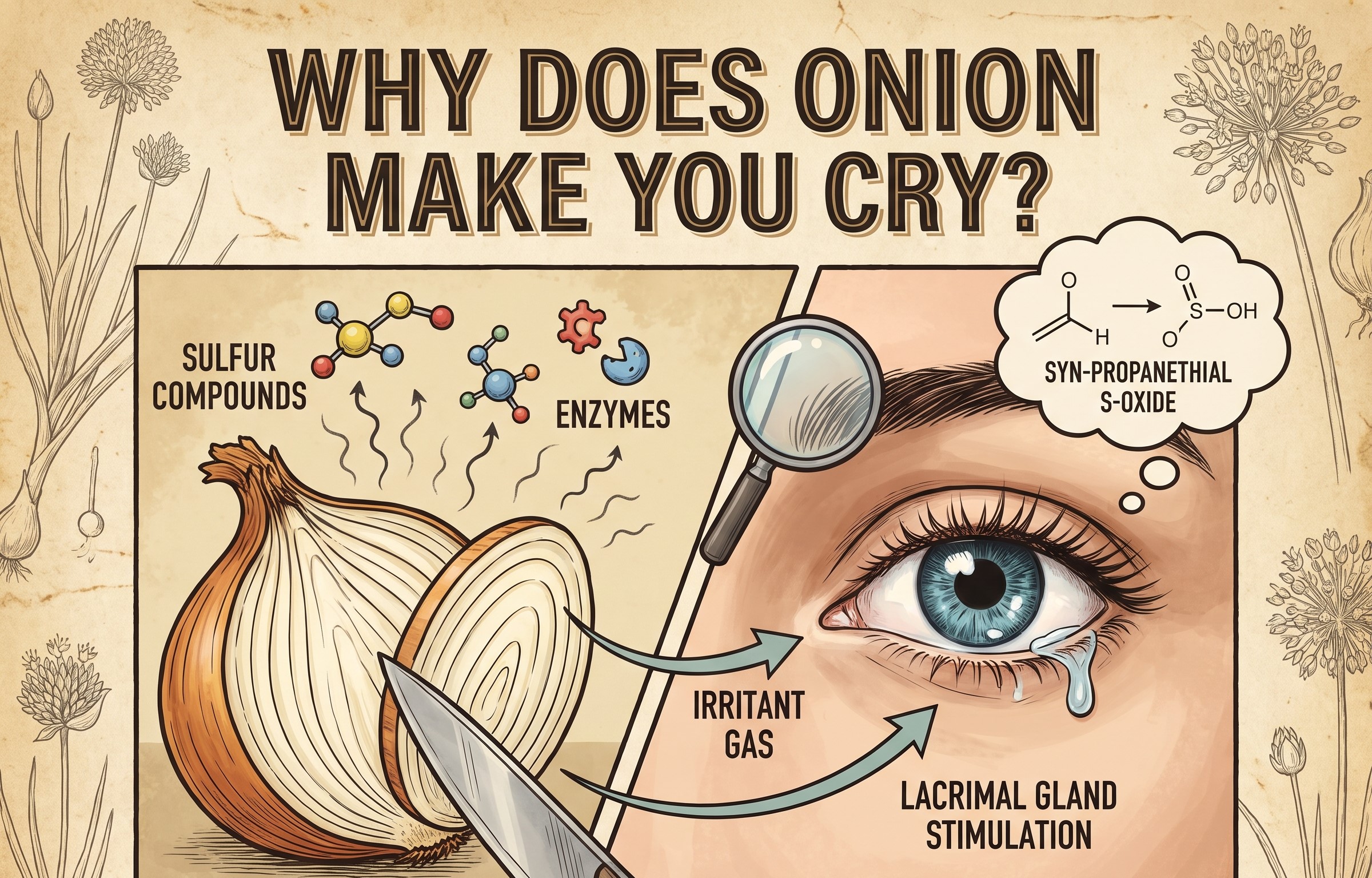
The cleverest part of this whole system is where the ingredients are stored before anything happens. Inside an intact onion cell, the chemical building blocks needed to make you cry are deliberately kept apart in two separate compartments, the way a two-part epoxy glue stays inert until its two components finally touch. In one compartment (the cell's cytoplasm) sit sulfur-containing amino acid compounds, most importantly one called PRENCSO. In a separate compartment (tiny sealed sacs called vacuoles) wait a set of enzymes, ready to act the instant they get access to those compounds — but under normal, uncut conditions, the cell wall keeps the two apart, and nothing happens at all.
Slice into the onion, and that separation collapses all at once across every ruptured cell along the cut. The enzymes and the sulfur compounds mix freely for the first time, and a fast, multi-step chemical reaction kicks off within seconds.
The Chemistry, Step by Step
First, an enzyme called alliinase gets to work on the released PRENCSO, breaking it down into an unstable intermediate compound called a sulfenic acid. On its own, that sulfenic acid would just settle into some other, less irritating sulfur compound and the story would mostly end there — which is roughly what happens in some of the onion's milder relatives, including garlic, whose cut-open chemistry mostly stops at this earlier stage.
But onions carry a second, more specialized enzyme that most of their relatives don't have, called lachrymatory factor synthase (LFS for short) — quite literally, "the enzyme that makes tears." Rather than letting the sulfenic acid settle down quietly, LFS rapidly rearranges it into an entirely different, much more volatile compound called syn-propanethial-S-oxide. This is the actual, specific molecule responsible for onion tears — genuinely nicknamed, informally, "onion tear gas" by chemists, because functionally, that's almost exactly what it is. The existence and identity of LFS wasn't even confirmed until 2002, when a team of Japanese researchers led by Shinsuke Imai identified and isolated the enzyme, publishing their discovery in the journal Nature under the memorably direct title "An onion enzyme that makes the eyes water."
From Your Cutting Board to Your Tear Ducts
Syn-propanethial-S-oxide is volatile, meaning it evaporates readily into the air right off the cut surface of the onion, drifting upward in an invisible cloud toward whatever's hovering closest to the cutting board — which, when you're chopping, is your own face. When this gas contacts the thin, watery film that constantly coats the surface of your eyes, it dissolves into that moisture and reacts further, forming trace amounts of mildly irritating sulfur-based acidic compounds directly on your eye's surface.
Your eyes are packed with trigeminal nerve endings specifically tuned to detect exactly this kind of chemical irritation, and once triggered, they send an urgent signal straight to your brain's reflex centers. Your brain responds the way it would to any harmful substance touching your eyes: it triggers reflex tearing, flooding the eye with tears specifically to dilute and physically flush the irritant away as fast as possible. This is worth distinguishing from emotional crying, which runs through an entirely different neurological pathway and even produces tears with a measurably different chemical composition — reflex tears are a defensive rinse cycle, not an emotional response, even though both, confusingly, come out looking identical.
Why Onions Bother With All This in the First Place
From the plant's evolutionary perspective, this entire elaborate chemical cascade is a defense system, not an accident. Onions can't run from a hungry animal, an insect, or a burrowing pest looking for an easy meal, so instead they've evolved a chemical deterrent that activates specifically when their tissue is damaged — precisely the moment an animal starts biting into them. A burst of eye- and nose-irritating gas is a genuinely effective way to make most animals reconsider finishing their meal, and the same broad chemical strategy shows up, with variations, throughout the allium family (onions, garlic, shallots, leeks) and even in a few unrelated plants, like Petiveria alliacea, that have independently evolved similar lachrymatory chemistry as their own defensive trick.
Kitchen Folklore vs. What Actually Works
Given how universal the "cutting onions makes you cry" experience is, it's no surprise that kitchens have accumulated a long list of folk remedies. Some hold up to the actual chemistry involved; others don't do much at all.
Chilling the onion before cutting genuinely helps, and it's one of the better-supported tricks: cold temperatures slow down both enzyme activity and the rate at which the lachrymatory gas evaporates into the air, meaningfully reducing how much of it reaches your eyes in the crucial first minute of cutting. Using a sharp knife also has real chemistry behind it — a clean, sharp cut ruptures fewer cells than a dull blade dragging and crushing its way through the onion, meaning less enzyme and substrate end up mixing overall, and less gas gets produced in the first place. Cutting the root end last is a reasonably well-supported tip too, since research on onions has found the reactive sulfur compounds are typically most concentrated near the root base, so saving it for last minimizes the time your eyes spend exposed to the most potent part. Ventilating the area, whether with a kitchen extractor fan or just a nearby window fan, genuinely helps by physically dispersing the gas before it can build up into a concentrated cloud around your face. And swim goggles or regular glasses/contact lenses work for a straightforward physical reason: they create a barrier between the gas and the moist surface of your eye, cutting off the reaction before it can start.
A few other popular tricks are considerably shakier. Cutting onions near a lit candle or flame, a very commonly repeated tip, has little solid evidence behind it and likely does far less than people assume, if anything at all — any effect is probably too small and inconsistent to rely on. Chewing gum while cutting onions is a popular claim, resting on the idea that breathing through your mouth reduces how much gas reaches your nose and eyes, but there's not strong direct research confirming it does much beyond what simply breathing through your mouth on its own, gum or no gum, would already achieve.
Onions Bred Not to Fight Back
Given how universally disliked onion tears are, plant breeders eventually took a more direct approach: breeding onions with naturally lower lachrymatory factor synthase activity in the first place. Sunions, developed through years of conventional cross-breeding (not genetic modification) by researchers including a partnership between Texas A&M University and a commercial seed company, are specifically bred to produce dramatically less of the tear-inducing gas than standard onions, while still tasting like a normal, mild-sweet onion. First introduced commercially around 2018, Sunions have since expanded to wider availability in grocery stores, offering something that, until recently, sounded almost like a contradiction: a genuinely tearless onion, achieved not through some special cutting trick, but by breeding the chemical trap itself to be weaker from the start.
Frequently Asked Questions
Why do some people cry more from onions than others? Individual sensitivity varies, partly due to differences in eye moisture, blink rate, and how close someone's face naturally sits to the cutting board, and partly due to genuine differences in trigeminal nerve sensitivity between individuals. Certain onion varieties also naturally produce more or less of the lachrymatory compound than others, which is part of why some onions reliably cause more tears than others even before factoring in the cook's own sensitivity.
Does cooking destroy the tear-inducing compound? Yes — heat breaks down both the enzymes involved and the volatile lachrymatory compound itself, which is exactly why cooked onions, even cooked just briefly, don't produce anywhere near the same eye-watering effect as raw ones being freshly cut.
Is the gas from onions actually dangerous to breathe? No, not in the amounts produced by ordinary kitchen cutting. It's genuinely irritating to the eyes and sometimes the nasal passages, but it's not toxic or harmful at typical household exposure levels, and the irritation resolves quickly once you step away from the source or it disperses.
Why doesn't garlic make people cry the same way onions do? Garlic contains related but different sulfur compounds and generally lacks significant lachrymatory factor synthase activity, so its cut-open chemistry mostly stops at less volatile, less eye-irritating sulfur compounds — which is also part of why garlic has such a distinctively different, more pungent smell rather than onion's specifically eye-watering effect.
Are tearless onions like Sunions genetically modified? No — Sunions were developed through conventional selective cross-breeding over many years, a traditional plant-breeding approach, rather than direct genetic modification or gene editing.
The Bottom Line
Cutting an onion and immediately tearing up isn't a strange quirk of human biology — it's a defense system working exactly as designed, just aimed at the wrong target. Everything from the separate storage compartments inside each cell to the specialized enzyme that exists seemingly for this one purpose reflects a genuinely elegant piece of plant chemistry, refined over a long evolutionary history of discouraging animals from taking a bite. You just happen to be standing close enough, holding the knife yourself, to catch the full effect meant for something with far worse intentions toward the onion than dinner.
References
Imai, S., et al. (2002). An Onion Enzyme That Makes the Eyes Water. Nature, 419, 685.
Wikipedia — Syn-Propanethial-S-oxide
ACS Chemical Biology — Enzyme That Makes You Cry: Crystal Structure of Lachrymatory Factor Synthase from Allium cepa
University of Bristol — Propanethial S-oxide: The Lachrymatory Factor in Onions
Discover Magazine — Why Do Onions Make Us Cry?
ScienceDirect — First Insights into the Mode of Action of a "Lachrymatory Factor Synthase"
Royal Society of Chemistry (Education) — Onion Chemistry and the Lachrymatory Effect.
Wikipedia — Sunion
Onion World — Tearless Sunions Now Widely Available to Growers
National Eye Institute — Reflex Tears vs. Emotional Tears overview.
Article last fact-checked: September 2026. Readers interested in deeper detail on the enzyme chemistry involved should consult the cited peer-reviewed research directly.