Divers have pulled gold coins out of two-thousand-year-old shipwrecks looking like they were minted yesterday — bright, unblemished, essentially unchanged since the day they sank. Sitting right next to them, in the very same seawater, the ship's iron anchor and nails are usually gone entirely, dissolved into crumbling orange stains on the seabed. Same ocean, same centuries, wildly different outcomes. The explanation isn't luck, and it isn't really about strength or hardness either. It comes down to something almost personality-like in how different metals treat their own electrons — some hoard them jealously, and some practically give them away. Iron is a spender. Gold is the ultimate hoarder. Here's the actual chemistry behind that difference.
What Rust Actually Is, Chemically Speaking
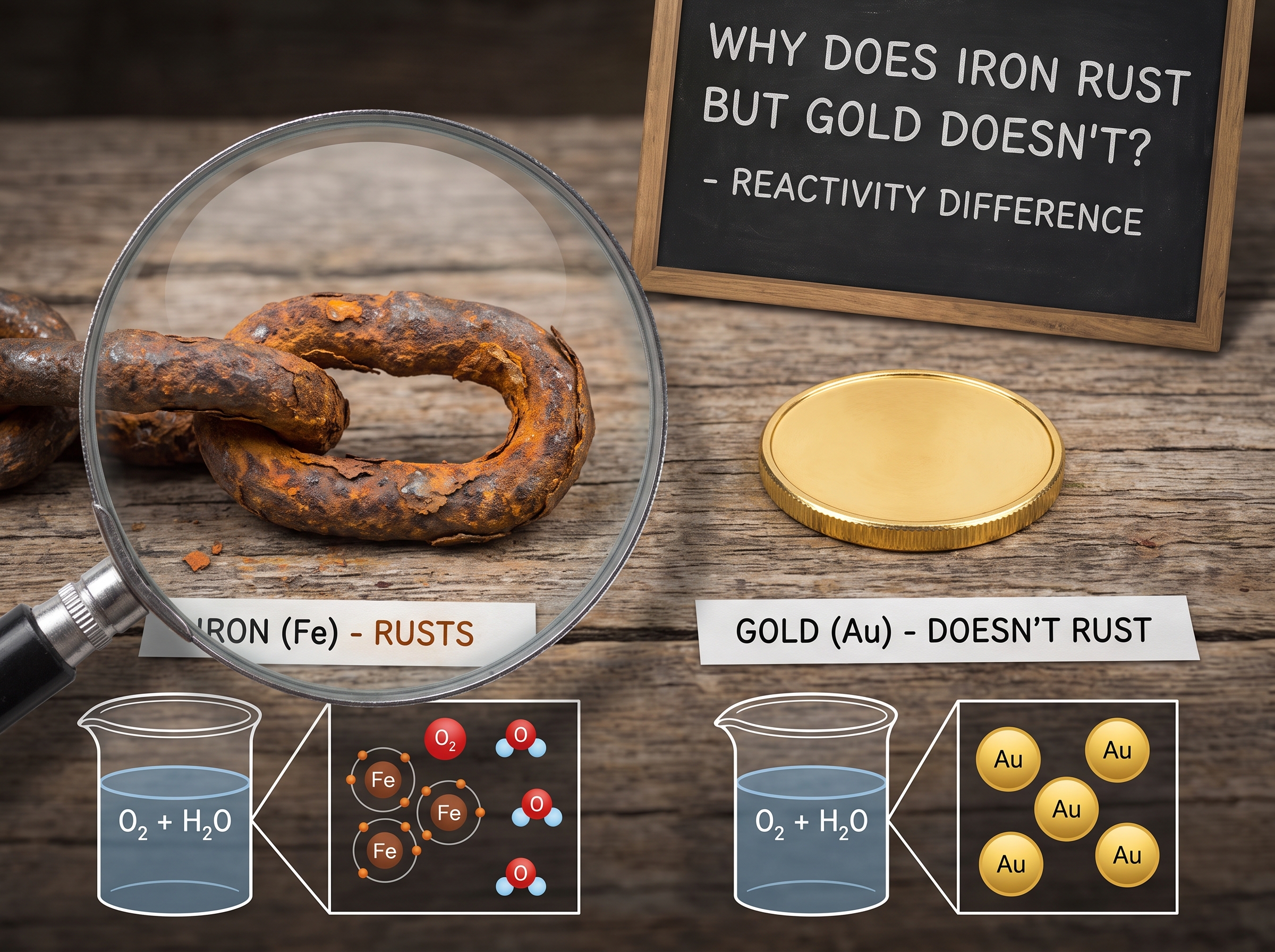
Rust isn't dirt, and it isn't simply "old iron" — it's an entirely new chemical substance, hydrated iron oxide, formed through a genuine chemical reaction between iron, oxygen, and water. When iron is exposed to both oxygen and moisture at the same time, individual iron atoms at the metal's surface lose electrons to nearby oxygen atoms, a process chemists call oxidation (it's literally where the term comes from). Iron atoms that lose electrons become positively charged iron ions, which then combine with oxygen and water to form the reddish-brown, flaky compound we call rust.
This isn't a simple, single-step reaction either — it's genuinely electrochemical, meaning it behaves like a tiny battery. One patch of the iron surface acts as an anode, where iron atoms give up electrons and dissolve into solution as ions. Those freed electrons travel through the metal to a different patch acting as a cathode, where they combine with oxygen and water to form hydroxide ions. The iron ions and hydroxide ions then meet and react further, eventually forming rust. Water (or moisture in humid air) is essential to this whole process because it acts as the electrolyte, the conductive medium that lets ions move around and completes the electrical circuit — which is exactly why dry iron in a low-humidity environment resists rusting far longer than the same iron sitting in damp air or seawater.
The critical, damaging detail is that rust is porous and flaky rather than tightly bonded to the metal underneath. Once it forms, it doesn't shield the remaining iron from further attack — it just flakes off, exposing fresh iron to keep reacting, which is why rust, left unchecked, keeps eating deeper into a piece of iron indefinitely rather than stopping after a thin protective layer forms.
Gold: The Metal That Simply Won't Give Its Electrons Away
Gold's resistance to corrosion comes down to a genuinely different story: gold atoms just don't want to give up their electrons in the first place, under almost any ordinary environmental condition. Chemists rank metals on what's called the reactivity series (or, in more precise electrochemical terms, standard electrode potential), essentially a ranking of how eagerly a metal's atoms give up electrons to react with something else. Highly reactive metals, like sodium or potassium, will react violently with something as mild as water. Iron sits in the middle of this ranking, reactive enough to slowly corrode under everyday conditions. Gold sits at the extreme opposite end, alongside platinum and, to a lesser degree, silver — a small club chemists call the "noble metals," named for their aristocratic reluctance to react with much of anything at all.
Here's where the story gets genuinely surprising, and it's one of chemistry's more delightful deep-cut facts: part of the reason gold specifically is so unreactive traces back to Einstein's theory of relativity. Gold has a very large, heavily charged nucleus (79 protons), and the innermost electrons orbiting that nucleus have to move extremely fast to avoid being pulled in — fast enough, in gold's case, to reach roughly half the speed of light, a speed high enough that relativistic effects (the same effects that cause time dilation and mass increase at high speed) become genuinely significant rather than negligible. This relativistic effect causes gold's inner electron orbitals to contract, which in turn pulls gold's crucial outer 6s electron closer to the nucleus and binds it more tightly than simple, non-relativistic chemistry would predict. Physicist Pekka Pyykkö's influential research on this effect, sometimes summarized under the phrase "relativity and the nobility of gold," helped establish that gold's famous chemical stubbornness and its distinctive yellow color (caused by the same contracted orbitals absorbing blue light differently than other metals) both trace back to this same relativistic quirk, tucked inside one of the periodic table's heaviest common elements. Gold isn't just reluctant to react out of some vague inertness — it's holding onto its electrons with unusually, physically reinforced grip.
An Important Twist: Not Every Rust-Resistant Metal Is "Noble"
Here's a detail that trips a lot of people up, and it's worth clearing up directly, because it changes the whole picture: plenty of metals that resist corrosion beautifully in everyday life — aluminum, stainless steel, titanium — are not chemically noble at all. Aluminum, in particular, is actually quite reactive by the standards of the reactivity series, chemically eager to give up electrons, arguably more so than iron in a raw sense. Yet an aluminum ladder or window frame can sit outdoors for decades without visibly corroding, while an iron equivalent would rust through in a fraction of that time.
The explanation is a completely different mechanism called passivation. When aluminum is exposed to oxygen, it does react, essentially instantly, forming a layer of aluminum oxide on its surface. But unlike rust, that aluminum oxide layer is thin, tightly bonded, and non-porous, sealing the surface and physically blocking oxygen and moisture from reaching the aluminum underneath. Once that microscopically thin shield forms, the reaction essentially stops on its own, protecting the bulk metal indefinitely under normal conditions. Stainless steel works on the exact same principle, deliberately engineered into the alloy: adding chromium (typically at least 10.5% by weight) to steel causes a similarly thin, tough, self-repairing layer of chromium oxide to form on the surface, which is the entire reason "stainless" steel doesn't rust the way ordinary carbon steel does, despite both being mostly iron underneath. If that passive layer ever gets scratched or damaged, it typically reforms on its own within moments, as long as oxygen is present — which is a genuinely different, more self-healing kind of protection than gold's approach of simply refusing to react at all.
How Humans Exploit This Chemistry on Purpose
Understanding this difference has let engineers get remarkably clever about protecting iron and steel, without needing to make everything out of gold.
Galvanization coats steel in a thin layer of zinc, a more reactive metal than iron. This does two jobs at once: it physically blocks moisture and oxygen from reaching the steel, and if the coating ever gets scratched, the more reactive zinc corrodes preferentially instead of the steel underneath, a strategy called sacrificial protection — the zinc essentially takes the chemical hit on the steel's behalf. The same sacrificial principle is used on a larger scale with sacrificial anodes: chunks of a highly reactive metal, like zinc or magnesium, deliberately bolted onto ship hulls, buried pipelines, and offshore platforms, wired to slowly corrode away in place of the more valuable steel structure they're protecting, and simply replaced periodically once they've worn down.
Gold, meanwhile, gets used in the opposite way: as a thin plating over more reactive metals in places where reliability really matters, like the contact pins inside high-end electrical connectors and some computer components, where even a microscopically thin layer of corrosion could disrupt an electrical signal. A few micrometers of gold plating is enough to keep the more reactive metal underneath permanently shielded from oxygen and moisture, borrowing gold's chemical stubbornness exactly where it's needed most.
Where the Research Is Headed Now
Corrosion isn't a solved problem industrially — it's estimated to cost the global economy trillions of dollars a year in damaged infrastructure, vehicles, and equipment, which keeps corrosion science a genuinely active research field. One particularly promising current direction is self-healing anti-corrosion coatings, materials science research ongoing through 2025 and 2026 aimed at designing coatings that don't just passively block oxygen and moisture the way a normal paint or oxide layer does, but actively respond to damage — releasing corrosion-inhibiting compounds or triggering chemical repair reactions when the coating is scratched or cracked, aiming to mimic, in an engineered material, something closer to the self-repairing passivation that already happens naturally on metals like aluminum and stainless steel.
Frequently Asked Questions
Does gold ever corrode at all, under any conditions? Under essentially all everyday environmental conditions, no — gold is remarkably stable even after thousands of years buried or submerged. It's not completely indestructible in a laboratory sense, since it can be dissolved by a few extremely aggressive chemical mixtures, most famously aqua regia (a specific concentrated blend of nitric and hydrochloric acids), but nothing resembling those conditions occurs naturally in ordinary environments.
Is rust just iron getting "eaten away," or is something actually being added to it? Both, in a sense. Iron atoms are being chemically converted, combining with oxygen and water to form a new substance (iron oxide), rather than simply eroding away physically. That's actually why rust takes up more volume than the original iron it came from, which is part of why rusting metal can visibly flake, crack, and bulge rather than just thinning down smoothly.
Why doesn't stainless steel rust if it's mostly made of iron? Because of the chromium deliberately added to the alloy, which forms a thin, tightly bonded, self-repairing protective oxide layer on the surface (passivation) — a completely different protective mechanism than gold's approach, but one that's remarkably effective under most everyday conditions, including exposure that would rust ordinary steel quickly.
Could scientists ever make iron as rust-resistant as gold? Not by making iron itself chemically noble — iron's reactivity is fundamental to its atomic structure and isn't something you can simply engineer away. But protective strategies like alloying (stainless steel), coating (galvanization), and sacrificial protection already get iron and steel remarkably close to gold-like durability in most practical situations, and ongoing coatings research aims to close that gap even further.
Is silver a noble metal too? Why does silver tarnish, then? Silver is indeed classified as a noble metal and genuinely resists most everyday corrosion very well — but it does slowly react with trace amounts of sulfur compounds in the air (from pollution, certain foods, and rubber products, among other sources), forming a thin dark layer of silver sulfide, commonly called tarnish. This is a real chemical reaction, just with sulfur rather than oxygen, and it explains why silverware needs occasional polishing even though silver otherwise sits very high on the noble metal spectrum.
The Bottom Line
Iron rusts and gold doesn't for two genuinely different, equally fascinating reasons layered into this one everyday observation: iron's atoms are simply willing to give their electrons away to oxygen, and the resulting rust does nothing to stop the process once it starts, while gold's electrons — held unusually tightly thanks to a relativistic quirk buried in its very heavy nucleus — essentially refuse the trade altogether. Everything else humans have built around metal durability, from galvanized nails to stainless steel sinks to gold-plated electrical contacts, is really just an elaborate, practical workaround for that one basic difference in how badly each element wants to hold onto what's already its own.
References
Pyykkö, P. (2012). Relativity and the Nobility of Gold. Chemical Physics Letters / related relativistic chemistry research summarized in ScienceDirect.
Royal Society of Chemistry — Physical Chemistry Chemical Physics, Issue 31 (2010), relativistic effects in gold chemistry.
National Association of Corrosion Engineers (AMPP, formerly NACE) — Corrosion Costs and Preventive Strategies Overview
Metalorix — Gold's Atomic Structure: Why Au Is Unique
MDPI Coatings — Self-Healing Anti-Corrosion Coatings: Challenges and Opportunities from Laboratory Breakthroughs to Industrial Realization
ScienceDirect — Research Progress and Challenges of Healing Mechanism, Types, and Applications of Reversible Self-Healing Anti-Corrosion Coatings
Corrosionpedia — Passivation and the Chemistry of Protective Oxide Layers.
Britannica — Rust (Chemical Compound)
Britannica — Reactivity Series
World Gold Council — Gold's Chemical Properties and Corrosion Resistance overview.
Article last fact-checked: September 2026. Corrosion science and protective coatings research continue to advance — readers wanting the latest materials science findings should check current publications in corrosion and materials chemistry journals directly.